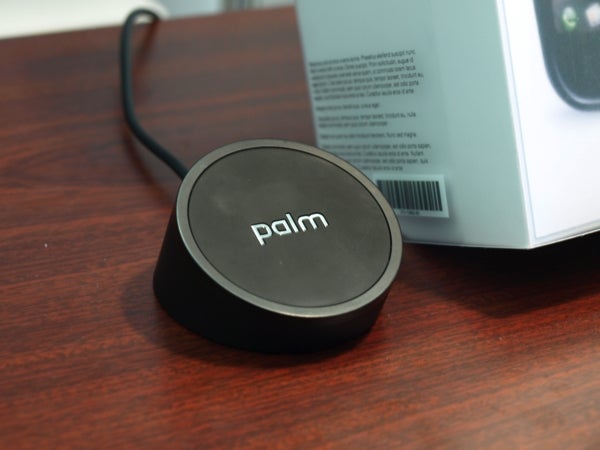
The Wireless Power Consortium, made up of Sanyo, Texas Instruments, Philips, Olympus, and Samsung, are making headway towards making their Qi wireless charging spec the industry standard. In their ideal world, any third-party, Qi-branded product will work on their line of charging pads, which function via magnetic induction. I happen to think it's just the boost wireless power technology needs.
The spec can deliver power of up to 5 watts, which is good for many small consumer electronics, and prototype gadgets using Qi will be revealed in the middle of September.
The technology, which works similarly to Palm's Touchstone charger, may draw a few naysayers because its not as radically futuristic as resonance-based charging like Witricity (which works over distances of meters). But there are a few things working in Qi's favor.
First, it's ready: Magnetic induction technology has already proven itself to be an effective solution in products like toothbrushes and doesn't need much more to be a consumer success. Resonance systems, however, are still in the testing phase.
Second, it's cheap: Not only has induction charging been in niche products for years, but it's really cheap to produce. Despite the $70 price tag on the Touchstone charger, it only cost something like $5 to manufacture. There's no wildly exotic tech going on with induction charging, so consumers won't be breaking the bank to get their hands on it.
Third, it has major industry backing: With electronics corporations from both the product and component-making sectors, Qi has solid backing that helps its chances of sticking around for awhile. With one unified technology, you won't have to worry about a charging base for every separate gadget. A focused effort might help innovations in wireless charging come quicker as well.
[via eWeek Europe via Slashdot]
Five amazing, clean technologies that will set us free, in this month's energy-focused issue. Also: how to build a better bomb detector, the robotic toys that are raising your children, a human catapult, the world's smallest arcade, and much more.


Online Content Director: Suzanne LaBarre | Email
Senior Editor: Paul Adams | Email
Associate Editor: Dan Nosowitz | Email
Assistant Editor: Colin Lecher | Email
Assistant Editor: Rose Pastore | Email
Contributing Writers:
Kelsey D. Atherton | Email
Francie Diep | Email
Shaunacy Ferro | Email
But, aren't magnets DEATH to hard drives and other electronic devices which use that type of technology to store data? I know that you wouldn't place an actual HDD on the thing, but don't some small electronics, i.e. iPods and other things have HDDs in them that are susceptible to magnetic forces?
Agree, I wouldn't take my stuff near that thing. like those magnetic tipped screwdrivers, i don't want to get my bolts magnetized and that's the only type of tools my local hardware sells? They need to think before they design.
Rpenri/Electrix :: I don't think this will be as much of an issue moving forward. SSD technology is advancing in leaps and bounds, and seeing that tech move to the PC is sort of the final big step it needed to take.
Since memory cards aren't affected like spinning disc storage (magnetic hard drives), it's not an issue to put a device like a phone or ipod on the charger as long as it's using solid-state memory.
And since the industry is moving in the direction of replacing spinning magnetic discs with said SSDs, this is a problem they don't really need to address as obsolescence will do that for them. :-)
Electromagnetic discharge, ED, is the build of electrostatic charge on a conducting material, even a sheet of paper. If ED builds up its not only going after your computer it will effect everything you touch because humans are conductors.
I don't know if this is the case for this new product but ED's from the tip of your fingers can destroy, over heat, circuits that aren't properly grounded. In most case's humans aren't grounded from ED's.
A painful example is when I go into the food section at my local Wallyworld store that isn't carpeted there are such a build of static electricity in my body coming from all the electronic devices in the store that when I touch something it gives off an ED. Believe it or not the ED's are in the range of thousands of volts passing from the tip of your fingers to most things you touch including paper items, glass, and metals.
Ok lets clear up some misconceptions about magnetic induction. First of all the type of electromagnet they speak of uses high frequency power to produce a small
pulse, the field radius of which is the inverse of the frequency.
Secondly the QI device will have a coressponding coil on the back of the device.
Now having said all of that you can imagine that a small pulse which will travel approximately 1/8 of an inch or less, from the top edge of the charging station into the back of the device. This effectively charges the device. Why a pulse magnet? simply put a magentic induction circuit works effectively on low voltages due to the principles of magnetics which state that either the fields or the conductor must move in opposition to each other since the items will not be moving pulse magnetic induction is neccessary. In addition do you really think that this idea was not tested thourghly before marketing? Come on folks we are in this business to make money