What's Next
The new device can be worn on an arm or leg
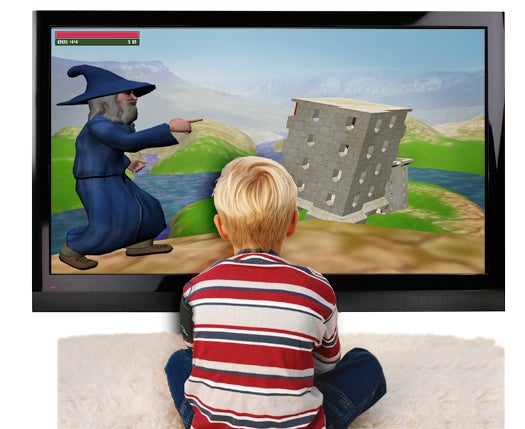
Zoning In Learning to focus lets a kid wearing the BodyWave armband move an onscreen building. Courtesy Vizio

Game your way to razor-sharp attention skills. North Carolina– based Freer Logic’s new biofeedback device, the Bodywave, trains you to become aware of your brain function, so you are better able to regain focus when you drift off at work, lose your steam on the back nine, or nearly fall asleep at the wheel. It’s the first brain-wave scanner to be worn on an arm or leg, forgoing clunky headgear.

The Bodywave works by tracking your brain-wave activity as you play games or engage in virtual-reality simulations. When synapses fire, they release electrical pulses that move through the body. The iPhone-size device uses three carbon contacts to tap the signal through the skin, while software filters out electrical interference from moving muscles, particularly the heart. The system comes with software, such as games or virtual-reality training scenarios, and it prevents you from engaging in any program until you’re in the zone. To determine focus, the Bodywave looks for brain-activity patterns indicative of attention, including beta-level waves from 12 to 30 hertz, which neurologists accept as a sign of concentration.

The system is currently used to help coach kids with attention-deficit hyperactivity disorder and has also been adopted as a virtual-reality training tool in nuclear power plants. In the future, expect similar sensors in real-world scenarios. A Bodywave-equipped golf club could help players stay centered on their shots, or a steering wheel could alert a drowsy driver to keep his mind on the road.

8 Comments

Yes!

This is very exciting. I was discussing this sort of thing with a friend recently- what we could do if we had "iphone-level" convenient neural feedback systems. How could we alter our behavior if we knew, in real time, what our brain was doing? What can we do with advanced personal biofeedback, in general? I wrote a quick discussion of the subject last week, here: www.infominster.net/2010/12/27/the-singularity-and-biofeedback/

I guess it's not quite a "pocket fMRI" machine, but it's an interesting trend. I will be watching to see where this tech goes in the near future. Thanks for the news.

I know people can change their blood pressure at will if they are connected to a feedback mechanism. It would be great to be able to optimize yourself with a pocket device. Athletes could undoubtedly benefit from a reliable way to get themselves "in the zone" before competition.

This is pretty cool stuff, but I have a small quibble.

"The iPhone-size device " c'mon PopSci. I know that your editorial policy is to lionize iPhones, iPads, MIT, DARPA, and Dean Kamen, but give us a break.

A "smartphone size device" would have been a better description. Heck, maybe you could even give some dimensions for those of us who don't really pay attention to the overhyped world of smartphones.

I understand that this is helpful to certain type of people, and also will probably be useful to keep us "sharp", but the impact on social life with this device will furthermore stray kids from actual face2face communications, and more towards the screen2screen virtual reality, at least in my opinion.

If you want to sharpen your brain, go study something, take up a hobby, do Yoga, socialize... there a thousand ways!
- DiGGY

@DiGMEH

Maybe, but I think that once a child uses the device, he or she may learn from it, permanently. If they start to associate their own thought patterns and states of mind with the device saying "Dude, you're not paying any attention right now.", they may start to catch themselves, without its help. I would predict the same for adult users.

But I guess it's like any other activity- bad things can happen if you become dependent on it (something that's not just true of "screened" activities).

@DiGMEH: Although I do agree that this could, potentially, further hinder the real-world social interaction abilities of our youth I also recognize that one of the strongest trends of today's "plugged-in" up-and-coming generation is multi-tasking oriented. This has been proven to reduce the ability to focus on a single task to the degree that certain tasks require (i.e. higher level maths, musical theory, etc) to successfully implement or, especially, to initially learn. Anything that can help students learn to be "in the zone" can introduce them to that sensation, and the potentialities that lie therein, I can only see as useful.

Does this article really propose that EEG can be recorded from the upper arm? As an active EEG/ERP researcher for 16 years, author of some 50 peer-reviewed published research papers, I am not aware of any evidence for this type of measurement.  If it is possible, then surely validation studies have been conducted that compare the BodyWave "EEG" to concurrently recorded scalp EEG - this would be an essential first step.   

EEG is a measure of central nervous system activity, and as such is recorded via electrodes placed as close as possible to the central nervous system (i.e. the brain). When recorded from the scalp the signal must be amplified at least 20,000 times so that it can be measured.

The upper arm is innervated by the peripheral nervous system, not the central. Certainly some peripheral measures (such as heart activity, blood pressure/volume.. perhaps even skin conductance although not typically measured in that location) show some relationship to attention in a blunt sense, but it is claimed that BodyWave measures brain activity. 

This claim is counter-intuitive (why not measure EEG from the source?) and requires solid research backing published in peer-reviewed journals before it can be taken seriously.     

EEG-researcher asks "why not measure EEG from the source?" Well, if you really are a researcher, then you'd know that the public is quite tired of interfaces worn on the head that a)make us look silly, b)make us look like we're from Mars, and c)use messy paste and gels.

Does the EEG-researcher think the brain's electric field is limited only to the head? I think this type of thinking seems close to 'the world is flat' type of logic. It makes perfect sense to think that with correct amplification and filtering, ionic impulses in the synaptic cleft could easily be measured on the skin if they've pushed their way through the meninges, cerebral spinal fluid, and skull. They diminish greatly away from the head, but if someone has found a way to measure them, then great. This will open the door to much more fun, ease of use, and no more silly looking headsets. The potential applications for this exceed anything currently in this market.

I could easily see myself using this on the subway to calm myself after a stressful day at work.

Popular Tags

Regular Features


June 2013: American Energy Independence

Five amazing, clean technologies that will set us free, in this month's energy-focused issue. Also: how to build a better bomb detector, the robotic toys that are raising your children, a human catapult, the world's smallest arcade, and much more.


Online Content Director: Suzanne LaBarre | Email
Senior Editor: Paul Adams | Email
Associate Editor: Dan Nosowitz | Email
Assistant Editor: Colin Lecher | Email
Assistant Editor: Rose Pastore | Email

Contributing Writers:

Kelsey D. Atherton | Email
Francie Diep | Email
Shaunacy Ferro | Email

circ-top-header.gif
circ-cover.gif