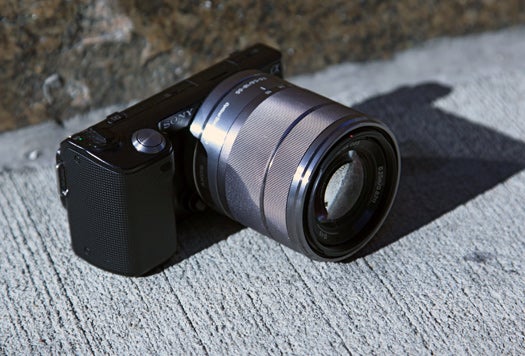
Earlier this year, I bought my first DSLR, and took it (and its gigantic lens) everywhere. My vacation photos and day-to-day snaps never looked better. But I couldn't say the same for my left (A.K.A. my bag-carrying) shoulder. So slowly, day by day, I stopped lugging my camera around with me. Then along came Sony's NEX-5.
This fall, I started carrying the NEX-5, the smallest lens-changing camera on the market, and I was snap-happy all over again. I'd used other compact, interchangeable-lens systems, such as the Olympus EP-series, before, even toting Panasonic's Lumix GF1 as my primary camera at this year's Consumer Electronics Show. Even so, I became addicted to the NEX-5 like no other.
Even though its body is no thicker than my old point-and-shoot, its images matched any of my best DSLR shots. The magic is in the versatility. The 18-55mm kit lens was able to handle nearly every shot (from close-ups to wider-angle landscapes), and full manual control (aperture, exposure, and shutter speed) allowed me to make every shot look exactly how I wanted. I was able to brighten and freeze a shadow-y waterfall, or sharpen a person in the foreground while blurring the back. And, unlike many other cameras in the category, this puppy is one fast focuser, so I was never left with that sinking I-missed-the-shot feeling; quick start-up helps avoid that woe, too.
Compact lens-changers from their inception over a year ago have promised DSLR quality images in point-and-shoot packages -- the best of both worlds. Until I tossed the NEX-5 into a small side pocket in my bag, though, I wasn't really a believer. Now I am.
Five amazing, clean technologies that will set us free, in this month's energy-focused issue. Also: how to build a better bomb detector, the robotic toys that are raising your children, a human catapult, the world's smallest arcade, and much more.


Online Content Director: Suzanne LaBarre | Email
Senior Editor: Paul Adams | Email
Associate Editor: Dan Nosowitz | Email
Assistant Editor: Colin Lecher | Email
Assistant Editor: Rose Pastore | Email
Contributing Writers:
Kelsey D. Atherton | Email
Francie Diep | Email
Shaunacy Ferro | Email
Well,
You may recall the days when your typical "run-n-gun" combat correspondent ran the streets with several cameras, hanging around their neck and slung in various ways.
The Range-Finder type platform was always worn high, on the chest, on a very short leash. I'm just going to guess that MANY award winning Photo-Journalism awards were won as a result of using this type of camera. Currently, the Leica M9 ($7K), along with a $3K (slightly) wider than normal lens is the Global Gold Standard (fer scher!).
Anyway ... A very large sensor and a good selection of quality glass ... INSTANT ON and INSTANT FOCUS are key to my own financial commitment, to this platform category.
As if your entire livelyhood depended upon your capturing one, single, surprise event, in your lifetime. Some "moment of impact" (or import).
Bigger sensor means higher ISOs, faster shutters, higher stops per megapixel ... greater depth of field ... wide field of view ... high megapixel resolution allows extreme crops without loss of usefull quality.
In theory, one should be able to shoot from the chest, without ever looking at the camera (much less, thru it) ...
You will capture everything in your personal field of view, at highest rez, with everything in focus, even at night.
DSLRS are for when you go somewhare knowing what you are going to shoot and you have the time to set up your shots and choose your modes, in advance.
flames?
What I find most amusing about this commercially enthusiastic piece is the absurd assumption that one must swallow - that this hefty, bulbous thing-a-ma-jig is
actually a point and shoot. It's practically the same size as my Canon Rebel, and would be larger with a more usable
telephoto that would allow the millions of shots that aren't possible with a paltry 18-55MM zoom. The writer talks about the ability to get shots they otherwise would have missed with a DSLR. That's total nonsense. He writes as though he can stuff this not-so-little little baby into his watchfob pocket, while requiring a wheelbarrow to lug around his DSLR. I can only assume that this guy has written advertising copy for mini-cameras in the past.
The size of the lens largely dictates how bulky a camera is, and this little fellow's lenses are no smaller than mine. Yet then the writer goes on to contradict himself and praise the availablility of large lenses for these so-miscalled mini cameras.And that, dear friends, is the essense of advertising. What is not, is, and what is not is also true. Comprendo?
I like the camera beacause of it's size and the sensor specs but when I read the reviews, the 18-55mm zoom lens is below Sony standard.Well may be this is becoming Sony's standard.
I quote from Camera Review "Their is one thing i would like sony to do. Build some better lenses for this camera." or
"Controls are poor and lenses are terrible" or "The smaller lens is useless, absurd withoput stabilisation" or "Sony should stop making cameras if they are not using Carl Zeiss lenses". So I am getting a little carful now.
Its a amazing camera and its quality so good and its famous everywhere and i personally use it.
http://orexissite.com/