Electrocardiogram-Equipped Cell Phone Allows Remote Monitoring
We may earn revenue from the products available on this page and participate in affiliate programs. Learn more › High-risk...
We may earn revenue from the products available on this page and participate in affiliate programs. Learn more ›
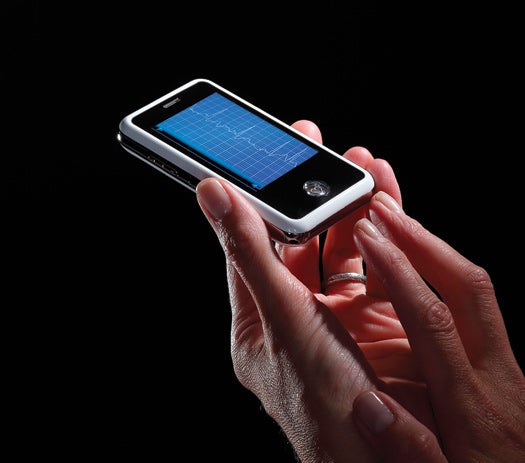
High-risk patients can lose hours and thousands of dollars to in-hospital heart monitoring, but now physicians can regularly check in from afar. German cellphone maker H’andy’s Sana 210 needs only 30 seconds to measure heart rhythm and send it to a doctor. When your heart moves, it sends electricity through your body; the Sana uses the same electric sensors as a hospital electrocardiogram (ECG) to record those pulses through your fingertips. The diagnostic is not as accurate as a hospital ECG, which uses more electrodes closer to the heart, but it does provide enough info for doctors to monitor patients who have abnormal rhythms.
As with any test, a clean reading is crucial. After three sensors under the phone’s steel frame pick up the signal from your fingers, it passes through two barriers devised to cancel interference caused by tiny movements in a patient’s arms and shoulders. A filter sits above the circuit board to physically deflect sound frequencies higher than the heart’s approximate 150 hertz. After that, the phone’s processor runs an algorithm that extracts the rhythm. This translates into a single ECG wave, which patients can text-message to their doctor.
H’andy is readying an update, with the ability to read blood pressure and temperature, to submit to the FDA next year.
H’andy Sana 210
Size: 4 x 2.3 x 0.7 in
Camera: 1.2 megapixels
Network: GSM only
Price: Price not set
Get it: handysana.com
