Wireless TV just got a whole new meaning. Sony has just announced a new short-range, intra-gadget technology that clocks a 11Gbps transfer speed. The tech, known as millimeter-wave, allows electronics innards to communicate wirelessly with one another, which could allow for slimmer designs and fewer wires--that means fewer connections to sever, and potentially more reliable gadgets.
Devices like HDTVs require a lot of data to be moved across internal circuitry quickly, and, Sony claims, even wires need a little help to get the job done. The data loads are so large that more connections are needed to keep pace, which currently means adding more wired connections--and bulk. A wireless connection, in this case, is a perfect assist.
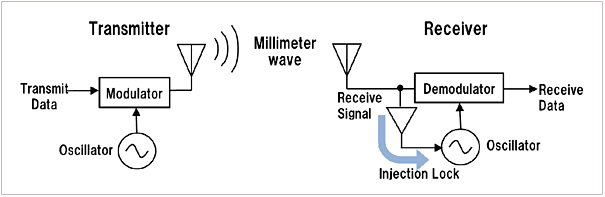
The new technology sends electromagnetic waves (between 1 and 10 millimeters in length) from source to destination on frequencies between 30 and 300 gigahertz. Such high frequencies lend themselves well to working in small electronics, since their antennas can be as small as one millimeter. The receiving component cam be up to 14 millimeters from the source.
Within these millimeter-wave circuits, the source and receiver sync up with one another to make sure they're on the same frequency--a task that, in the past, sipped a lot of extra power. In this case, however, Sony has revamped the way the circuits communicate with each other. Thanks to the short range, the receiver can essentially "hear" the frequency of the source, and thus oscillates at the same frequency.
Sony is no stranger to speedy wireless transfers. At CES last month, the company unveiled the first products employing their TransferJet technology, which moves photos between devices. The close-proximity transfer works when two chips are within 3 centimeters of one another and clocks speeds as high as 560Mbps (or one high-res photo per second).
Getting TransferJet into a real-life product, however, was not quite as speedy. Sony first unveiled the standard at CES 2008, two years before any product was ready for market. So it may be a while before your TV's guts go wireless.
138 years of Popular Science at your fingertips.
Each issue has been completely reimagined for your iPad. See our amazing new vision for magazines that goes far beyond the printed page
Stay up to date on the latest news of the future of science and technology from your iPhone or Android phone with full articles, images and offline viewing
Featuring every article from the magazine and website, plus links from around the Web. Also see our PopSci DIY feed
Science is reinventing play, from extreme sports to gamification to ridiculous roller coasters to the playgrounds of tomorrow, and this issue is chock full of fun. Also, on a less fun note: Did global warming destroy my hometown?
I wonder what sort of data loss would be expected.
i could see this tech being VERY useful in the ps4.
You mean the Sony Beams-into-your-mindable.
so they are eliminating solder? How do the parts of the circuits get electricity?
Another beautiful but expensive technology.
It's very hard to replace solder with milimeter wave connection,just because of the cost.
And what about EMC or interference problem? Milimeter wave penetrates most of our known materials.
Since Sony is working on this, I'd say that there's a fair chance that it will be practical. They seem pretty competent. (and no, I never had a Betamax).
I do have a small quibble. I think that the frequencies involved probably range from 3 to 30 gigs. 3 gigahertz has a wavelength of 1 mm.
Also, I don't know of too many 300 GHz ICs. IBM has just been bragging about their 100 GHz graphene transistors.
From reading the headline, I thought Sony invented tiny scissors and mechanical hands to cut those wires. How odd.
This would mean that the transmitter and receiver would be powered separately. I can see many benefits like intermittent problems with a given circuit not to cause the whole circuit to be inoperable. redundancy can be built in to allow secondary circuits to kick in when problems occur. Also, this means that the transmitter and the receiver circuits are powered separately thus allowing accessories and added circuits to be plugged in without cables or visible metal contacts. No more user problems like inserting upside down or backwards. I really like to potential of this technology.
Bob Katayama Executive Editor
www.technobrains.com
I can see many benefits like intermittent problems with a given circuit not to cause the whole circuit to be inoperable. Redundancy can be built in to allow secondary circuits to kick in when problems occur. Also, this means that the transmitter and the receiver circuits are powered separately thus allowing accessories and added circuits to be plugged in without cables or visible metal contacts. No more user problems like inserting upside down or backwards. I really like the potential of this technology. Not sure if this will really be commonly used within most consumer products though. The ease of use and the low cost factor will certainly dictate its future acceptance.
Bob Katayama
thats so cool all these gadgets
http://articles.uvc.cc