PopSci talks to futurist Michio Kaku about the (not necessarily) impossible physics of Star Trek
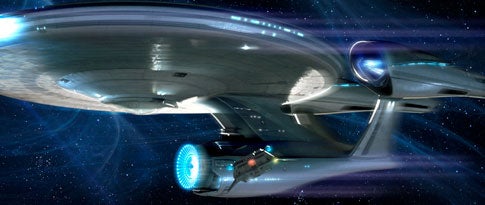
The Enterprise Courtesy Industrial Light & Magic/Paramount Pictures

Science geeks, Trekkers, and action-movie fans have now had a few days to digest the newest incarnation of the Star Trek franchise. PopSci set out to answer some of the movie's most puzzling questions (aside from what Winona Ryder was doing on Vulcan): Can we time-travel through black holes? Can we seed said black holes using something called "red matter"? How about teleportation -- will someone named Scotty (or Chekov) ever beam someone up?

To get a better grasp on these seemingly impossible concepts, PopSci talked to Michio Kaku, co-creator of string theory, professor, author and, of course, Star Trek fan. Kaku's latest bestseller, Physics of the Impossible, has entire chapters devoted to Star Trek lore like phasers, force fields, and time travel. A TV show with the same name will debut this fall on the Science Channel.

According to Kaku, science fiction is often prescient. He believes scientists might one day create laser (or phaser) guns powered by nano-batteries or nano-capacitors, for instance. And he doesn't rule out warp-speed travel.

This really isn't too far-fetched; there have been many instances wherein fiction fertilizes real discoveries. Jules Verne's 20,000 Leagues Under the Sea inspired American Simon Lake to invent the submarine, for instance. In H.G. Wells' 1914 book The World Set Free, a scientist unlocks the secret of atomic bombs in 1933. The Hungarian physicist Leo Szilard read that book in 1932 and made the discovery his goal. In 1933, he figured out the chain reaction process. And when the U.S. created its first reusable space ship, we named the prototype the Enterprise.

There are a few spoilers ahead, so consider this fair warning.

PopSci: Let's talk about some concepts that are familiar in the show and that you talk about in your book, like teleportation. There is a scene in the movie where Kirk and Sulu are falling without a parachute, and they have to be beamed up; Chekov decides he has to do it manually. Unlike "The Next Generation," which had "Heisenberg compensators," the movie doesn't mention the Heisenberg uncertainty principle (the more precisely you locate the position of a particle, the less you can know about its momentum.) I know there has been success in teleporting atoms, but will we ever be able to teleport a human?

Michio Kaku: Well, quantum teleportation already exists. For the past 10 years, we've been teleporting photons as well as atoms of cesium and rubidium and terbium. The world record is 1,800 feet, across the Danube River. I suspect very soon that we will be teleporting molecules. I wouldn't be surprised if, in the coming decades, we are able to teleport DNA, or maybe even a virus. But beyond that, it starts to get very difficult. You have to entangle two atoms, they have to vibrate in unison, and that is very difficult beyond the molecular level. But, Star Trek takes place in the 23rd century, so maybe by then we can teleport 100 trillion cells, which is about the number of cells in a human body.

Michio Kaku:  courtesy Random House, © Andrea Brizzi
In the entanglement process, is the initial piece of matter that you are teleporting destroyed or changed in some way? What would happen to a person?

You have to have a carbon copy waiting for you; you can't be beamed to the surface of a planet. And the information content of the original gets destroyed when you beam the information over to another place. You are destroying the original to reconstruct it somewhere else. Well, then you begin to ask the question, who is this copy over there? All the atoms and cells get destroyed; you're dead. But somebody over there has emerged who is identical, atom to atom, to you. Well then it raises the question, who are you? Are you your body and all your neurons, or are you just information that can be transmitted across a room? Is there a soul? It raises all sorts of questions.

The movie makes frequent use of black holes. Future Spock, or old Spock, travels through one after he fails to save a planet from being blown up by a supernova, and he winds up 130 years in the past. Events change that alter the course of history as we know it for the Enterprise crew (which will be handy for sequels.) But my understanding of physics is that it's not possible to go through a black hole and come back out, at least in one piece?

Yes and no. There is a debate about this question. If you have a spinning black hole -- and all the black holes we've seen in space are spinning very rapidly -- then the math says they collapse to a ring, not a dot. If you fall through the ring, you wind up in a parallel universe. This solution was first found by Roy Kerr in 1963, and it is the most realistic description of a spinning black hole. There are many, many questions raised by this. If you could go through the ring, then who knows where the other universe is located? It could be backwards in time, it could be a parallel universe. But there are problems like radiation. The radiation would be very intense. And if you add radiation, there is a debate among physicists right now about, will it close up the wormhole, is it stable? Math says there is a wormhole at the middle of a spinning black hole. To keep the hole open so you can go through it, you need negative matter to stabilize the black hole. These are called transversable wormholes; you can go back and forth freely without too much effect.

Negative matter meaning antimatter, or something else?

Negative matter meaning negative mass. It falls up, it doesn't fall down. On Star Trek, they call these things dilithium crystals, which open up gateways through space and time. We physicists don't call them dilithium crystals; we call them negative matter. But no one has ever seen negative matter.


Spock:  Courtesy Industrial Light & Magic/Paramount Pictures

There was another issue about black holes in the movie -- the characters create one using "red matter." Is there any theoretical basis for "seeding" a black hole, to start one from scratch?

Well, anything can become a black hole if you squeeze it enough. If you squeeze our sun down to two miles, it becomes a black hole. The sun cannot be squeezed down to two miles, so it's not gonna happen. The Earth would have to be squeezed down to two centimeters to collapse down to a black hole. So any object can become a black hole; you just have to squeeze it down to a small enough size. But the only mechanism we are aware of is gravity.

In the movie, Romulans put red matter in Vulcan's core and it creates a singularity that leads to the creation of a black hole; all the mass of the planet becomes the black hole. That made me think of the Large Hadron Collider and some of the concern last summer about mini black holes gobbling up the Earth.

Oh, cosmic rays give you more energy than the Large Hadron Collider. It is a pea-shooter compared to the humongous energy that cosmic rays have. The Earth, for billions of years, has been bathed in cosmic rays, much more powerful than anything created by the LHC. I don't think the LHC will create anything at all, any mini black holes. By nature standards, it's puny.

When Vulcan consumes itself in a black hole, Spock is watching from a distance that seems like it would be about as far as the Earth is from the moon. Is that a safe viewing distance?

If you were outside the event horizon and you orbit the black hole, you are perfectly safe. A lot of people ask me all the time, if there's a black hole in the middle of the Milky Way, how come we're not sucked in? The answer is very simple -- we orbit around it. We are outside the event horizon, so it's very stable as long as you are a safe distance away from the event horizon.

If you enter a black hole and you fall through a wormhole that is somehow stabilized, wouldn't you still be spaghettified by the tidal forces?

A large black hole has very little tidal forces. The tidal forces decrease the larger it is. If it is a big black hole, the less the tidal forces, which defies common sense, but that's what the equations show; the larger the black hole, the less the tidal forces. The small black holes are the dangerous ones, because the gravitational fields are very intense, and as you fly through one you would be ripped apart.

We all know the Enterprise travels at warp speed. Will it ever be possible to travel at "warp factor 4"?

We physicists used to laugh at Star Trek's warp factor. We don't laugh anymore. About 10 years ago, a Mexican relativist named Miguel Alcubierre was watching Star Trek, and he came up with a new solution to Einstein's [general relativity] equation. The loophole is negative matter -- Einstein never considered it. And Alcubierre got a solution that looked very similar to warp drive. The key is, you don't go to the stars, the stars come to you. Everybody assumes you have to go to the stars, which means you have to break the light barrier and violate the laws of physics. But you can compress the space like an accordion -- compress the space between you and the stars. It's like a wrinkle in space. There are some objections to this, of course. We don't have negative matter, for instance. But in principle, if you have, let's say, a meteorite made of negative matter, then it may be possible. Einstein never said that nothing can go faster than light. Empty space can contract or expand faster than the speed of light. That's the Big Bang. It's emptiness that expanded. It looks very similar to the rendition of warp drive in the movies -- you would see distortion of star light, stars would come at you very fast, but inside you feel nothing.

What about weapons? Could we ever create a ray gun or phaser small enough to put in a space holster?

We already have ray guns that are powered by nuclear power plants, which are very powerful lasers. But in a firefight, you don't want to put a nuclear power plant on your shoulder. The problem with jet packs and ray guns is always a portable power pack. Well, people say, we could use batteries. No -- these batteries don't exist. That's why jet packs only last a few minutes. That's why a lot of the stuff you see in the movies is not possible today. With nanotechnology, I do believe we will be able to create powerful batteries. It's like with gasoline. Pound for pound, gasoline has more energy than a battery. Why? Gasoline is concentrated sunlight. It's sunlight concentrated from the dinosaur era, and it's concentrated on a molecular level. In a battery, it's a fluid. You are not storing energy on a molecular scale. But there's no reason we cannot create a nano-battery. Take a capacitor, which is nothing but two parallel plates that store charge. You can store vast amounts of charge in a capacitor. In the future we might be able to make nanoplates and store vast amounts of energy on them. Maybe then, laser guns will be possible.

Do you think Star Trek will inspire people to figure these things out, a la Jules Verne and H.G. Wells?

These are technical problems. I suspect by the 23rd century they will solve many of these problems. There are no laws of physics that prevent most of what you see in the movies. It's just an engineering problem.

We physicists don't like to admit it, but some of us are closet science fiction fans. We hate to admit it because it sounds undignified. But when we were children, that's when we got interested in science, for a lot of us. When I was a kid, I watched Flash Gordon. Eventually I realized, I didn't have big muscles, I didn't have long hair, but it was the scientists who made the whole series work. I was fascinated by that. Here was a man who, just by thinking, could create starships and cities in the sky.

So, these are impossible technologies, but impossible today and maybe possible in the future.

Want to read more articles like this, plus stories on gaming, music, movies, and more? Subscribe to Popular Science today, for less than $1 per issue!

21 Comments

Very nice interview, much of what I expect from Popular Science as I grew up on your magazine. I would recommend Dr. Kaku's books to everyone! He has a fantastic mind, a healthy imagination and a unique talent for explaining things so that even average folks are inspired to learn more about science. As an artist I have often found inspiration from his work.

Great interview, inspiring. It's nice to hear how genius' can be like the rest of us and read comics. Dr Kaku makes everything understandable.

Great story. I have the book, it is fantastic! Very understandable. I recommend this book to anyone!

I saw the film today - great interview I am going to go and get the book now!

Davidoff @ http://www.fixedgearbiking.co.uk

Great interview! Very topical and inspiring. Kaku is a great author and makes difficult concepts easy to understand. Thanks for the heads up on the Science Channel show. That is sure to be a winner!

I'm perplexed by many of Kaku's responses.

"Gasoline is concentrated sunlight. It's sunlight concentrated from the dinosaur era, and it's concentrated on a molecular level."
—Excuse me? He must be thinking of glucose and oxygen, the products of photosynthesis. Gasoline is the product of refining crude oil with considerably well-developed technologies. If not for industial and chemical engineering, petrolelum products would not exist. Black gold doesn't come from a pump, gasoline does.

"In a battery, it's a fluid. You are not storing energy on a molecular scale."
—Have I misinterpreted the VSEPR theory? Isn't the charge gradient that causes electric potential a result of interactions at the inter/intramolecular level?

"But there's no reason we cannot create a nano-battery. Take a capacitor, which is nothing but two parallel plates that store charge. You can store vast amounts of charge in a capacitor. In the future we might be able to make nanoplates and store vast amounts of energy on them."
—I'm sure one of the most accomplished physicist in the world knows a bit more about electricity than an undergrad, but I can't imagine any instance where a capacitor could provide energy (1) in great quantities and (2) consistently over time. Capacitors are intended to store energy, not release it.

The premise of this analogy, however, is even more worrisome.

OBSERVATION: Burning gas has a larger energy delta than killing a battery.
ILLOGICAL ASSUMPTION: Gas contains more energy than battery fluid (which is actually a paste)
LOGICAL ASSUMPTION: BURNING gas releases more energy than KILLING a battery.

Gas doesn't have more potential energy than battery acid. It's because the two methods of releasing energy are, well, TWO DIFFERENT METHODS OF RELEASING ENERGY! I'm sure the results would be different if you tried to burn batteries and conduct small current with petrol. How could any reasonable person come to that conclusion?!

I have all ready watched two shows about how star trek tech can be used and how it mite work and one about star wars tech as well and lots of times plasma shows up in both shows so plasma could be very important to are future.

I believe that what he was referring to is that the crude oil and other fossil fuels are the result of concentrated sunlight that was then converted into gasoline.

and even without industrialization we still found uses for fossil fuels. Refining just allowed us to refine the product into a more efficient hydrocarbon chain for our use.

The glucose you were referring to is nothing more than a hydrocarbon chain created via plant Photosynthesis. But if the old theories are correct they could become the fossil fuels of the future given the right circumstance.

On the nature of capacitors he clearly does know more than you.

You should research before coming here to challenge him on something that you should know (Mind you I have no idea what you are going for your degree in)

here is some relevant information that too approximately 30 seconds to recover.

Pulsed power and weapons

Groups of large, specially constructed, low-inductance high-voltage capacitors (capacitor banks) are used to supply huge pulses of current for many pulsed power applications. These include electromagnetic forming, Marx generators, pulsed lasers (especially TEA lasers), pulse forming networks, radar, fusion research, and particle accelerators.

Large capacitor banks (reservoir) are used as energy sources for the exploding-bridgewire detonators or slapper detonators in nuclear weapons and other specialty weapons. Experimental work is under way using banks of capacitors as power sources for electromagnetic armour and electromagnetic railguns and coilguns.

As for batteries vs Fossil fuels he is clearly referring to the potential energy retrieved per weight of the listed materials.

Just because the Energy is removed from them via different methods does not in any way negate the fact that we currently draw different potential energies from them.

So his point clearly stands in our current state (And hopefully this will change soon) you can get more energy per KG for a stated use out of Gas then from a standard Li-ion or Led acid Battery.

In total I am not impressed with any of your arguments. Maybe you should go think more on them.

Let's assume that there is an element lighter than hydrogen (dark matter), so light that it can not accept electrons. Time is running when something changes in space. If the Enterprise would be somehow clocked in the layer of such substance, then there would be no information flow between the vessel and the outer space. So it may travel with virtually unlimited speed, and time would normally run inside the shell.

"A Blunt Rebuttal'

Sunlight never enters the equation. Although the exact mechanism for how fossil fuels form is unexplained, scientists know surely that formation occurs several kilometers below surface level and reaction uses geothermic heat (the kind which heats natural geyser). Solar energy isn't even a secondary source, as plants typically form coal [Oil is Mastery]. The only time that crude oil sees the light of day is when people extract it. Before the Industrial Revolution, kerosene was the only significant product of refining crude oil. High energy fuels weren't even feasible. Sunlight is DIRECTLY involved in the synthesis of glucose, so saying that glucose is a product of sunlight is more than appropriate.

Perhaps you should have spent another 30 seconds in order to read the "information" you provided (good reliable source, by the way).

Nothing mentioned addressess the issue of total power output, only the means of transferring the power (in pulses). Yeah, a capacitor can deliver a huge burst of energy, like the kind needed to power a laser for a millisecond. Thus, you could have multiple capacitors and could shoot multiple shots [Wikipedia via mitEj]. So yes, a ray gun the size of a sedan is feasible. But a battery would be more practical for a handheld weapon or jetpack. I guarantee that any laser or such tech would require a capacitor, since a battery comes up short when it comes to delivering as much energy as possible in the shortest time possible.

On the matter of the potential energies of batteries and gasoline, perhaps I didn't relay my message well enough. YES, given two equal amounts of gasoline and battery power (accounting for the costs of producing each), the burned gasoline might release more total energy than the drained battery. But Kaku's response implies that the batteries are inefficient and that burning gasoline is an example of how resources could be put to better stores of energy. Well, it's fucking logic. If you take a resource and extract utility from it in two different methods, then two situations can occur. (1) Both use the resource with equal efficiency, an admittedly unlikely situation. (2) One uses the resource more efficiently, perhaps by being inefficient in some other aspect. Kaku' statement regarding the two mediums can be likened to the claim that public transportation is more fuel-efficient that airplanes. Just because a statement is true doesn't make it relevant evidence. I'm sure that Kaku is smarter than me in all aspects of science. It's more likely that he got carried away and just started ranting, rather than me outsmarting him.

I was disappointed to read that my comments didn't impress you. My knowledge of quantum physics is limited to an undergraduate education, but I'm still very impressed by that which I don't fully understand.

1. "Oil is Mastery." oilismastery.blogspot.com/2008/05/oil-window.html

2. "Capacitor - Wikipedia." en.wikipedia.org/wiki/Capacitor

From Wikipedia: "Geologists view crude oil and natural gas as the product of compression and heating of ancient organic materials (i.e. kerogen) over geological time. Formation of petroleum occurs from hydrocarbon pyrolysis, in a variety of mostly endothermic reactions at high temperature and/or pressure.[13] Today's oil formed from the preserved remains of prehistoric zooplankton and algae, which had settled to a sea or lake bottom in large quantities under anoxic conditions (the remains of prehistoric terrestrial plants, on the other hand, tended to form coal)."

"A number of geologists in Russia adhere to the abiogenic petroleum origin hypothesis and maintain that hydrocarbons of purely inorganic origin exist within Earth's interior.... The abiogenic origin hypothesis lacks scientific support."

From "Oil Is Mastery: The Oil Window"

"The next chapter of this book explains that there is an 'oil window' that depends on subsurface temperatures. The rule of thumb says that temperatures 7,500 feet down are hot enough to 'crack' organic-rich sediments into oil molecules. However, beyond 15,000 feet the rocks are so hot that the oil molecules are further cracked into natural gas. The range from 7,000 to 15,000 feet is called the 'oil window.' If you drill deeper than 15,000 feet, you can find natural gas but little oil."

"The reality is that oil rigs have been drilling below 15,000 feet true vertical depth looking for oil since 1938. And guess what else? They've found it!!!

InfoGulf.Com via Offshore Mag: Exploration and Development Below 15,000 feet TVD.

'For exploration greater than 15,000 ft TVD on the shelf during the period 2003-2005, 115 wellbores (45 in 2003, 41 in 2004, and 29 in 2005) were drilled by 35 operators.'

Those wells were drilled at least 3 years ago. We are finding oil much deeper now. According to Chris at Anadarko, the Grand Cayman well was drilled to 32,440 feet TVD. According to Guy at Transocean they've gone down to 35,000 feet TVD. And Transocean is building ships that will drill to 40,000 feet TVD.

Furthermore, 275 degree heat is no problem for oil: Brazil Oil Trapped by 500-Degree Heat"

I guess the Sun could support the formation of petroleum. But then how would we get it here from there? Eyes lookin' at you, futurist, Michio Kaku!

String Theory actually produces warp speeds as a basic part of the theory, however the theory is not testable and offers no new predictions, OK, It is not actually a theory in the sense that anything can be written down which can be used to prove the theory is wrong. But warp speed engines are an immediate result of the elegant math underlying the theory.

If you assume that the universe is shaped somewhat like a horse's ass then you also discover gravity to be a non local non abelian field with no lights.

In addition to my previous post. I'am Thinking about the possibility, how we could move the object, hidden from the space-time in cloack of anelectric dark matter. If we isolate Enterprise from outer space, how would it move than. We could let's say, accelerate it to a certain direction, then turn the space shield on and, after a period of time, switch it off and then brake. During the trip, in the compressed space however, it would be difficult to control it, because the information would not reach the exterior of the ship.
There is another option. If there is a matter that does not accept electrons, those elektrons would flow around the objekt and form a strong electromagnetic field. This could be harnessed to drive, simply by changeing the geometry of the field, which would actually propel and steer the vessel.
Today's research shows that the universe came from the point and that's why it is of such shape. If the above hypothesis held, then the same force could drive apart the galaxys. In that way, the universe is not expanding, but follows the open geometry of space, the galaxys are traveling on interference of electromagnetic force lines. An interesting comparison to the condenser. That kind of dark matter could not be found on earth, due to the buoyancy. Maybe this would also explain the speed of rotation, of the galaxys,origin of the dark energy, porhapse even begining of the universe and black holes, among other things.

I had already watched this movie for twice times.But i cann't believe that we can go through the back hole in our future!

Great, inspiring stuff as always.

However, "Jules Verne's 20,000 Leagues Under the Sea inspired American Simon Lake to invent the submarine, for instance." Haha, despite the fact that Jules Verne's story was itself based on existing submarines and submarine technology. Nice one. You may want to check your history on that one.

I just wish the man called Jesus would come back to vist us again..don`t forget he said he would...All of our questions would be so simple to him..and I hope he would fix this mess the world is in...I just hope he is not pissed...just think, every thing would be solved....

Well hung, you seem to have got it wrong about the capacitor thing. Capacitors are already being used to power buses which are still in the prototype phase though. They will power many more things including gadgets like mp3 player, radios.... And of course they are getting more powerful with better storage capacity and at the same time compact.
Check this link: http://en.wikipedia.org/wiki/Ultracapacitors

@Cognition

From wikipedia.org "Twenty Thousand Leagues Under the Sea (French: Vingt mille lieues sous les mers) is a classic science fiction novel by French writer Jules Verne published in 1870."

Also from Wikipedia.org "Simon Lake (September 4, 1866 - June 23, 1945) was a Quaker American mechanical engineer and naval architect who obtained over two hundred patents for advances in naval design and competed with John Philip Holland to build the first submarines for the United States Navy."

The only person who needs to check their facts is you.

It could be backwards in time, it could be a parallel universe. But there are problems like radiation. The radiation would be very intense. And if you add radiation, there is a debate among physicists right now about, will it close up the wormhole, is it stable? Math says there is a wormhole at the middle of a spinning black hole. To keep the hole open so you can go through it, you need negative matter to stabilize the black hole.

www.AdvanceLoan.net

I'm not a Physicist or anywhere near I'm just an 8Th grade student about to be in 9Th. Anyways i had a comment on this. Warp speed refers to warping the space time continuum as far as i know so that one could travel faster than the speed of light. My thoughts were that why should we warp the S.T.C. when we could harness the speed of light and travel on that. My understand is that a Light Bulb creates and pushes out light. what if we reverse engineered that concept and focused on taking in light waves in a vacuum like thing. well in my mind i see it like like a small suction on light pulling the device or craft through space at a high speed rate. Just an idea I'm only 14 so don't be judgemental if this idea isn't scientifically possible.
-Kyelin-


July 2013: The Future Of Flight

The incredible innovations, like drone swarms and perpetual flight, bringing aviation into the world of tomorrow. Plus: today's greatest sci-fi writers predict the future, the science behind the summer's biggest blockbusters, a Doctor Who-themed DIY 'bot, the organs you can do without, and much more.


Online Content Director: Suzanne LaBarre | Email
Senior Editor: Paul Adams | Email
Associate Editor: Dan Nosowitz | Email
Assistant Editor: Colin Lecher | Email
Assistant Editor: Rose Pastore | Email

Contributing Writers:

Kelsey D. Atherton | Email
Francie Diep | Email
Shaunacy Ferro | Email

circ-top-header.gif
circ-cover.gif
bmxmag-ps