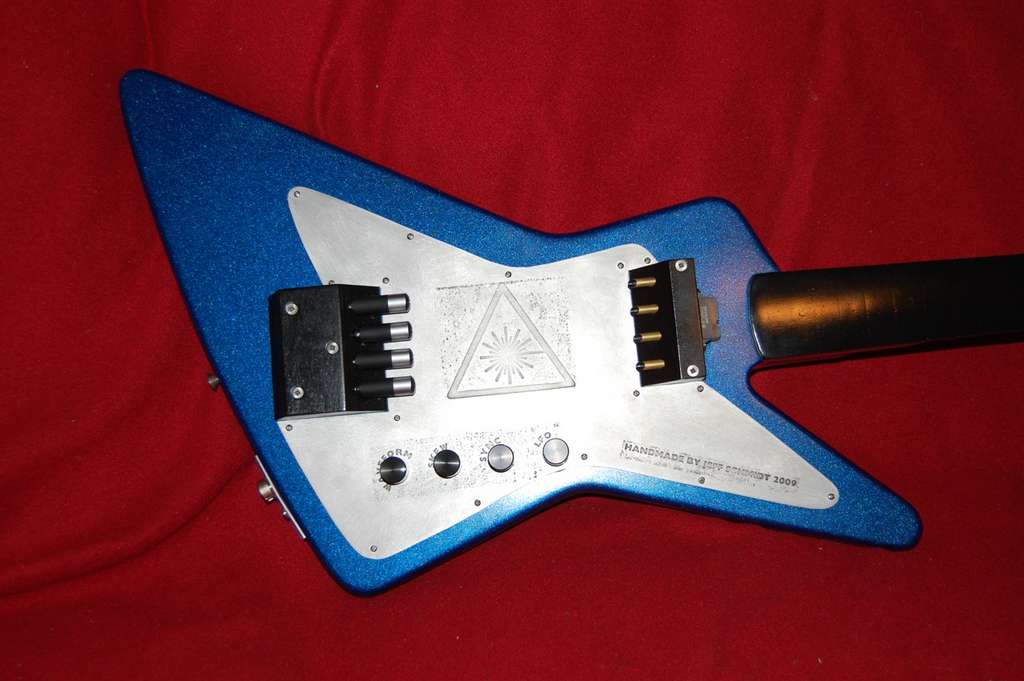
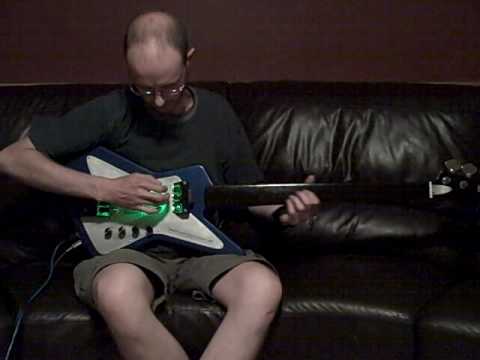
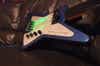
The Prism, in all its completed glory. jeff-o / InstructablesSHARE
Building your own guitar or synthesizer is impressive enough. But when you decide to smash the two music makers together—and throw some lasers in for kicks—the end result is the jaw-droppingly awesome “Prism.”
This synth-guitar uses lasers as “strings,” allowing the player to select octaves, and a fretboard equipped with infrared rangefinders, to electronically detect your fingers’ positions and modify the pitch of the instrument.
Unlike a DIY Guitar Hero controller, it requires no special software and plugs into any amp, making setup a breeze.
Aside from the lasers, the heart of the beast consists of a voltage-controlled oscillator, a low-frequency oscillator, and three selectable synth waves (sine, square, and triangle). And for something that’s been Frankensteined together, it doesn’t look too shabby either.
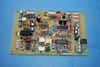
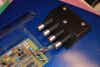
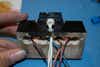
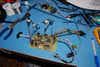
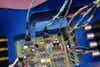
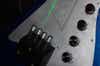
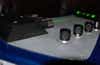
The starter guitar: The circuit boards, sensors, and lasers of the Prism were built into this old, unwanted electric guitar. jeff-o / InstructablesHere’s a look at the guitar sanded down and fitted for its custom PCB. jeff-o / InstructablesA closeup look at the PCB used to power the Prism. Each resistor, capacitor and transistor was assembled by hand. jeff-o / InstructablesThe completed block of laser sensors act as a photoresistor, letting you change octaves depending on the combinations of blocked laser light paths. jeff-o / InstructablesA glance at the wiring underside of the lasers. jeff-o / InstructablesEach component on the PCB is tested before it’s dumped into the Prism. jeff-o / InstructablesFreshly painted up, the Prism is ready to have its parts put in place. jeff-o / InstructablesThe Prism has three selectable wave generators (triangle, square, sine), a low voltage oscillator, and a low frequency oscillator. jeff-o / InstructablesThe Prism makes use of no Midi controllers, computers, or special software. Playing it is as easy as plugging the synth-guitar into an amp. jeff-o / InstructablesA range finder was installed on the Prism’s neck to provide a Theramin-like effect of pitch bending. jeff-o / Instructables