particle physics

Newly Discovered Magnetic Monopole Particles Flow Like Electric Currents

They're calling it "magnetricity" -- catchy, eh?

Dy2Ti2O7: This rare, "spin ice", crystal contains the atomic monopoles needed to create magnetricity.  via Muon Science Laboratory
In 1931, physicist Paul Dirac hypothesized that on the quantum level, magnetic charge must exist in discrete packets, or quanta, in the same way that electric energy exists in a photon. This implies the existence of magnetic monopoles: particles that have a single magnetic charge, or polar identity -- north or south.

For 78 years, Dirac's speculation interested only hardcore theorists, because the conjecture failed to find any expression in observed phenomena. All magnets had two poles, one north and one south, inextricably attached to each other.

[ Read Full Story ]

LHC Test Could Lead to Hyperdrive Space Propulsion (Well, In Theory)


Add one more thing to the list of mysteries, theories, and unsubstantiated ideas that will be confirmed/denied/debunked if CERN ever gets the Large Hadron Collider up and running: hyperdrive spacecraft propulsion.

In 1924, German mathematician David Hilbert published a paper noting a pretty amazing side effect to Einstein's relativity: a relativistic particle moving faster than about half the speed of light should be repelled by a stationary mass (or at least it would appear to be repelled, to an inertial observer watching from afar).

[ Read Full Story ]

Have Scientists Finally Found the Elusive Magnetic Monopole?


A long-hypothesized particle, stuff of tantalizing detection attempts and thrilling sci-fi novels, may have finally been sighted.

[ Read Full Story ]

Berkeley Lab Builds a Desktop Particle Accelerator

Multi-terawatt lasers make acceleration possible on a scale of inches instead of miles

Giant particle accelerators like the Large Hadron Collider (LHC) have become the poster children for big science. Immense in size, cost, and ambition, these gargantuan structures hurl particles at velocities close to the speed of light, in the hopes of uncovering the most basic constituents of matter and energy.

But when Wim Leemans gets his way, particle accelerators will be just another piece of lab equipment, no more obtrusive than a gene sequencer or a desktop printer.

[ Read Full Story ]

New Theory Postulates Galaxy-Sized Neutrinos, Expanding Since the Beginning of Time

And these are the massive tanks used to detect them

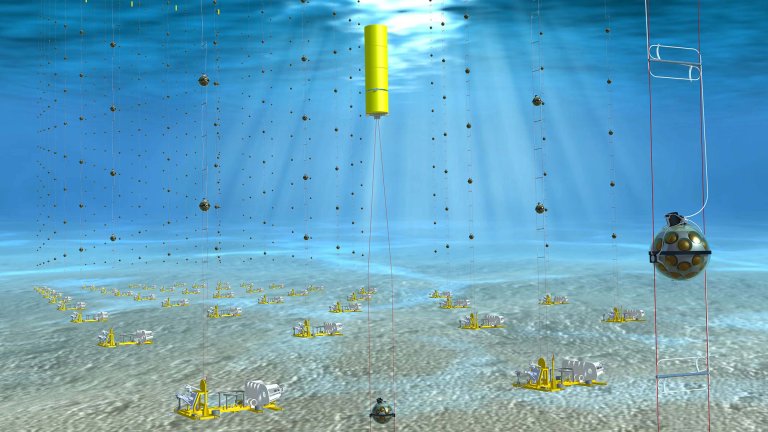
Irvine-Michigan-Brookhaven Detector: Located in an abandoned salt mine, this detector contains 2.5 million gallons of ulta-pure water. To give an idea of the scale of the tank, the object in the middle of the tank is a diver.  Joe Stancampiano via National Geographic
Of all the subatomic particles that make up matter, neutrinos are the smallest. So small, in fact, that a billion neutrinos pass through your body every second without hitting a single atom. However, a new study postulates that some ancient neutrinos, born shortly after the Big Bang, may now be as large as some galaxies.

[ Read Full Story ]


Download Our iPhone App

Stay up to date on the latest news of the future of science and technology from your iPhone with full articles, images and offline viewing


Follow Us On Twitter

Featuring every article from the magazine and website, plus links from around the Web. Also see our PopSci DIY feed


Become a Fan On Facebook

Share links with friends, comment on stories and more


December 2009: Best of What's New

In our December issue, Popular Science names the 100 best innovations of the year: bombproof wallpaper, self-parking cars, the fastest helicopter, and 97 more. Plus inventor profiles and videos.

Check out the best of what's new here.

Popular Science Photo Pool


Share your photos in the Pop Sci pool at www.flickr.com!
tags_sprite.png
POP_embeddedForm_cover_May09.jpg