hubble space telescope

Happy Birthday Hubble

To celebrate, NASA has released the largest single collection of images from the famous telescope. See all 59 amazing shots inside

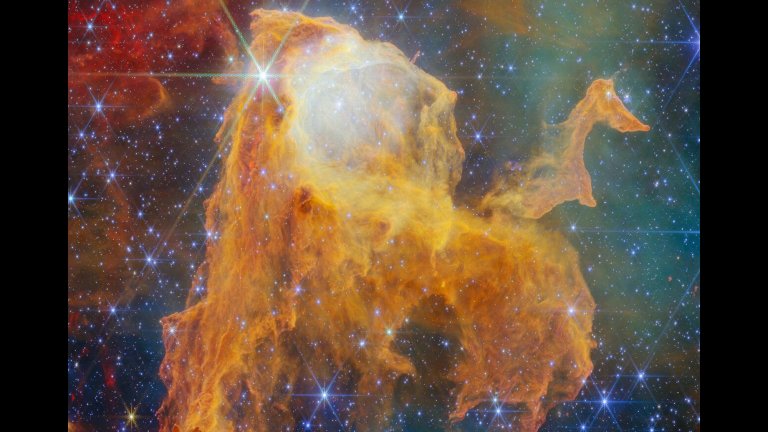
Today marks the 18th anniversary of the launch of the Hubble Space Telescope, and to celebrate, NASA has released a collection of 59 new Hubble images (under the fantastic title "Galxies Gone Wild!") that present galaxies in all of their volatile wonder.

[ Read Full Story ]

Google Earth Looks Up

Hubble Nothing inspires like looking up at the stars on a clear night, but a new feature from Google Earth could come close. In fact, the experience it offers is much closer to how many professional astronomers study the sky on a daily basis – not through a lens, but on a computer screen.

The newest version of Google Earth, the free program that has been downloaded by an estimated 250 million people, includes a “Sky” function that allows you to switch the view from any point on the planet so that you’re looking up and out instead of down at the ground. It works just like Google Earth, except now you can zoom in on stars, galaxies and planets. You won’t be looking at a live view; the images are compiled from shots taken by the Hubble Space Telescope. Find out more, or download it yourself, here.—Gregory Mone

(Image credit: NASA)

[ Read Full Story ]

Pluto Downgraded Again

Eris_and_dysnomia2
Eris and its moon, Dysnomia. Courtesy NASA

First it was demoted to a “dwarf planet,” leaving only eight proper planets in our solar system. Then scientists reported that another dwarf planet, Eris, is bigger than Pluto. And now the final blow: Eris is 27 percent more massive than Pluto.

Scientists Michael E. Brown and Emily Schaller at the California Institute of Technology in Pasadena used the ground-based Keck Observatory and the Hubble Space Telescope to determine the mass of Eris: 16.6 billion trillion kilograms. Brown and Schaller calculated the mass by measuring the time it takes for Eris’s moon Dysnomia to complete an orbit.

Earlier observations by Hubble had already shown that Eris has a diameter of about 2,400 kilometers, which is slightly larger than Pluto. Both dwarf planets are probably made of rock and ice. Brown says they are “essentially twins—except that Eris is slightly the pudgier of the two.”

Like Pluto, Eris resides beyond Neptune in the Kuiper belt. The icy bodies in this belt orbit the sun at distances 30 to 50 times greater than Earth’s orbit. Eris is three times farther from the sun than Pluto, and takes twice as long to orbit it.—Dawn Stover

[ Read Full Story ]

1 step forward, 2 back?

Where’s the money for President Bush’s bold new vision going to come from?

He’s not likely to raid Social Security for it—so NASA will have to scare up most of the cash. Of the $12 billion allotted for the first five years of the new Moon and Mars exploration plan, $11 billion will be siphoned from existing space programs.

[ Read Full Story ]

NASA Milestones

NASA has had its share of ups and downs over the years.

1958 National Aeronautics and Space Act establishes NASA.

1961 Russian cosmonaut Yuri Gagarin becomes the first
human in space. A month later, Alan Shepard becomes the
first American in space.
Kennedy vows to land
Americans on the moon.

1962 John Glenn becomes the first American to orbit Earth. Mariner 1, America's first
attempt at an interplanetary spacecraft, ends up at the bottom of the Atlantic Ocean.

1965 Mariner 4 flies past Mars, sending back the first images of the Red Planet's surface.


[ Read Full Story ]

Better Eyes for Hubble

This month, astronauts will deliver an even better internal eye to the Hubble Space Telescope.

It's arguably the most powerful scientific instrument ever created, adept at inspecting exploding stars and glimpsing billions of years back in time. Yet the Hubble Space Telescope is really just a giant orbiting lens, only as good as the camera within. This month, astronauts will deliver an even better internal eye, the Advanced Camera for Surveys. The upgrade will allow Hubble to operate 10 times more quickly. Here is a brief history of the telescope that changed the way we think about the universe.


HUBBLE IN FOCUS


April 1990

[ Read Full Story ]

PPX: The PopSci Predictions Exchange

RSS Link

New IPO

Hot Stocks

Ready to bet on the future? Start here!

Subscribe for 2 free issues!

may2008_cover.jpg