galaxies

Chandra Space Telescope Snaps Grand New Shot of Milky Way


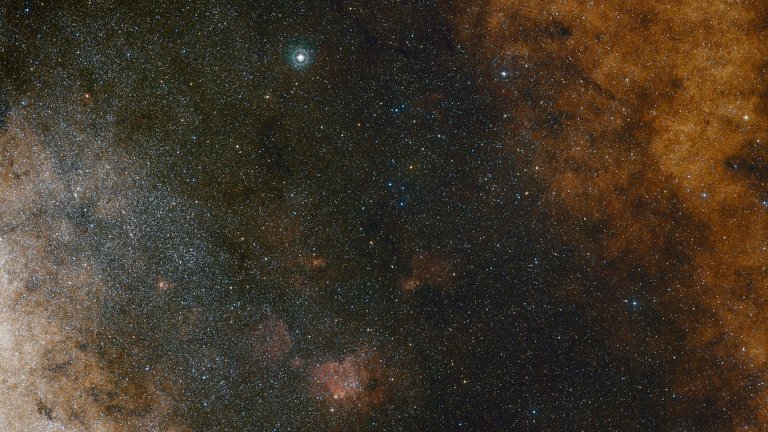
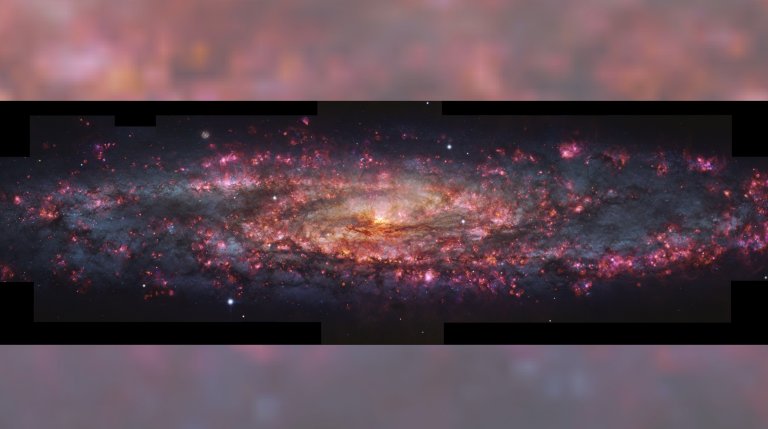
New Milky Way Panorama :  courtesy of NASA
NASA today released a new, panoramic mosaic of the Milky Way, and frankly, it rivals anything snapped during the Hubble's early days. Taken by the Chandra X-ray space telescope, the picture shows the massive energy released by neutron stars and black holes more vividly than any previous picture.

[ Read Full Story ]

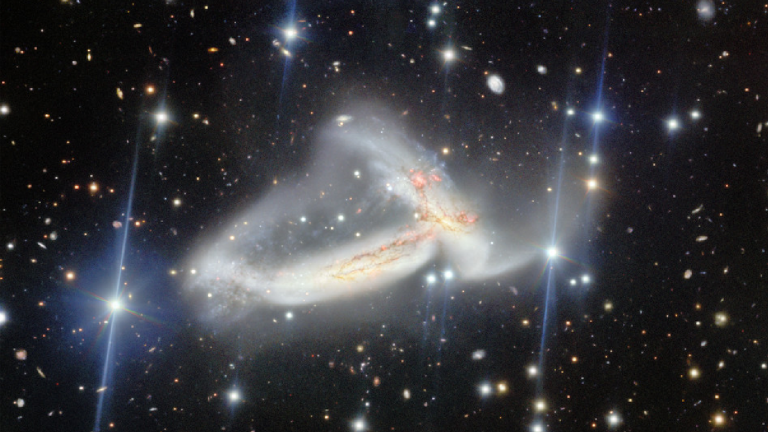
When Galaxies Collide, 280 Million Light Years Away

A new image using data from NASA's Chandra X-Ray Observatory captures Stephan's Quintet in a new light

Stephan's Quintent, Colliding:  NASA
130 years ago, astronomers discovered Stephan's Quintent--a compact group of galaxies 280 million light years from Earth. NASA's Chandra X-ray Observatory has captured the X-rays generated by the interstellar collision, as one of the galaxies is sucked through the center of the group at 2 million miles per hour.

[ Read Full Story ]
READ MORE ABOUT > , , , ,

New Nano-Device Detects Light from Big Bang

An electronic circuit 100 times smaller than a hair, could help astronomers shed light on the universe's creation

For centuries, the creation of the universe has loomed large in human thought, cropping up in everything from ancient folklore to modern scientific theories. A newly-developed nano-sized device, 100 times smaller than the thickness of human hair and capable of detecting infrared light that dates back to the "big bang," could soon give us more food for thought concerning the galaxy's formation 14 billion years ago.

[ Read Full Story ]

A Star Is Born. Well, a Lot of Stars

A newly discovered galaxy turned out 4,000 stars a year, contradicting a long standing theory

Baby Boomer: The Baby Boom galaxy churned out stars at a never-before-seen-rate.  NASA/JPL-Caltech/Subaru
Considering the birth rate, astronomers might have named this the Rabbit Galaxy. According to a new paper in today’s issue of Astrophysical Journal Letters, researchers have discovered a galaxy that birthed stars 400 times faster than our Milky Way, overturning previously held ideas about the formation of giant galaxies

[ Read Full Story ]

Astronomers Discover Missing Mass

A sensitive, space-based X-ray observatory focuses between galaxies at low-density gas

Granted, it might not seem like such a big deal when astronomers find some of the missing mass in the universe, since there's very little that isn't missing. Roughly 95 percent of the cosmos is either dark matter or dark energy. About five percent of the universe is made up of the normal mass we're familiar with—baryonic matter. Yet by adding up the known stars and galaxies and gas, astronomers have only accounted for about half of that five percent.

[ Read Full Story ]

The State of the Universe

Scientists take a look at one of the most complicated puzzles concerning our existence and discover how long galaxies should keep expanding

Not much in science is more of a mind-bender than thinking about the size and fate of the known universe (except for quantum mechanics and string theory, which also has a lot to do with the size and fate of the universe, albeit on the opposite end of the size spectrum). When we first developed theories about the universe, the model which resulted depicted all of space as static and unchanging, infinite in depth in any direction. Then Einstein posited general relativity and suddenly a whole host of universes were theoretically possible: static, dynamic, infinite, and finite.

[ Read Full Story ]

Happy Birthday Hubble

To celebrate, NASA has released the largest single collection of images from the famous telescope. See all 59 amazing shots inside

Today marks the 18th anniversary of the launch of the Hubble Space Telescope, and to celebrate, NASA has released a collection of 59 new Hubble images (under the fantastic title "Galxies Gone Wild!") that present galaxies in all of their volatile wonder.

[ Read Full Story ]

These Rays Ain't from Around Here

Scientists confirm that the most energetic particles in the universe originate far from our cosmic neighborhood

Ultra-high-energy cosmic rays carry more energy than any known particles in the universe, so we should probably all take it as good news that scientists have confirmed that they don't originate in our cosmic neighborhood. In fact, the majority of these rays—which are mostly hydrogen and helium—lose most of their juice on their way towards Earth because they interact with the cosmic microwave background radiation, the energetic leftover of the Big Bang.

[ Read Full Story ]


Download Our iPhone App

Stay up to date on the latest news of the future of science and technology from your iPhone with full articles, images and offline viewing


Follow Us On Twitter

Featuring every article from the magazine and website, plus links from around the Web. Also see our PopSci DIY feed


Become a Fan On Facebook

Share links with friends, comment on stories and more


November 2009: Astronaut 3.0

Inside NASA's astronaut bootcamp and the grueling new training regimen for deep space. Plus, ten young geniuses shaking up science today, one writer's quest to analyze every man-made chemical in her body and more.

Check out the issue's full contents online here

Popular Science Photo Pool


Share your photos in the Pop Sci pool at www.flickr.com!
tags_sprite.png
POP_embeddedForm_cover_May09.jpg