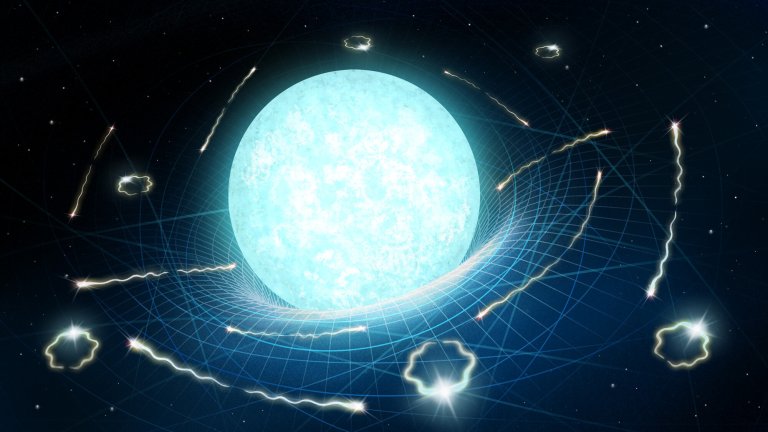
black holes

Artificial Black Hole Created in Chinese Lab


Just because most black holes are solar-system-sized maelstroms with reality-warping gravitational pulls doesn't mean you can't have one in your pocket! That's right, just in time for the holidays comes the pocket black hole. Designed by scientists at the Southeast University in Nanjing, China, this eight-and-a-half-inch-wide disk absorbs all the electromagnetic radiation you throw at it, with none of the pesky time dilation and Hawking radiation associated with the larger, interstellar versions.

[ Read Full Story ]

This Week in the Future, October 5-9, 2009


This Week in the Future, October 5-9, 2009:  Illustration by Baarbarian
The littlest gold miners, the tidiest bees, and the least fun Wii game ever. Welcome to this week's Future.

[ Read Full Story ]

Universe To End Sooner Than Previously Thought


While Robert Frost famously said that he prefers the world to end in fire, physicists have long predicted the universe will end with an icy sputter known as "heat death." Heat death occurs when the universe finally uses up all its energy, with all motion stopping and all the atoms in creation grinding to a halt. And, based on new calculations from a team of Australian physicists, it looks like heat death is far closer than previously thought.

[ Read Full Story ]

NASA Catches Two Black Holes Sucking Face

The Chandra X-ray Observatory helped discover two merging black holes a mere 3,000 light years apart

Black Hole Merger: Two pinpoints of light represent black holes in the center of this combined X-ray/optical image  NASA/CXC/MIT/C.Canizares, M.Nowak/STScI
Colliding black holes may prove more interesting to scientists than the immovable object versus the unstoppable force. New data from NASA's Chandra X-ray Observatory has combined with optical images from Hubble to show off a merging black hole pair in all its glory.

[ Read Full Story ]
Science of YouTube

Threat Watch, LHC?

A new report has people insisting the LHC's miniscule black holes might be more dangerous than previously believed

After decades of work, the Large Hadron Collider went live 143 days ago and went down 139 days ago. Its being offline, however, has hardly put an end to speculation over what exactly will happen when the repairs are completed and the switch is flipped on the world's largest particle accelerator. Scientists from the Universities of Bologna and Alabama recently submitted a paper to Cornelll's arXiv.org exploring the possibility that those (harmless) microscopic black holes we'd heard so much about could stick around longer than previously believed. No matter that their conclusion was basically, still: "so what? Ain't gonna do nothin." News outlets,as SciAm notes, jumped over the story and the anti-LHC kook-contingent resurfaced.

So here's to you, naysayers and doomsdayers alike. After the jump, a very special episode of "Science of YouTube," wherein the LHC goes online and the Earth is destroyed. Enjoy!

[ Read Full Story ]

Large Hadron Collider Probably Won't Destroy Earth

Despite its potential to create microscopic black holes, the new particle accelerator is unlikely to collapse our planet

The Large Hadron Collider, the giant particle accelerator that's scheduled to begin colliding protons in August, has the potential to produce the long-sought Higgs boson. That elusive particle is a missing link in the commonly accepted model of physics. Observing it would be an important milestone in our understanding of the fundamental forces of the universe.

[ Read Full Story ]

New Entrant in a Long-Running Black Hole Debate

Physicists try to prove the hungry cosmic objects don't break the laws of quantum mechanics when they suck in particles

For years, some scientists contended that black holes swallow everything, including the information associated with the particles they suck up, and that this information can never be recovered. The problem with this idea - the chief proponent of which was the legendary Stephen Hawking - is that it violated a law of quantum mechanics.

[ Read Full Story ]

Supermassive Black Hole Takes a Nap

Japanese scientists propose that the giant black hole at the center of our Milky Way Galaxy may be in a rest period

It packs 4 million times more material than our sun, but relative to the black holes sitting at the center of some neighboring galaxies, it actually doesn't do all that much. The fact that this black hole, known as Sagittarius A*, kicks out billions of times less energy than others of its kind has made it something of a mystery. But now a team of scientists at Kyoto University suggests that Sagittarius A* may be resting after a far more active period a few centuries ago.

[ Read Full Story ]

Black Hole Threesome

Scientists model a collision between three massive black holes

What's cooler than a black hole? Two of them, rotating around and then crashing into one another. And what could be more entertaining than that cataclysmic cosmic dance? Why, one more, of course.

A team of scientists at the Rochester Institute of Technology has simulated the merger of three black holes.

[ Read Full Story ]

These Rays Ain't from Around Here

Scientists confirm that the most energetic particles in the universe originate far from our cosmic neighborhood

Ultra-high-energy cosmic rays carry more energy than any known particles in the universe, so we should probably all take it as good news that scientists have confirmed that they don't originate in our cosmic neighborhood. In fact, the majority of these rays—which are mostly hydrogen and helium—lose most of their juice on their way towards Earth because they interact with the cosmic microwave background radiation, the energetic leftover of the Big Bang.

[ Read Full Story ]
Page 1 of 2 12next ›last »


Download Our iPhone App

Stay up to date on the latest news of the future of science and technology from your iPhone with full articles, images and offline viewing


Follow Us On Twitter

Featuring every article from the magazine and website, plus links from around the Web. Also see our PopSci DIY feed


Become a Fan On Facebook

Share links with friends, comment on stories and more


December 2009: Best of What's New

In our December issue, Popular Science names the 100 best innovations of the year: bombproof wallpaper, self-parking cars, the fastest helicopter, and 97 more. Plus inventor profiles and videos.

Check out the best of what's new here.

Popular Science Photo Pool


Share your photos in the Pop Sci pool at www.flickr.com!
tags_sprite.png
POP_embeddedForm_cover_May09.jpg