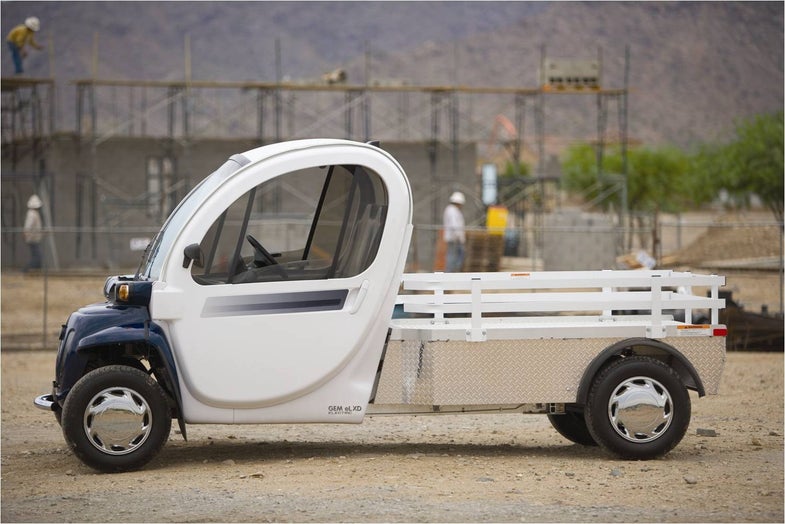
Soldiers may soon get greener rides on-base, after the U.S. Army announced the acquisition of 4,000 neighborhood electric vehicles.
The plug-and-chug vehicles come in both sedan and light truck models, and can charge their batteries at any three-pronged household outlet. Estimates put the savings over a six-year service lifetime at 11 million gallons of fuel, not to mention 115,000 tons of carbon dioxide emissions.
"We estimate the cost of charging an electric vehicle in a given year at $400, which is a substantial savings from the fuel that would be purchased for a petroleum vehicle," said Paul Bollinger, deputy assistant secretary of the Army for Energy & Partnerships, during a Department of Defense bloggers roundtable on Monday.
Total savings on the vehicles: $45.8 million over six years.
This doesn't represent the first time that the Army has sunk substantial investment into energy-efficient vehicles – it has snapped up 40,000 alternative fuel vehicles to date. But a lack of alternative fueling stations led to the decision to skip over hybrids and go directly to electric.
The Army does not stand alone in deciding to jump to electric vehicles – Popular Science talked with U.S. entrepreneur Elon Musk about his efforts with Tesla Motors to develop a viable electric car.
Six of the electric vehicles have arrived at Fort Myer, VA, to be followed by 800 more this year. More will continue to pour into Army bases over the next two years, courtesy of Chrysler subsidiary GEM and possibly some other car manufacturers.
No one's going to be tearing around at high speed yet, given the 25 mph speed limit on Army bases and the limitations of the electric vehicles. But Bollinger said that manufacturers want to produce road-speed electric vehicles for the Army that could travel off-base.
If this and the North American International Auto Show are any indication, it seems like the electric car may still have a future. Bollinger stated that the Army hopes its acquisition will "drive battery technology in the future," and noted that a Navy captain had told him the Navy wants to follow in the Army's footsteps.
"Now, if the Air Force piggybacks it, I mean, you may be talking potentially 40[,000] or 50,000 vehicles purchased by the military," Bollinger said. "If that doesn't create a market I don't know what does."
Neighborhood electric vehicle (NEV) from U.S. Army on Vimeo.
Five amazing, clean technologies that will set us free, in this month's energy-focused issue. Also: how to build a better bomb detector, the robotic toys that are raising your children, a human catapult, the world's smallest arcade, and much more.


Online Content Director: Suzanne LaBarre | Email
Senior Editor: Paul Adams | Email
Associate Editor: Dan Nosowitz | Email
Assistant Editor: Colin Lecher | Email
Assistant Editor: Rose Pastore | Email
Contributing Writers:
Rebecca Boyle | Email
Kelsey D. Atherton | Email
Francie Diep | Email
Shaunacy Ferro | Email
"Now, if the Air Force piggybacks it, I mean, you may be talking potentially 40[,000] or 50,000 vehicles purchased by the military," Bollinger said. "If that doesn't create a market I don't know what does." Yeah, air force is better, so while its good, the air force should take some too.
As a retired soldier, I can tell you that any military base uses a ton of vehicles just to haul around civilian workers and contractors and supplies from parts to groceries for the mess halls. A lot of the parts and other supplies are small and do not require an 8 cylinder gas or diesel engine to move them. Electrics, IF they have 1) a useful range, 2) rapid recharge, 3) long battery life and 4) easily recyclable batteries would save a lot of money in the long run.
If there are electrics available to military units they can use them in garrison rather than firing up a Humvee for non-tactical requirements.
Of course, the USAF and any USMC or USN flight base uses a load of small vehicles on flight lines, as well as army aviation.
The big things to watch will be battery life, replacement costs for batteries and what is to be done with the thousands of used-up batteries that will have to be recycled/landfilled.
Where is all the electricity to charge these cars going to come from. Every ones on this emotional environment gig, but no real thought is being put into the realities. Nothings for free, there is going to be some environmental cost only at another location. Apart from that what happens when the batteries need replacement?
RSAmadman Wrote
"Where is all the electricity to charge these cars going to come from. Every ones on this emotional environment gig, but no real thought is being put into the realities. Nothings for free, there is going to be some environmental cost only at another location. Apart from that what happens when the batteries need replacement?"
Even if ALL the electricity used to recharge the cars comes from say COAL (the worst), all those cars use ZERO petroleum and create ZERO emissions. Truly "green". Batteries WILL need replacement, but so do engines and transmissions today - it comes with the deal. 40-50k orders from the military should raise efficiency and use-time, and DECREASE price.
Go Army!
Not to be critical, but Infojunkie777's comment sort of undervalues the actual cost of electricity here. I am a proponent of electric cars (I'd love a Tesla), but let's be realistic. Only something like 10-15% of the energy seen at a power plant actually reaches the end users. The rest is lost in conversion from one energy source (coal/petro etc) to another (electricity) and transmission line losses (then there's energy loss between the batteries and the wheels, but we won't go there).
Naturally, energy conversion and transportation of petroleum also has its costs, but they are far less dramatic, and the infrastructure already exists to support demand. At this moment in time the country really isn't prepared for a large-scale conversion to electric cars. We'll need many more power plants and far less transmission line loss immediately to handle this shift.
Obama is well aware of this issue- for example he mentioned some time ago that the overloaded, antiquated national power grid is a major impediment to electric vehicles.
From my perspective, "Green" has to look at the entire pipeline, not just the endpoint, if it's to be more than just a slogan.
.
to
orajnamalik
InfoJunkie777:
Thanks for your positive comments on EVs.
Warpig:
I'm glad you're open to the widespread adoption of EVs, but battery life is not an issue-- we are no longer trying to power EVs with lead-acid batteries that only last for 500 charges. If you spend a little time googling battery technology, you'll see that batteries can now outlast the vehicles themselves by a wide margin-- the Altair NanoSafe battery can be recharged more than 30,000 times with no reduction of charge density, which is equivalent to something like 50-80 years of steady use.
The only existing barriers to EVs replacing GVs (gasoline vehicles) are not technological; the barriers are inertia and ignorance.
The best batteries can be recharged in less than 10 minutes. The first problem is getting them into high-volume production, which will also make them far more affordable-- that's just inertia. We need a widespread network of high-speed charging stations, so that we can drive our EVs anywhere just as we can drive GVs today-- that also is inertia. These charging stations do not need to be as large, expensive or as commonplace as gasoline stations are today, since most people charge their EVs at home where it is cheaper and more convenient to both the consumer and the power stations, since there is far more excess energy available at night.
The other problem, ignorance, is also one of inertia as well, since it may take time to undo the mistrust and misinformation surrounding EVs: people have spent 100 years becoming comfortable with their noisy, toxic GVs, and it will take a special effort to warm them to the full suite of advantages they will have with electric cars.
As for your concern for the recyclability of these new batteries, they are composed of materials that are far more benign than the batteries of years past-- titanium, for instance, is so cheap and nontoxic it is used as an abrasive in toothpaste, and is a common ingredient in house paint.
chuckgass:
You try to say you're a proponent of EVs, but that's more than just hard to believe.
You will find NO credible source of data that can back up your claim that there is a loss of 85-90% energy loss from generator to end user! More typical is what anyone can find if they google ENERGY TRANSMISSION EFFICIENCY and read some of the hits: typical of such results is the following statement, on the IEC (International Electroenergy Commission) website:
"...the overall losses between the power plant and users can easily be between 8% and 15%"... that is the exact OPPOSITE of what you said.
You also say, "...energy conversion and transportation of petroleum also has its costs, but they are far less dramatic..." which is also clearly false. Gasoline tankers require dispatchers, delivery route planners and strategists, drivers, and other human handlers that chean, silent electric power lines do not-- the smelly, noisy, high-maintenance tanker trucks congest our streets and highways as they zig-zag from station to station on their delivery routes; the hidden costs of these tanker trucks nearly doubles the overall cost of driving a GV, a cost EVs do not have. Next time you're on the freeway count the number of tanker trucks delivering of returning from delivering fuel, and realize all that labor- and energy-intensive activity will no longer be needed once we switch over to EV use. Unlike electricity, gasoline must be delivered and stored in huge, expensive, dangerous underground tanks for days or weeks before it is used, increasing costs significantly. So the tanker trucks you say are preferable to grid lines are actually closer to 10% efficient.
"We'll need many more power plants and far less transmission line loss immediately to handle this shift." Again, untrue! When googling "V2G", you'll find that EVs are typically charged at night when electric loads are lowest and there is excess cheap energy for sale. V2G, which stands for Vehicle-to-Grid, is an intelligent energy delivery system in which power companies can send signals to EVs at times when there is a danger of grid overload. If the car is charged and not in use, it can back-feed some of its battery charge to the power company, easing the threat of a blackout; the more of these EVs there are, the less likely there will be a power crisis, and the less likely we'll need a
So EV owners can buy their electricity at night when it's cheap, and sell it back to the power companies at a fair profit, a significant incentive to participate in the program. So rather than increasing load on the grid, EVs will decrease it.
If you really are an EV proponent, why are you spreading so many false, critical comments? Do you actually work for the oil industry?!
Of course there will be a greater electrical load on any base useing electrical cars. At some point, however, I think the brass would start to seriously consider on site generators or incentives for personnel installing personal windmills or solar cells.
"it seems like the electric car may still have a future"
THIS IS LAUGHABLE!
Electric cars ARE the future! Norweigan "Think" have already excellent cars in production and are cooperating with Swedish electricity companies to make 1/3 of all Swedish cars by 2020 electrical ones. Sweden will be the frontrunner for E-cars in the years to come.
Unlike U.S. which is corrupt by the Oil companies to hush-hush every developement and try to remain its control over the citizens choices.
Nice Article and comments
NKPROUD
Win/win...keep our cash here, sell our fossil fuels and keep everyone else's fuel here as well. Time to purchase our Country Back...it was amazing that so many missed the initial sale. They were busy. Now they have plenty of free time...bankruptcy does that.
Electric power generation may not be a problem, anywhere, in 5 or 6 years. Check out focusfusion.org . How does universally available power at <<½¢/kwh sound?
Just awesome!