
On September 5, 2001, a concert started inside a medieval church–and it continues to this day. If all goes as planned, the performance won’t finish for another 616 years.
One may expect a composition like John Cage’s ORGAN²/ASLSP to encompass thousands, if not millions of pages of musical notation—but as its name implies, it’s the exact opposite. “ASLSP” is Cage’s shortening of “As Slow As Possible,” and so far, the custom-built, electric pipe organ has only issued nine chords. The current one started in February 2024, while the next chord won’t play until August 5, 2026. At that point, an A4 chord will ring out for 911 more days.
John Cage died in 1992 at the age of 79, but both fans and detractors have continued discussing and performing his work. After discovering the I Ching in 1951, Cage incorporated the Chinese divination system’s philosophy into his art for the rest of his life, particularly on topics like sound, time, and chance.
Cage’s most famous piece, 4’33”, is in some ways the exact opposite of ORGAN²/ASLSP. Instead of a flurry of melodies, it’s actually four minutes and 33 seconds of pure silence (ironically, the public and critical response wasn’t as serene). But while 4’33” is regularly performed around the world, it’s rarer to see a rendition of ORGAN²/ASLSP. The ongoing version in Germany is one of a kind.
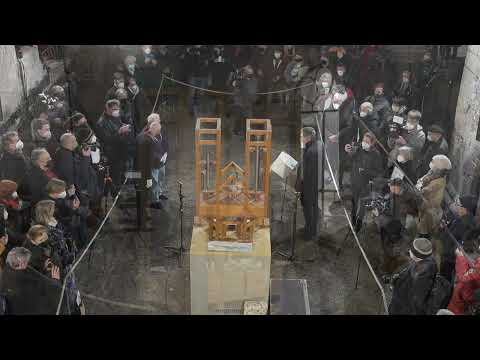
ASLSP Chord Change 05.02.2022
Cage was fascinated by the consequences of chance, but the experiment’s organizers had very precise ideas in mind when they mapped out the multigenerational concert. It officially started on the composer’s birthday (September 5), and its 639-year duration is the same length of time as the stretch between the debut of the world’s first 12-tone Gothic organ in 1361 and the year 2000. Each chord and pause of the music notation was then scaled to fit the centuries-long timeframe.
Although a musician can play ORGAN²/ASLSP on a variety of instruments, the organ is arguably the only one up to the challenge. Unlike a traditional piano, the organ is designed to maintain sound for indefinite periods of time. The piano produces sound from a key hammer striking a string that then resonates. Those vibrations diminish over time, causing the sound to fade and end. In comparison, an organ creates sound from bellows pumping air through metal pipes tuned to certain pitches. As long as there’s air in an organ, there’s sound.
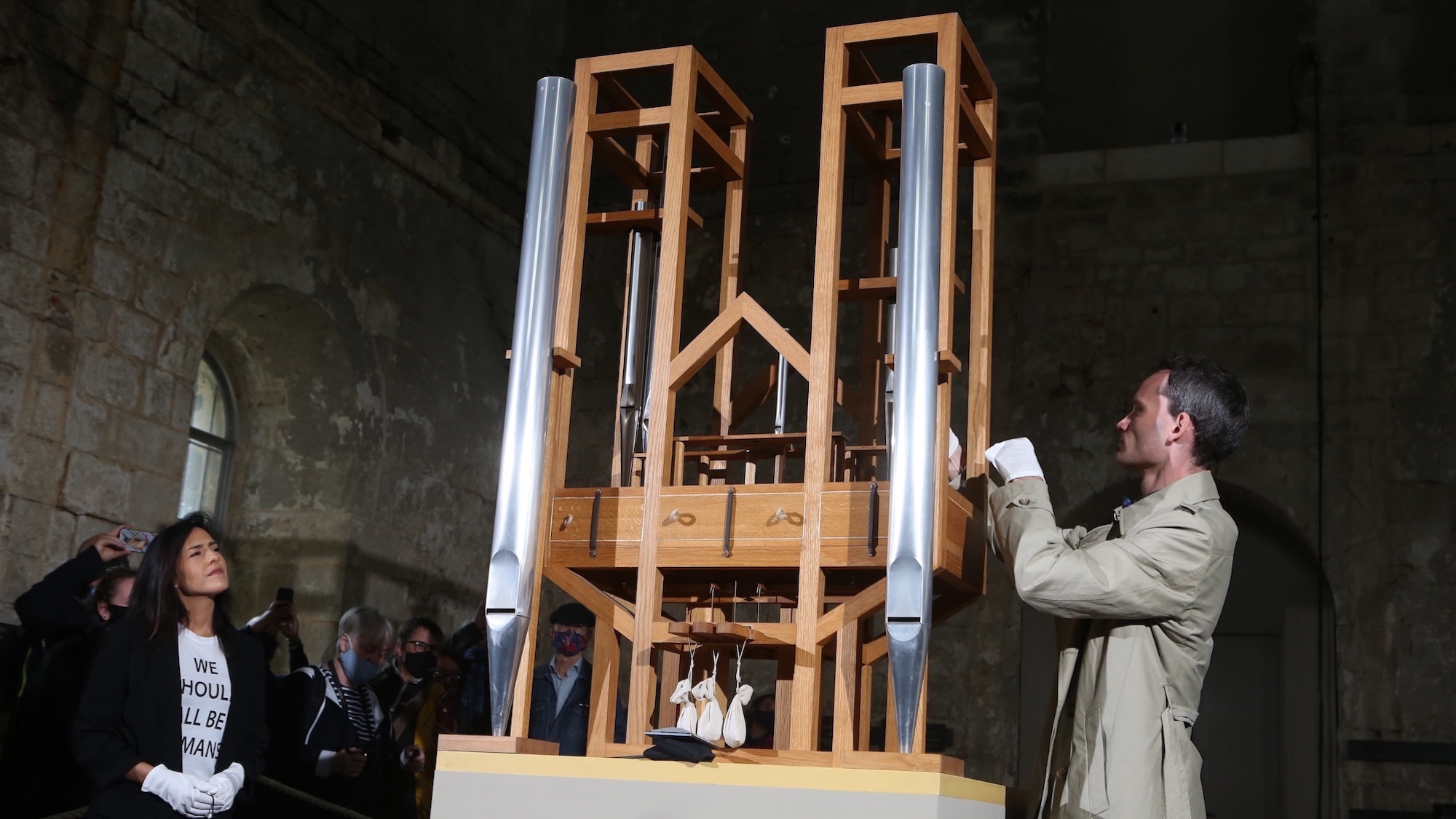
But how is a 639-year performance even possible? No one living today will be around to see the ORGAN²/ASLSP’s finale, of course, and nobody is expected to constantly play the church’s organ. The workaround is a specially designed instrument that relies on sandbags to depress wood keys while electrically powered, backup generator-supported bellows supply continuous airflow. Only when it’s finally time to change chords does a human arrive to swap out the necessary pipes.
Assuming no unintended concert interruptions occur, the longest-running musical performance has centuries left to go. That said, it’s unclear if it will have any fans by the time of its finale. In 2011, the bespoke organ was encased in an acrylic case in an effort to allegedly reduce noise complaints.
