
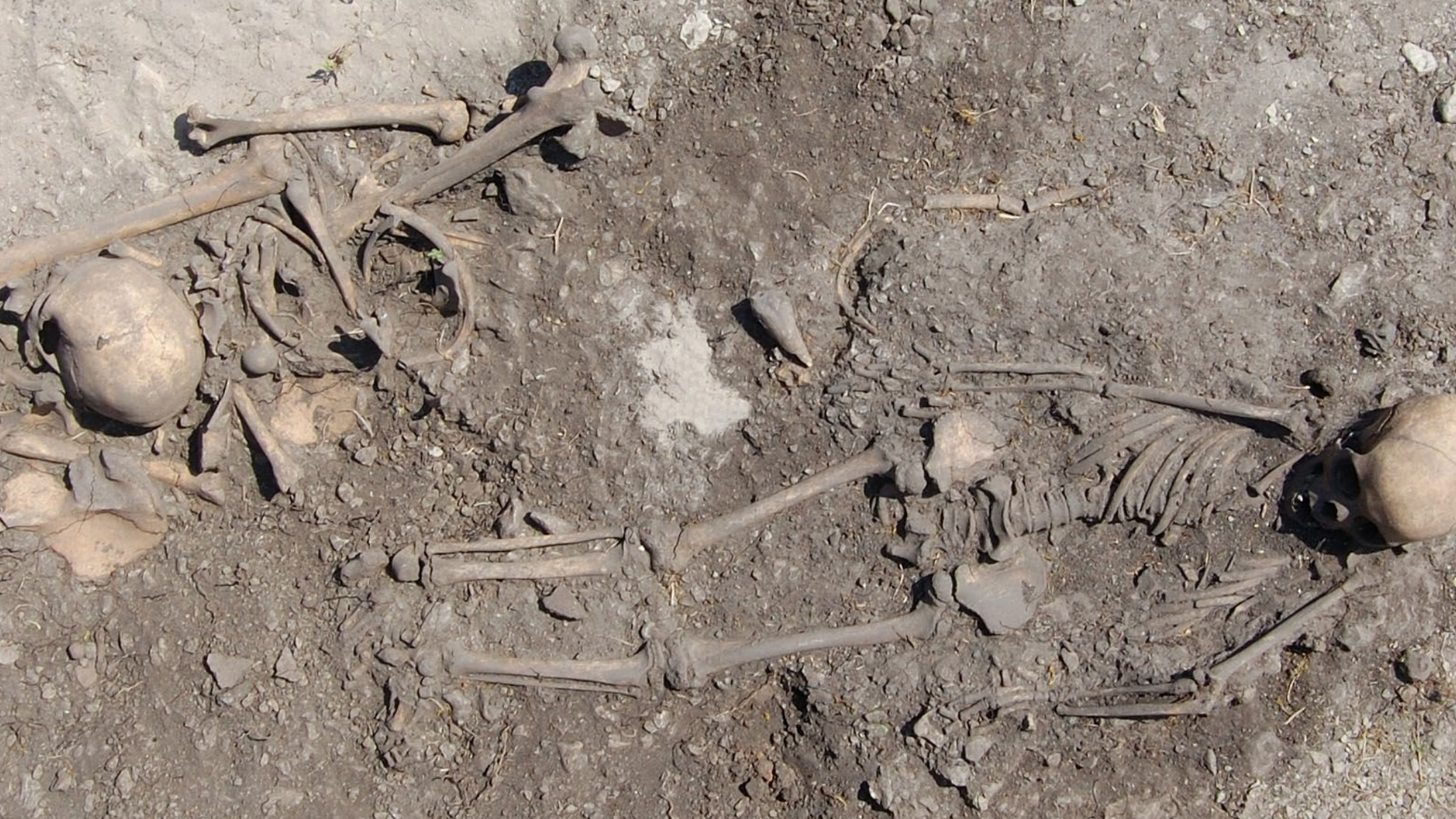
If you could share your grave with someone, who would it be? Researchers investigating the genetic relationships among those buried at the Swedish Stone Age site of Ajvide have revealed that people buried together weren’t always immediate relatives.
“Surprisingly enough, the analysis showed that many of those who were buried together were second- or third-degree relatives, rather than first-degree relatives—in other words, parent and child or siblings—as is often assumed,” Helena Malmström, an archaeogeneticist at Uppsala University, said in a statement. “This suggests that these people had a good knowledge of their family lineages and that relationships beyond the immediate family played an important role.”
Malmström and colleagues describe their results in a study recently published in the journal Proceedings of the Royal Society B Biological Sciences. They investigated the relationships of individuals in four graves from a hunter-gatherer culture that existed at the Ajvide archaeological complex on the Swedish island of Gotland approximately 5,500 years ago. While agriculture was widespread in Europe, hunter-gatherer cultures remained further north.
DNA analysis of the deceased in these four graves revealed a set of unexpected relations. One grave held a 20-year-old woman with a four-year-old on one side and a toddler on the other. The two children are full siblings, and the woman is probably their aunt or half-sister. Another grave had a young girl next to the remains of her adult father, which had likely originally been located elsewhere.
Related Stone Age Stories
The third grave carried two children with a third degree relation—probably cousins—and the fourth grave had a young woman and a girl, also related at the third degree. Likely, one was a cousin or great aunt to her grave buddy. The four graves are just half of the eight shared graves identified at a funerary site of 85 burials known to researchers.
“The analyses provide insight into social organisation in the Stone Age,” said Paul Wallin, an Ajvide burial ground expert.
The team used DNA taken from their bones and teeth to determine the hunter-gatherers’ sex and blood relations. While the children’s skeletons do not indicate their sex, the researchers could tell if they had an X and a Y chromosome or two X chromosomes, which would mean either a male or female, respectively.
As for their relationships to others in the burial ground, this was revealed by how much DNA was shared. For example, half of the DNA of first-degree relations is the same. For second-degree relations) half-siblings or grandparents-grandchildren)it’s one quarter. And for third degree (great-grandparents/great-grandchildren or cousins) it’s one eighth.
“As it is unusual for these kinds of hunter-gatherer graves to be preserved, studies of kinship in archaeological hunter-gatherer cultures are scarce and typically limited in scale,” said Tiina Mattila, a population geneticist at Uppsala University and co-author of the study.
Moving forward, the team hopes interdisciplinary studies of over 70 people’s remains from the same site will shed light on more aspects of the ancient hunter-gatherer cultures’ life histories, burial practices, and social organization.
