
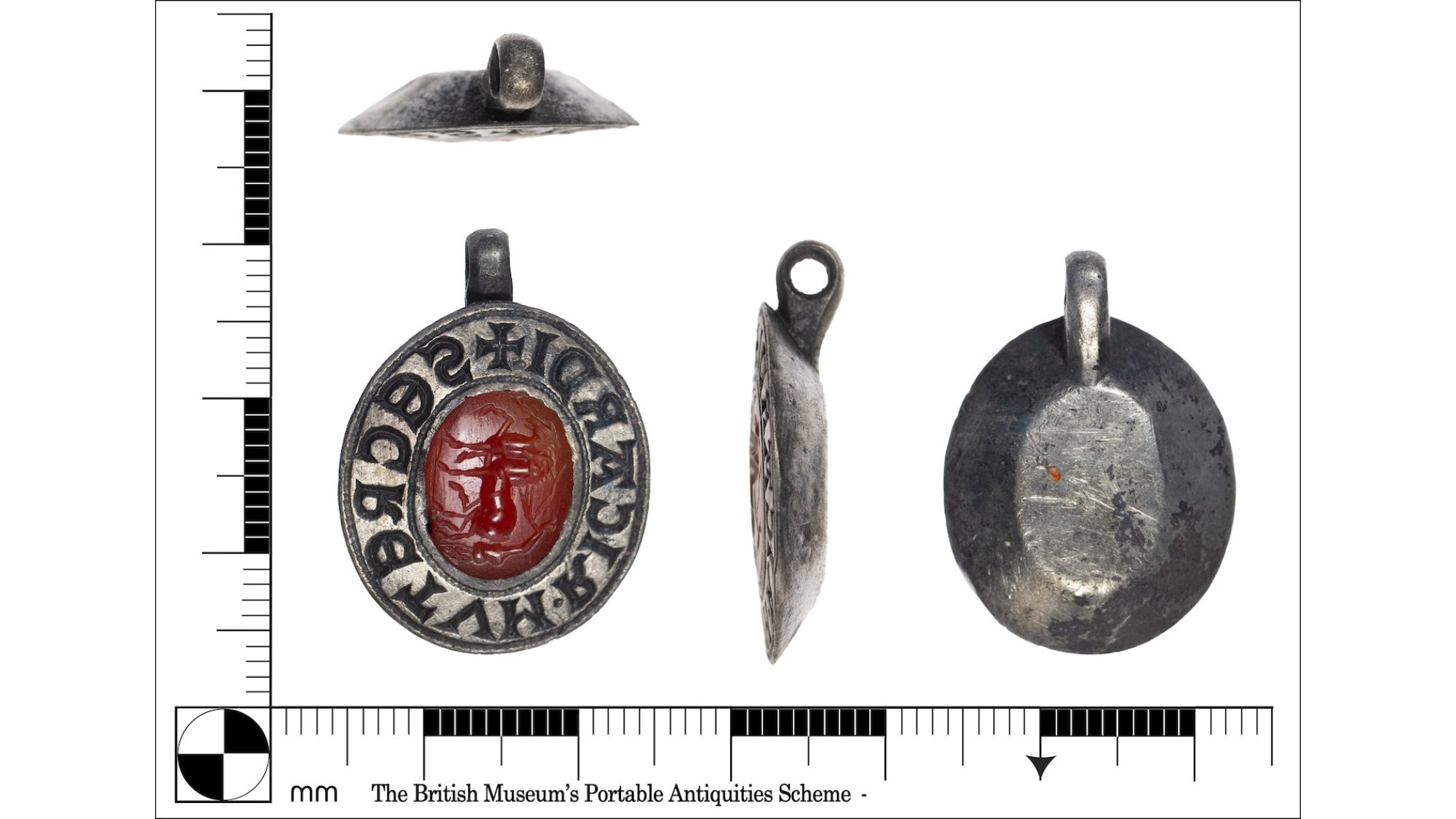
A discovery on a farm in Essex, England, is a bit of an archaeological version of the 2010 film Inception. In September 2024, a metal detectorist scouring a farm about 45 miles northeast of London found a silver, oval pendant measuring about one-inch-long. The piece included an inscribed frame of mirrored Latin text that allowed for wax impressions. Once pressed onto the malleable material, the phrase “SECRETVM.RICARDI” (“Richard’s secret” or “Richard’s secret seal”) would appear next to a tiny cross symbol commonly seen across medieval Christian art. Based on its location, appearance, and condition, experts believe that the jewelry dates somewhere between 1200–1400 CE.
The pendant’s red gemstone centerpiece was already an antique itself at the time of the jewelry’s creation, however. Etched similarly to its silver enclosure, a gem depicted a racing chariot that would also appear as a raised scene in wax seals. According to archaeologists, the inset was previously crafted during the Augustan era of the Roman Empire as far back as the late first century BCE. Although extremely rare, it’s not the first example of its kind.
“Gem-set seal matrices were used by both citizens and the nobility, to indicate social status,” reads the artifact’s official record in the United Kingdom antiquities database.
The entry notes that while English nobles during the 11th–13th centuries imported “better executed” gemwork examples, commoners and farmers often repurposed poorer examples after rediscovering them while plowing fields.
As Archaeology News explained, objects fusing components from vastly different time periods is rarely documented in the historical record. Such a striking example also illustrates the Roman Empire’s lasting influence on the British Isles. Rome’s forces first landed in Britain during the Gallic Wars under the direction of Julius Caesar in 55-54 BCE. Within a century, the empire officially occupied the region and would remain the dominating presence until 410 CE.
Given its rarity, U.K. assessors officially deemed the pendant “treasure,” meaning it likely won’t remain the property of its discoverer. The nearby Braintree Museum is now in talks to acquire the antique, which it hopes to eventually place in a permanent public display.
