This article was originally featured in Knowable Magazine.
The Argentinean Patagonia is known for its right whales, penguins, guanacos and elephant seals. But a lesser-known species, the burrowing parrot, also arrives there every year to nest and raise its chicks. The world’s largest colony of these boisterous green birds dwell within a sandstone cliff that runs 21 kilometers (13 miles) along the Atlantic Ocean.
The creatures are members of one of the most endangered groups of birds, the order Psittaciformes, which includes macaws and cockatoos. In the hopes of shoring up their future, a team of scientists has been monitoring the parrots for three decades, documenting their breeding activities, population fluctuations and their roles in the ecosystem. The accumulated findings led to the creation of a nature reserve in the area to protect them.
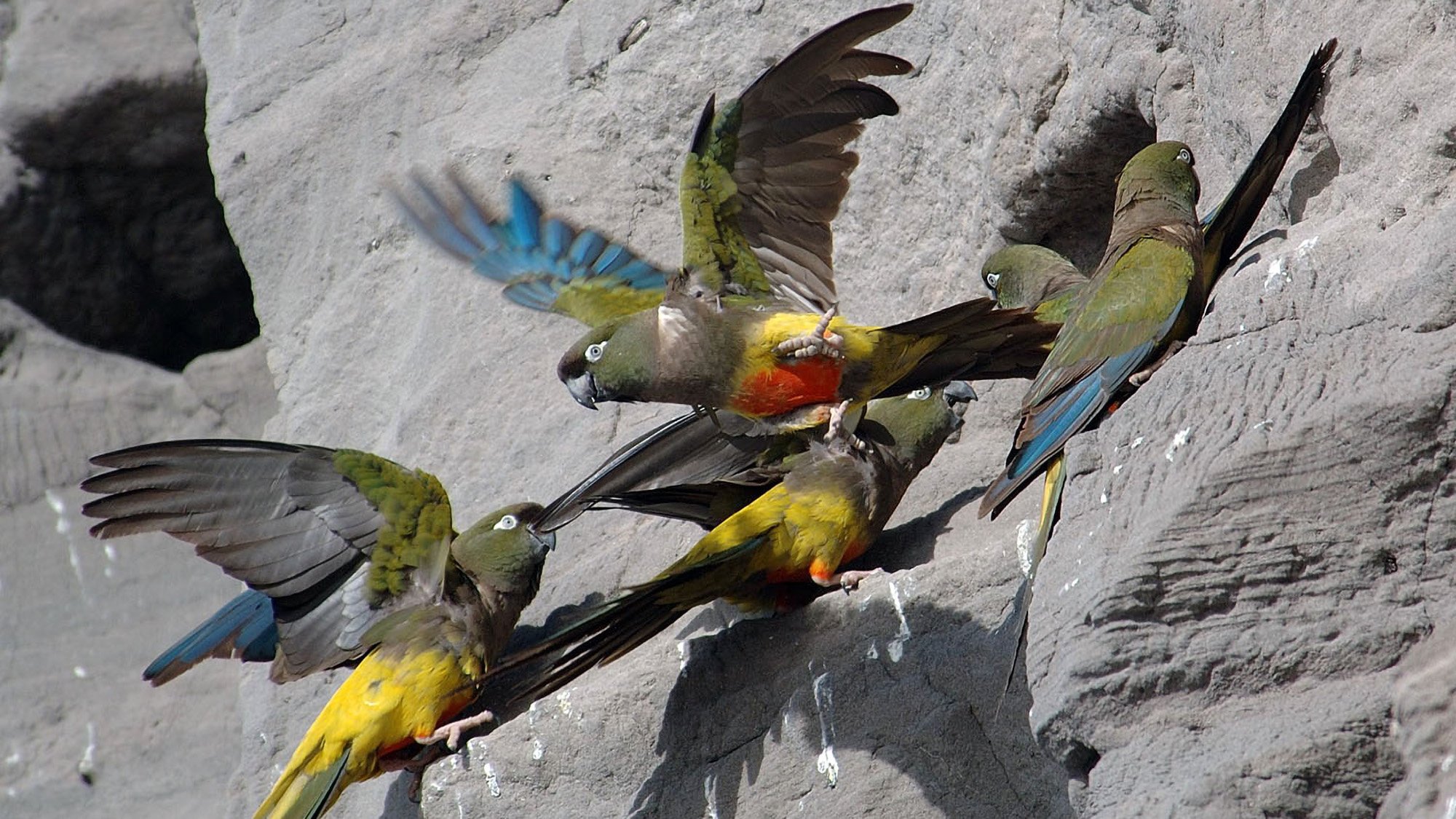
Easily recognizable by the olive-green plumage on their heads, blue tones in their wings, and yellowish and reddish tones on their bellies, the species, Cyanoliseus patagonus, are known as burrowing parrots because they excavate their nests in the ravines of rivers and streams or in cliffs facing the sea. “They can dig burrows up to 3 meters deep and always keep them clean. Even the older chicks help expand these nests,” says Mauricio Failla, a biologist who has been part of the Burrowing Parrot Project since 2001.
The long-studied colony is in the town of El Cóndor, near the estuary of the Río Negro in northeastern Argentinean Patagonia, and accounts for 71 percent of the breeding population of the species. C. patagonus was once abundant, with a wide range in Argentina and Chile, but its numbers began to decline in the mid-19th century due to habitat loss and degradation, capture for the pet trade, and targeting because they were considered crop pests.
The research at El Cóndor, led by Juan Masello and Petra Quillfeldt, a husband-wife team of biologists at the University of Giessen in Germany, started in 1998. Masello describes the exuberant, constantly calling colony as a riot of color and joy for life: “Seeing and hearing them fills my soul.” The species also has strong family bonds. The birds choose a single mate with whom they remain for life and collaborate in their parenting, with older chicks helping to feed their siblings.
Every year, during the nesting season of these migratory birds — which begins in August with nest preparation and culminates in December when the two to five new chicks per couple are ready to fly — scientists have monitored the nests. At first, they relied solely on photographs that were taken after reaching the site on foot or climbing up to it — “a logistical challenge,” says Masello, that’s possible only during low tide. Over the years, as new technology became available, scientists installed video cameras and could remotely monitor any nest activity. An artificial intelligence system now allows the researchers to count parrots in the images more quickly and accurately.
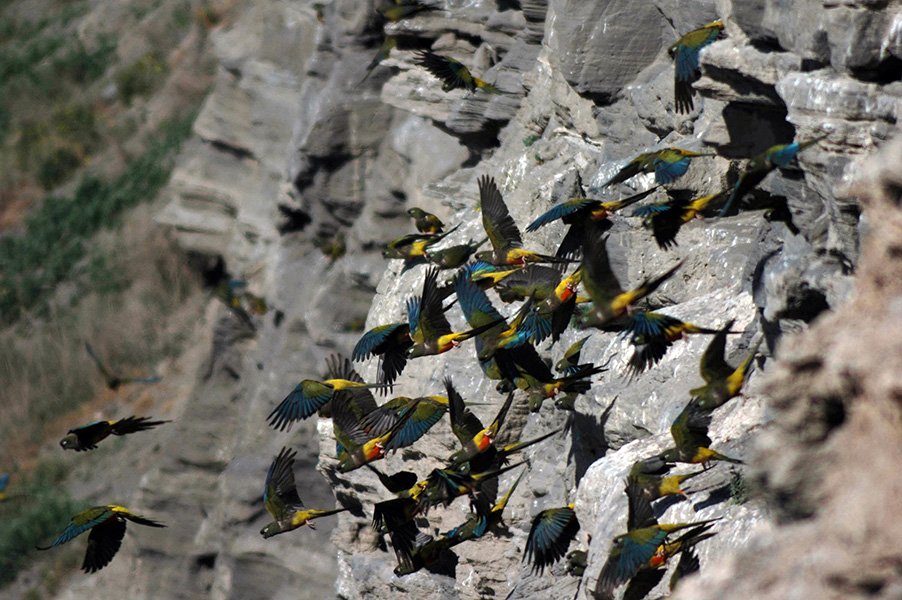
Through such monitoring, the scientists have found that the El Cóndor burrowing parrots experienced ups and downs. Not long after the study began, a period of severe drought came during the global La Niña weather phenomenon, and a lack of food hit the birds in that colony hard. The parrot population fell by 42 percent between 2001 and 2005 — from 37,531 active nests in 2001 to just 21,883 in 2005 — as detailed in a 2024 study inWildlife Biology.
But the parrots were able to recover. By 2019, researchers documented 40,671 active nests, the highest count recorded throughout the study. In addition, the colony expanded — growing from 9 to 18.1 kilometers (5.6 to 11 miles). The most densely populated area also shifted 5 kilometers (3 miles) to the west, probably due to human activities, the scientists note. The construction of buildings and parking lots, paragliding, and poaching for the pet trade caused the parrots to move to quieter areas.
Based on this research, the nature reserve became official in 2024, thanks to a proposal by the scientists, non-governmental organizations, neighbors and authorities in the region, followed by the approval of the City Council of Viedma, in Río Negro. However, two years in, a management plan — a crucial step — has yet to be implemented. “Without an adequate management plan, the erosion currently occurring in the eastern part of the colony could have even more serious consequences, such as landslides and a reduction in the number of nests,” says Masello.
Masello also worries about the deforestation of native forests, which is destroying the flocks’ feeding grounds and natural roosting sites, in southwestern Buenos Aires. The parrots fly up to 66 kilometers (41 miles) from the colony several times a day to reach that area. “Due to deforestation, the food they obtain is of lower quality, which could affect their ability to reproduce — an issue we are currently studying,” he says. With no native vegetation left where they can roost after their flights, the birds invade towns and farmlands in search of shelter, leading to conflicts with local farmers.
The future of burrowing parrots, then, depends on what happens along that short stretch of the Patagonian coast. But while he awaits a management plan for the reserve as well as measures to curb erosion, Masello draws great hope from the local community — who are passionate about the birds that he has dubbed the “guardians of El Cóndor.” If this squawking, family-loving, cliff-dwelling parrot can be safeguarded, Failla says, “we will be saving a colony that is unique in the world.”
Article translated by Debbie Ponchner
This article originally appeared in Knowable Magazine, a nonprofit publication dedicated to making scientific knowledge accessible to all. Sign up for Knowable Magazine’s newsletter.