
Humans have gambled and gamed for millennia. However, new evidence suggests the odds are good that our relationship with…well, odds probably dates back much further than many experts believed. Based on evidence recently detailed in the journal American Antiquity, Ice Age hunter-gatherers living on the western Great Plains toyed with dice and other probability tools over 12,000 years ago. For those keeping score, that’s more than 6,000 years earlier than similar artifacts found among the Bronze Age societies of present-day Europe, Africa, and Asia. What’s more, the people who most often played these games of chance likely aren’t who you imagine.
For decades, most archaeologists considered it a safe bet to assume humans first explored probability and randomness around 5,500 years ago. This theory primarily stems from the discovery of multisided dice and other similar objects at sites across the Middle East, India, Asia, and other locations in the so-called Old World, a.k.a. the world as Europeans understood it prior to their arrival in the Americas. While it’s nearly impossible to know their initial uses, activities like gambling and divination certainly paved the way for probabilistic thinking and other crucial mathematical theories.
“Historians have traditionally treated dice and probability as Old World innovations,” Colorado State University archaeologist and study co-author Robert Madden said in a statement.
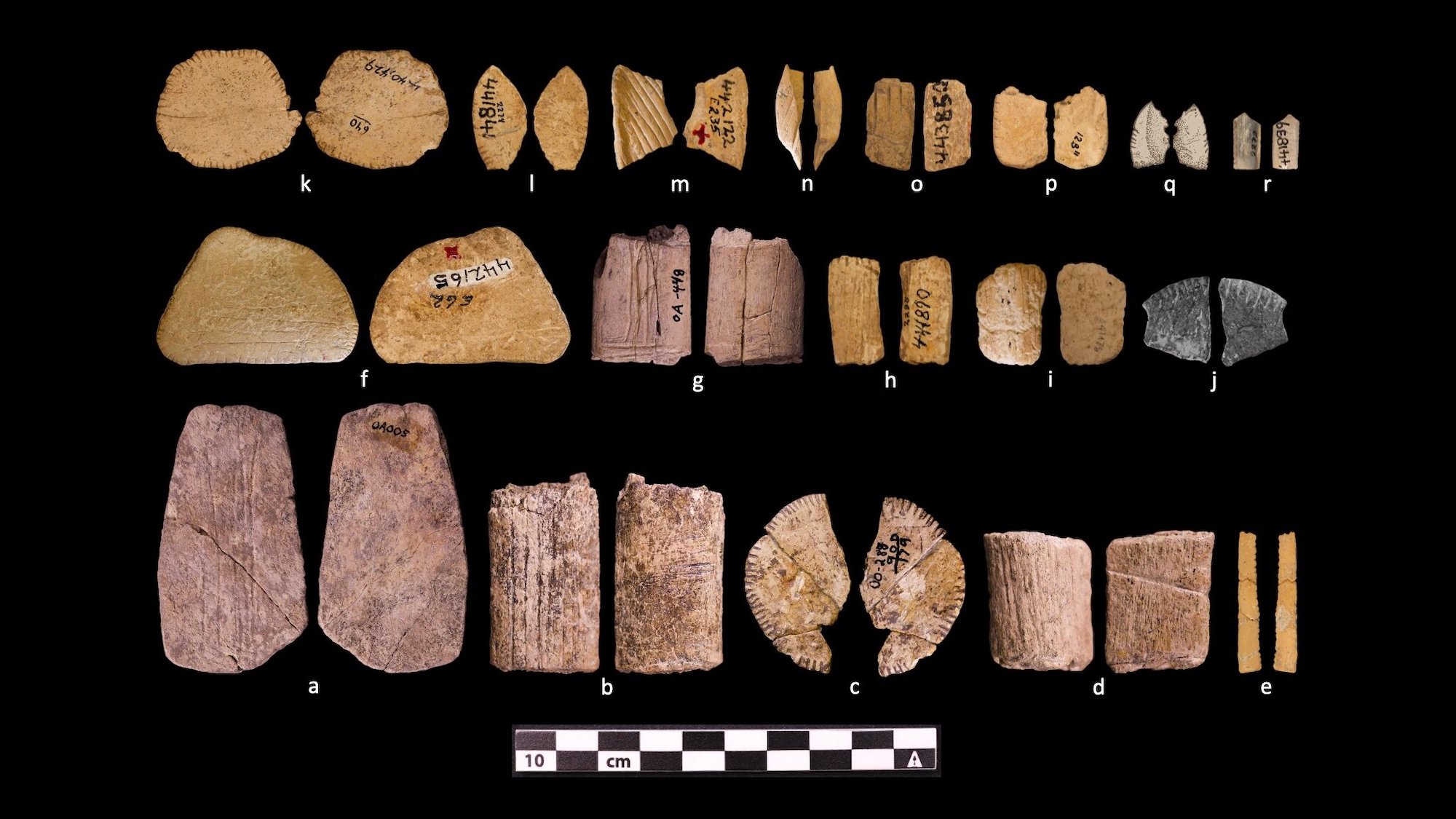
Madden and colleagues are now confident that significant timeline revisions are required—and the reasons have remained hidden in plain sight for over a century. In 1907, the ethnographer Stewart Culin published Games of the North American Indians, a major work analyzing 293 sets of historic Indigenous dice gathered throughout the continent. Using a newly designed systematic analysis of measurable physical characteristics, Madden’s team re-examined these and other artifacts previously given the broad designation of “gaming pieces.” In the end, the researchers flagged more than 600 dice items from 57 sites in 12 states across North America. These objects date as far back as the Late Pleistocene, all the way up to post-European contact.
“In most cases, these objects had already been excavated and published. What was missing wasn’t the evidence, it was a clear, continent-wide standard for recognizing what we were looking at,” explained Madden.
The earliest identifiable dice were crafted 12,800–12,200 years ago at sites in present-day Wyoming, New Mexico, and Colorado. Instead of today’s popular cubic dice, the items were flat, two-sided tools carved from small bones called binary lots. Each side of a lot featured visible modifications like markings or dye so that clear results could be determined from tossing groups of them onto a surface.
“They’re simple, elegant tools. But they’re also unmistakably purposeful,” said Madden. “These are not casual byproducts of bone working. They were made to generate random outcomes.”
Given the geographical scope of the finds, archaeologists argue that these and other probability tools were immensely important to multiple Indigenous cultures as long ago as the Late Pleistocene era. They were also used in far more instances than an idle way to pass the time.
“Games of chance and gambling created neutral, rule-governed spaces,” Madden said. “They allowed people from different groups to interact, exchange goods and information, form alliances, and manage uncertainty. In that sense, they functioned as powerful social technologies.”
The study’s authors also note that past ethnographic analysis suggests a much different demographic makeup than most of today’s gamblers. A review of 131 gaming accounts documenting gender dynamics revealed 81 percent were played solely by women, 12 percent played by both sexes, and only seven percent played by men alone.
“Additional research could shed light on whether this historical pattern extends into the prehistoric past, suggesting the possibility that women may have been leaders in the social and intellectual innovations associated with ancient Native American dice, games of chance, and gambling,” the latest study’s authors wrote.
