
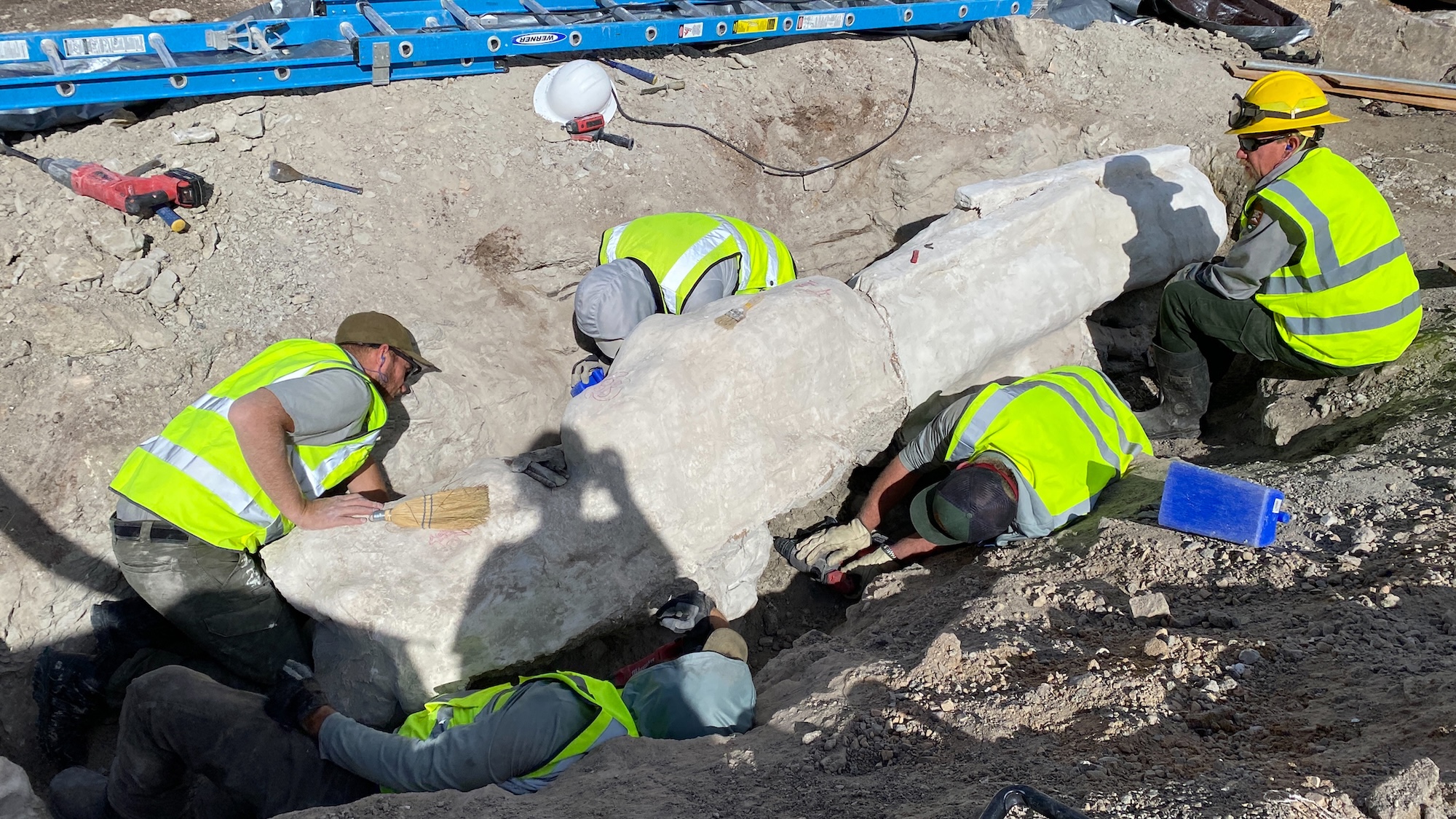
For a place named Dinosaur, it’s been a while since the small Colorado town revealed any actual fossils. But after a 101 year lull in discoveries, work was paused on a new parking lot near Dinosaur National Monument, after construction crews uncovered a section of unexpected sandstone. Park staff and paleontologists soon examined the find, and identified sauropod bones most likely belonging to Diplodocus—a massive, long-necked dinosaur from the Late Jurassic period.
Located on the Colorado-Utah border at the meeting of the Green and Yampa rivers, Dinosaur National Monument was established as a federally protected site in 1915. Its nearly 330 square miles of land encompasses over 800 separate paleontological sites dating back 150 million years to the Jurassic era. The Carnegie Museum oversaw the very first excavations from 1909 to 1922, followed by projects from the Smithsonian Museum and the University of Utah in 1923 and 1924.
The region is largely arid desert landscape today. However, over 150 million years ago, a vast river bed regularly received the remains of dinosaurs as they floated downstream. These bones slowly fossilized in the sandstone and conglomerate rock, resulting in one of the continent’s best preserved and diverse collections of ancient megafauna. Today, the nearby national monument offers visitors a glimpse at the range of species that once roamed North America such as Allosaurus, Deinonychus, and Stegosaurus.
After identifying the new Diplodocus bones in a parking lot, paleontologists worked with park staff, the Utah Conservation Corps, and local volunteers between September and October 2025 to remove around 3,000 pounds of rocks and fossils. The finds were then moved to the Natural History State Park Museum in Vernal, Utah, where they can be viewed in the institution’s public fossil preparation lab. Additional examples are already on display at the Dinosaur National Monument’s Quarry Exhibit Hall. Also known as the Wall of Bones, the exhibit hall is situated over an intact section of the original Carnegie quarry dig showcasing an estimated 1,500 dinosaur fossils still embedded in rock.
Researchers are now continuing to clean and examine the parking lot discoveries that broke the century-long dry spell for Dinosaur, Colorado. That said, the town wasn’t always so aptly named. Originally known as Baxter Springs, the location was eventually retitled Artesia during an oil rush in the 1940s oil boom. In 1966, the small hub finally received its current Dinosaur designation.
