
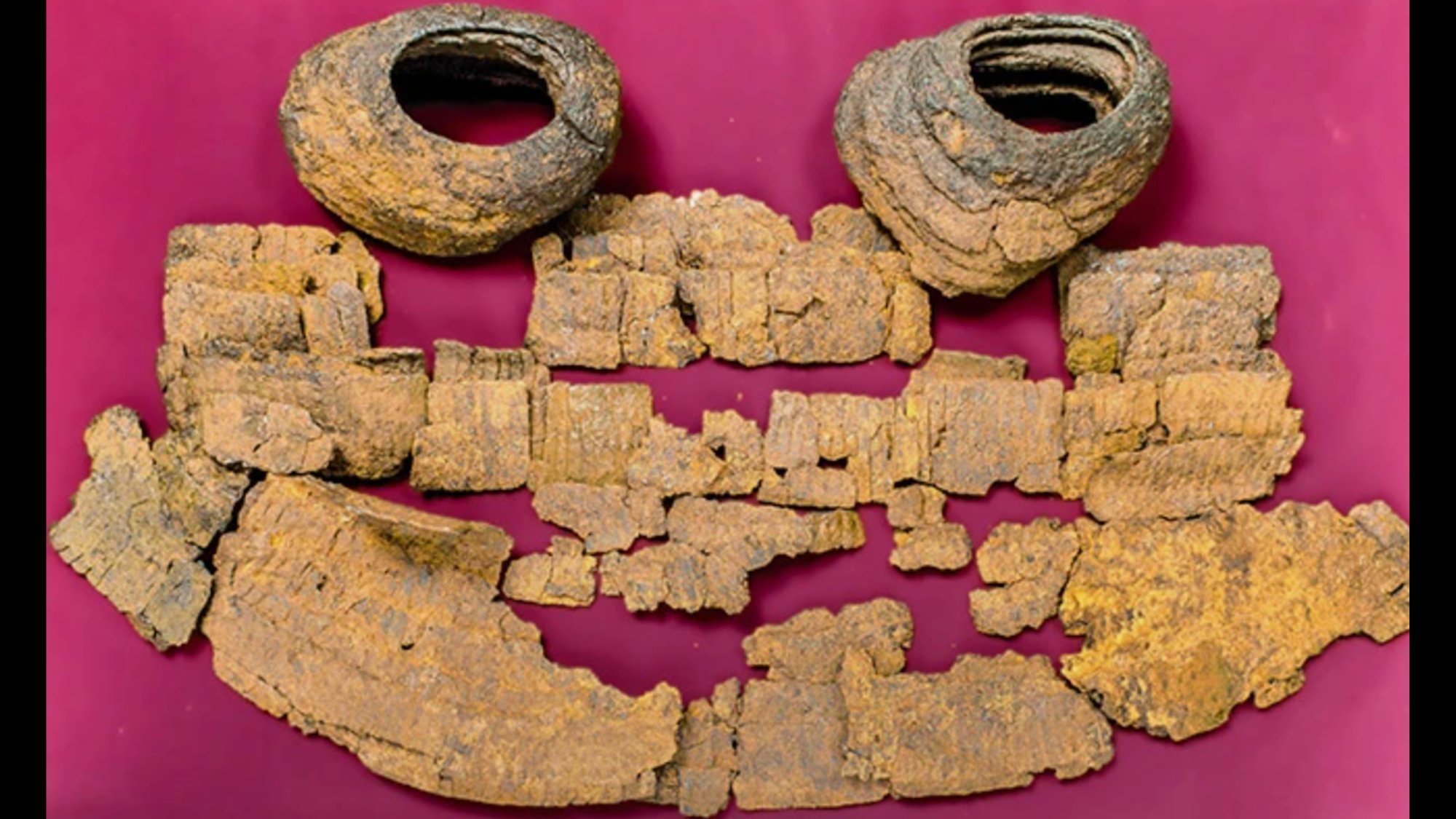
Few cultures exist in a vacuum, even those separated from others by hundreds of miles of open sea like the island nation of Japan. Nearly 70 years ago, archaeologists discovered an ancient suit of armor beneath one of the island nation’s most prominent historical sites. Now, researchers can finally trace the 1,400-year-old armor’s telltale artisanry back to Korea. Specifically, to the Baejke Kingdom—one of Korea’s three major empires dating back to the 18th century BCE.
Buddhism truly began to flourish in Japan beginning in the sixth century CE after monks arrived from mainland China and Korea. Few places represent this monumental cultural shift more than the Asuka-dera Temple complex, located about 23 miles southeast of Osaka.
Asuka-Dera’s establishment near the start of the seventh century marked the first full-scale Buddhist temple on the island archipelago.
According to ancient documents including the second-oldest history of Japan, Nihon Shoki, craftsmen and monks from the Baekje Kingdom helped build the temple complex. Baekje was one of the “Three Kingdoms of Korea” that flourished between the 18th century BCE and 660 CE.
Archaeologists from the Nara National Research Institute for Cultural Properties originally located the armor fragments beneath a pagoda’s foundation during 1957 excavation work. While its construction resembled armor previously linked to Baekje royal sites in Korea, technology at the time wasn’t advanced enough to supply a definitive answer.
In 2015, however, equipment like X-ray and 3D imaging finally allowed researchers to further examine the Asuka-dera armor. They discovered that, like Baekje armor, the Japanese monastery finds were crafted by interlacing small iron plates with cords into what’s known as a lamellar structure. This approach provided wearers with solid protection without sacrificing flexibility, especially because the torso, upper arm, and shoulder segments were all connected into a single shirt-like piece of armor.
Similar armor excavated between 2011 and 2014 at Gongsanseong Fortress, a historic Baekje compound located about 50 miles southeast of Seoul, also supports this. At the fortress, researchers identified inscriptions on the plating that date to 645 CE—around the exact same era as Asuka-Dera’s construction. In 2024, archaeologist Takehiro Hasumura confirmed the overlaps after examining the Gongsanseong specimens firsthand.
By the 7th century, elite Japanese warriors began to adopt keiko-style armor. Like the Baejke design, keiko armor consists of interwoven and flexible lamellar iron scales. Keiko’s adoption—along with its design—now makes it clearer than ever that Baekje artisans, specifically armorers, traveled alongside mainland Buddhist monks and emissaries.
With additional excavation projects, archaeologists hope to further contextualize other pivotal cultural exchanges between these and other East Asian kingdoms.
