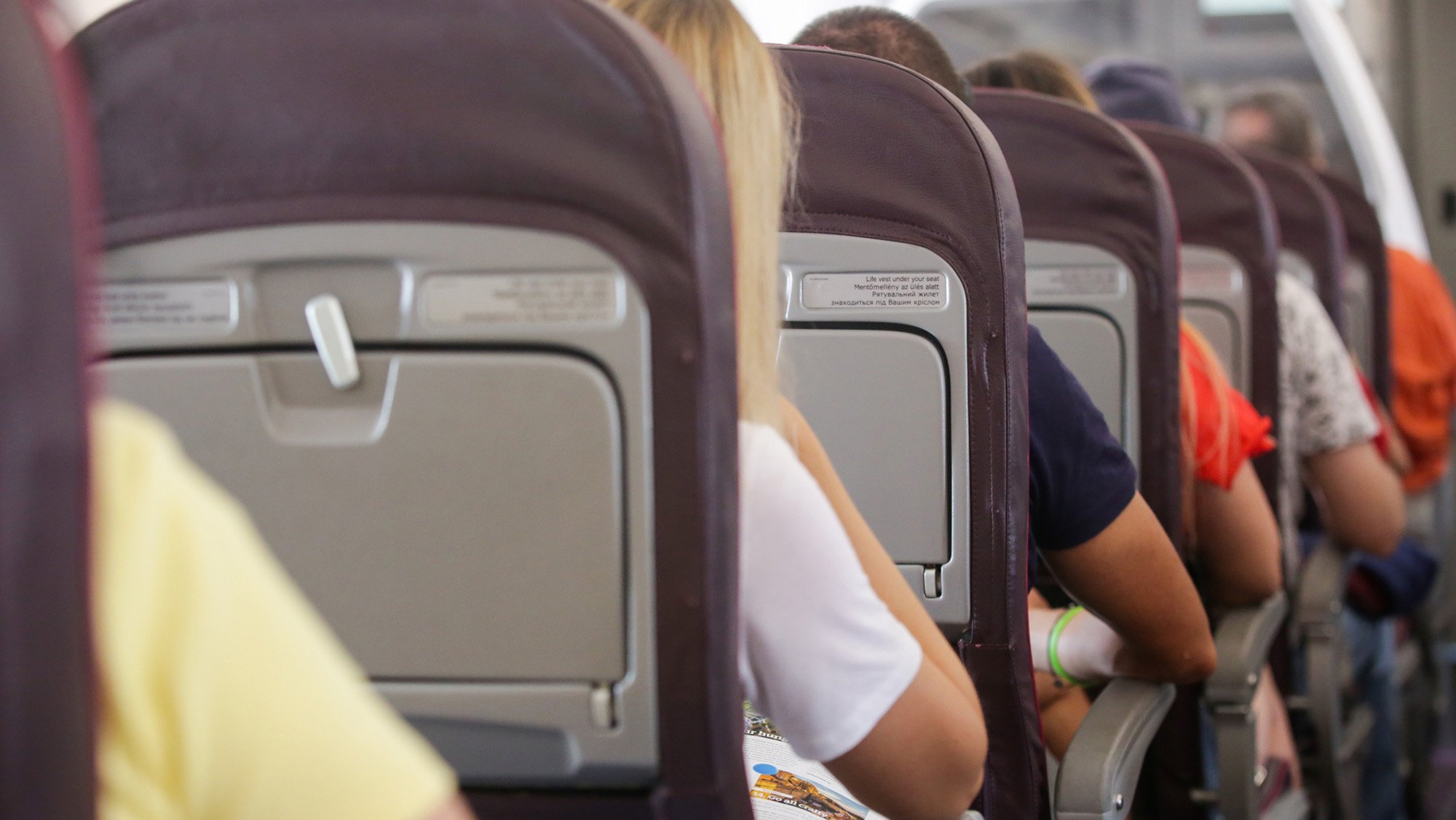
Airplane seats can feel ridiculously small. It’s gotten to the point where I, a small woman of average height, have trouble even reaching under the seat in front of me. But have airplane seats always been so dang squished? The short answer, which we explore in a new episode of Popular Science’s Ask Us Anything podcast, is a resounding no.
Ask Us Anything answers your most outlandish, mind-burning questions—from the everyday things you’ve always wondered to the bizarre things you never thought to ask. So, yes, there’s a reason why most people are right handed and no, not all cats hate water and that’s okay. If you have a question for us, send us a note. Nothing is too silly or simple.
This episode is based on the Popular Science article “Why are airline seats so small? It all started in 1978.”
Subscribe to Ask Us Anything
Listen and follow Ask Us Anything on your favorite podcast platform:
Spotify | Apple Podcasts | YouTube | Or wherever you get your podcasts.
Full Episode Transcript
Sarah Durn: You finally make it onto the plane. You shuffle down the aisle trying not to hit anyone with your roller bag and overflowing personal item. You find your row. You squeeze into your seat. Your knees are almost touching the seat in front of you. Your elbows are tucked in, and now you and the person next to you are silently battling over that one precious armrest.
You haven’t even taken off yet, and you’re already uncomfortable. You can’t help but wonder: Surely, planes haven’t always been so cramped? And you’re totally right. Airplane seats really have gotten smaller. So how did we get here? And why are we all squeezing ourselves into tinier and tinier spaces at 35,000 feet?
Welcome to Ask Us Anything from the editors of Popular Science, where we answer your questions about our weird world, from why are most people right-handed to why can’t we remember being babies? No question is too offbeat or mundane. I’m Sarah Durn, an editor at Popular Science.
Annie Colbert: Hello, I’m editor-in-chief, Annie Colbert.
SD: Here at PopSci, we’re always pondering quirky questions.
AC: And this week we’re wondering why are airplane seats so small. All right, Sarah, am I imagining things or were airplane seats actually bigger in the past?
SD: You are not imagining things. Experts say seats really have gotten smaller over the past several decades.
AC: I knew it.
SD: I know. Some major airlines have lost several inches of precious leg room compared to what passengers had in the late ’90s.
AC: All right. So what happened? Did airlines just wake up one day and decide, “You know what passengers would love? Less space.”
SD: Not exactly. The story actually starts with a huge change to the airline industry nearly 50 years ago.
AC: Ooh, historical twist.
SD: Exactly. Flying used to work very differently. Tickets were more expensive, airlines were regulated differently, and the entire experience looked nothing like it does today. Then everything changed.
AC: I’m guessing that change eventually led to my knees banging the seat in front of me.
SD: Yeah, it did. And here’s the other part, seats have been getting smaller at the same time passengers have also been getting larger.
AC: Hmm. That feels like a bad combination.
SD: Yeah, very bad. And some experts say this isn’t just about comfort. It could raise questions about passenger health and safety.
AC: All right. Now I’m intrigued.
But before we get to how flying went from spacious cabins to fighting over armrests, we wanna hear from you. What questions are taking off in your brain? If there’s something you’ve always wanted to know, submit your question by clicking the “Ask Us” link at popsci.com/ask.
SD: Send us your questions.
AC: Send them. All right. Coming up, we’ll look at how airplane seats started shrinking.
SD: And the nearly 50-year-old decision that changed the way we fly.
AC: That’s after this quick break.
SD: Welcome back. So Annie, before we get into the history here, I feel like we need to acknowledge that flying today can be a lot.
AC: Yes, it really can. And I will say from experience, flying with kids is a whole different level. I have a nine-year-old and a two-and-a-half-year-old, and traveling with them, it basically feels like packing up your entire house and trying to fit it into one tiny airplane row.
SD: Oh my gosh.
AC: You have snacks and toys and water bottles and jackets and stuffed animals, and whatever random object my toddler decided to pick up along the way that she had to bring. And then you get on the plane, and you’re like, “Wait, where is all this stuff actually gonna go?”
SD: Yeah. I can’t even imagine.
I don’t have kids, but I have flown a couple of times with my cat.
AC: Yeah. I mean, that feels like its own challenge.
SD: It is and was. Yeah, a lot of times your cat counts as your personal item, so then I have all these odds and ends I’ve tried to stick into my cat carrier’s very tiny little side pockets.
My cat is meowing at my feet. I’m trying to figure out where to put my jacket, and suddenly I’m just sitting there like, “Where do my feet go?” You know?
AC: I mean, who needs feet really?
SD: Apparently not airplane passengers. I had one particularly wild experience flying with my mom and sister in Europe. We were running late to a connection after our original flight was oversold.
We finally get to the plane and, of course, the overhead bins are full, and mind you, we all have carry-on suitcases with the, you know, rolling wheels and massive personal items.
AC: Oh no.
SD: And the flight attendants told us to just put our rolling suitcases under the seat in front of us.
AC: Wait, your actual rolling suitcases?
SD: Our actual rolling suitcases. So the whole flight we had our feet sitting on top of our luggage because there was literally nowhere else for anything to go. Sounds horrible, but also a safety hazard. I honestly don’t even know how they allowed it. It was one of the most uncomfortable flights I’ve ever been on.
But I think everyone has some version of that moment where they sit down and think, “Was flying always this cramped?”
AC: Okay, so that’s the big question. Were airplane seats actually bigger in the past?
SD: It’s not just in your head. According to experts interviewed by Popular Science, airplane seats and leg room really have shrunk over the past several decades.
AC: How much are we talking?
SD: So William McGee, a senior fellow for the American Economic Liberties Project, has tracked seat sizes for years, and McGee says major US carriers like American, Delta, Southwest, and United have lost somewhere between two and five inches of leg room since the 1980s. They’ve also lost around two inches of seat width.
AC: Okay, that’s a lot.
SD: It really is. Today, the average leg room on those airlines is about 31 inches. Back in the late ’90s, it was closer to 35 inches. That’s more than even some economy premium seats today. And on some budget airlines, seats can be even smaller, around 28 inches of leg room.
AC: So what happened? Because flying used to have this reputation of being glamorous. You see these old pictures of people dressed up on planes.
SD: Totally. Flying used to be a very, very different experience, and to understand how we got from there to fighting over armrests, we have to go back to 1978.
AC: The plot thickens.
SD: Indeed. So before 1978, the airline industry was heavily regulated. The government controlled things like which airlines could fly which routes and how much tickets cost. Flying was basically seen by the government as a utility.
On average, flying was more expensive, but passengers got a lot included in that price, things like checked bags, meals, and much more space.
AC: Mm. So what changed?
SD: So in 1978, Congress passed the Airline Deregulation Act. The idea was that if the government stepped back, more airlines could enter the market, there would be more competition, and ticket prices would go down. And at first, that did happen.
AC: So more people could afford to fly.
SD: Exactly, and this is, this is a really important part of the story.
Air travel became way more accessible to way more people. But over time, the industry changed again. There was a wave of consolidation, and today, the biggest airlines dominate most of the U.S. market.
AC: And somewhere along the way, the seats started shrinking.
SD: Exactly. Airlines realized that if they could fit more seats onto each plane, they could sell more tickets. More passengers per flight means more revenue.
AC: Which makes sense from a business perspective.
SD: Totally. And airlines would argue that these changes helped keep basic fares cheaper, but the trade-off is that passengers have way less space.
AC: And at the same time, humans have changed too, right?
SD: Exactly. Seats have gotten smaller at the same time that Americans, on average, have gotten larger.
According to the CDC, the average U.S. adult weighs about 15 pounds more than they did 30 years ago. People have also gotten slightly taller, though those increases have leveled off more recently.
AC: So people are getting bigger.
SD: And the seats are getting smaller.
AC: Not ideal.
SD: Not ideal. Paul Hudson, the president of the passenger rights organization Flyers Rights, told Popular Science that what’s unusual is that most other seating has adjusted over time.
Movie theater seats, car seats, other venues. Those seats have generally gotten bigger, but airplane seats have gone the opposite direction.
AC: Okay, but there are rules about this? Like, is there a minimum size an airplane seat has to be?
SD: Surprisingly, no. The FAA does not currently set minimum seat requirements.
AC: Really?
SD: I know. It’s kinda shocking. The FAA could set minimum seat dimensions if it determined that smaller seats created safety risks, but so far the agency has said no new rules are necessary for passenger safety.
AC: I’m guessing not everyone agrees with that.
SD: You guessed correctly. Some passenger advocates argue that smaller seats are not just uncomfortable, they could be dangerous.
AC: Like how?
SD: One major concern is health. On long flights, sitting still in cramped conditions can increase the risk of blood clots for some passengers. The CDC recommends getting up and moving around every couple hours on longer trips.
AC: Which is sometimes easier said than done.
SD: Right. If the seatbelt sign is on for turbulence or you’re stuck in the window seat and two people next to you are asleep.
AC: Ah, yes, the classic airplane dilemma.
SD: Exactly. The other big concern is emergency evacuations. FAA rules say a full airplane needs to be able to evacuate within 90 seconds.
AC: That sounds very fast.
SD: It is very fast, and some experts worry that smaller seats, fuller flights, more carry-on luggage, and changing passenger demographics could make that harder.
AC: But has the FAA tested this?
SD: They have. The FAA conducted evacuation testing and concluded that seat size and spacing did not negatively affect emergency evacuations.
AC: Hmm.
SD: Right. But critics have pushed back on those tests.
AC: Mm-hmm.
SD: For example, Paul Hudson from Flyers Rights, who actually observed one simulation, argued that the testing didn’t fully reflect real-world flying.
He pointed out that it didn’t include children, older passengers, or people with physical disabilities. The testing also didn’t happen on an actual plane, but in a parking lot with seats set up.
AC: Those feel like very large blind spots. I’m thinking of tiny toddler legs, and they do not move quickly. Plus, you think of the stress of an actual emergency, and, ugh, it’s very scary to think about.
SD: Yeah, very scary, and for now it doesn’t look like airplane seats are going to get suddenly bigger.
AC: So what can people actually do, besides magically getting upgraded to first class?
SD: Right, if only. Experts say if you can afford extra leg room on longer flights, it can be worth considering. And especially on long flights, try to move around when you can.
Hudson from Flyers Rights actually said he gets up whenever someone else in his row does, even if he doesn’t need to, because you don’t always know when you’ll get another chance.
AC: I mean, good advice.
SD: Right? And maybe my personal advice: Be very thankful whenever the overhead bins have room…
AC: because otherwise…
SD: you might end up using your suitcase as a footrest.
AC: The world’s least comfortable ottoman.
SD: Least comfortable.
If you wanna read more about why airplane seats have gotten smaller, check out our full story on Popular Science. We’ll link it in the show notes.
AC: And with that, we’ll be right back after this quick break.
SD: When we come back, we’ll answer another airplane mystery: Why do we still have to use airplane mode when we fly?
Welcome back. So, Annie, we all know how flying goes. You sit down, you buckle your seatbelt, you’re ready for takeoff, and then you hear, ding, “Please switch your devices to airplane mode.”
AC: Of course, very familiar. But do we really need to be switching our phones to airplane mode? Are we gonna bring down an entire jet if we accidentally get a call?
SD: Yeah, so the short answer is no. At least on modern airplanes, experts say the chance of your phone interfering with navigation equipment is extremely, extremely low.
AC: Mm.
SD: Like, basically non-existent.
AC: Got it.
SD: But the original concern actually goes back decades.
AC: Of course it does. Another airplane history lesson. Let’s hear it.
SD: I know. There is a lot of aviation lore in this episode. But back in the 1960s, before iPhones and Walkmans, the only way to actually listen to something on a plane was on a little portable FM radio, and there was a real concern with those radios interfering with airplane communication systems.
And that made more sense because those signals use very similar frequencies, but today’s cellphones use completely different frequencies.
AC: Then what is my phone actually doing when I put it into airplane mode?
SD: Basically, it stops your phone from constantly communicating with cell towers. Normally, your phone sends and receives signals using something called radio frequency energy, or RF energy.
RF energy isn’t as powerful as things like X-rays or UV rays from the sun, but this is what allows our phones to actually make calls. When it comes to flying, the rule is mostly a precaution. There’s very, very little chance that your phone could actually interfere with the plane’s communication system.
AC: Great. Well, that’s a relief because I feel like I’ve definitely forgotten to turn on airplane mode on a flight before.
SD: Same, all the time.
AC: Yes.
SD: Sorry, United. But even though the danger is basically next to zero, there’s another reason people have suggested keeping airplane mode around. Okay, imagine this. You’re stuck in one of those tiny airplane seats we just talked about, and now imagine everyone around you taking phone calls for six hours.
AC: Absolutely not.
SD: Right. The safety concern might be smaller today, but the do we really want an entire plane of people talking on the phone? That concern?
AC: Still very real.
SD: Very, very real.
AC: Honestly, airplane mode might be protecting all of us after all.
SD: Just maybe not in the way we originally thought.
AC: And that’s it for this episode. But don’t worry, we’ve got more episodes of Ask Us Anything live in our feed right now. Follow us or subscribe to Ask Us Anything by Popular Science wherever you enjoy your podcasts. And if you like our show, leave a rating and a review.
SD: Our producer is Alan Haburchak. This week’s episode was based on stories written for Popular Science by Mack DeGeurin and Tom Hawking.
AC: Thank you, team, and thank you everyone for listening.
SD: And one more time, if you want something you’ve always wondered about explained on a future episode, go to popsci.com/ask and click the “Ask Us” link.
AC: Keep the questions coming.
SD: Until next time, may your flight be smooth.
AC: Your middle seat stay empty.
SD: And your leg room be plentiful.
AC: Whoosh.
SD: Oh, that was good, Annie
AC: Thank you. These are airplane takeoff sounds, everyone.
SD: I know. I like that we, uh, both started using the hand to, like, help that.
AC: Oh, that really helps.
SD: Yeah, you can’t, you can’t make the noise without the visualization of the hand. It doesn’t work.