
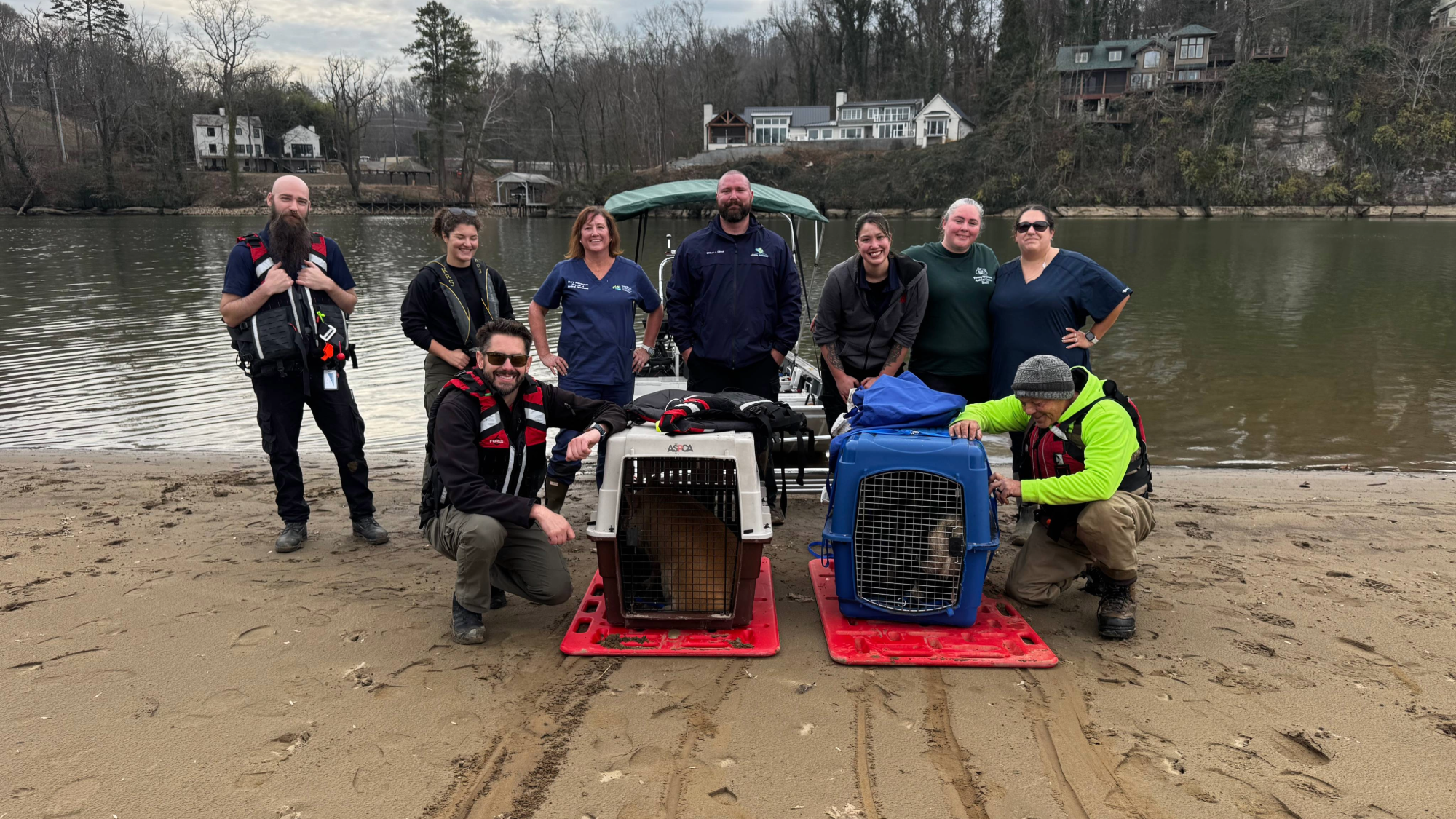
A team from the Young-Williams Animal Center in Knoxville recently rescued two pigs stranded on a group of islands in the Tennessee River. After receiving multiple calls about the animals that appeared to be abandoned on Looney Islands, the team worked with the Knoxville Fire Department and Knox County Rescue to get to the islands.
After some searching, the two pigs were found together and rescued thanks to a bit of patience and the team’s “pig whisperer.” This pig whisperer is Mary Nussbaum, the Young-Williams Animal Center’s Director of Medical Operations. Nussbaum has over 30 years of experience in veterinary medicine, including working at the University of Tennessee College of Veterinary Medicine and its Veterinary Medical Center.
“She also is passionate about the care and protection of animals. Since the pigs were stranded on Looney Islands in January, available food resources were scarce, and the rescue team was able to lure the pigs with a whole lot of patience and several snacks,” Janet Testerman, CEO of the Young-Williams Animal Center tells Popular Science. “As soon as Mary started offering them food, they approached and were comfortable coming to her.”

The pigs were brought back to the rescue center and received a medical evaluation. As of now, it is not clear how they made it to the islands. If an owner comes forward to reclaim the pigs, Young-Williams will inquire further. If no one claims ownership, the duo will be made available for adoption.
The municipal no-kill shelter takes in over 10,000 animals every year, primarily stray cats and dogs. “But we also see our share of roosters, chickens, rabbits, hamsters, gerbils, snakes, turtles, and pigs,” says Testerman.

The two-year-old facility accepts animals no matter the severity of sickness or injury and is considered a “no-kill” shelter. According to the Animal Human Society, in order to be considered a no-kill, a shelter or rescue must have an at least a 90 percent animal placement rate.
“The story of the pigs is but one of thousands of calls we have responded to in less than two years that have led to better options for the community and our animals,” says Testerman.
