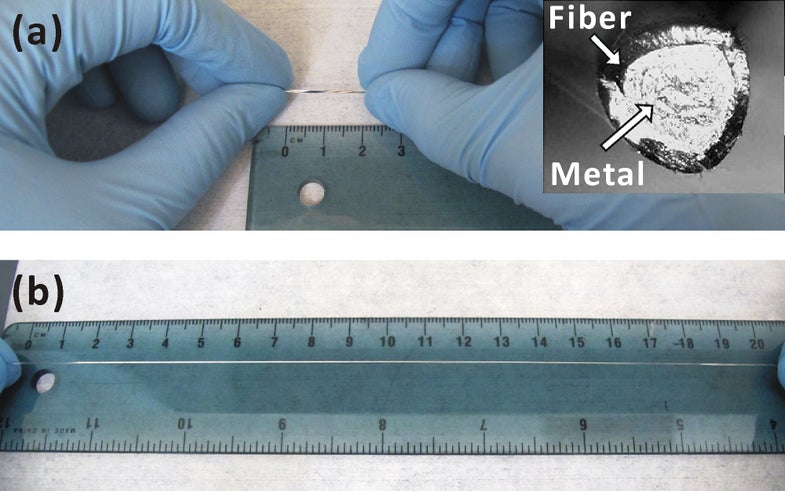
At some point soon, we'll have wireless everything--wireless charging, wireless syncing, wireless video, wireless audio. We've already got a lot of that stuff, in fact. But today, we still need wires and cables, and a new creation from researchers at North Carolina State University could make them much more usable--by making them stretchy.
The basic construction of the new super-stretchy wires is an elastic tube filled with a highly conductive liquid metal alloy. Other attempts at stretchy wires, say the researchers, have relied on embedding conductivity into elastic, as opposed to separating them. The wires can be stretched up to eight times their original length, which is pretty amazing--an order of magnitude more stretchy than existing stretchy wires.
The paper appears in Advanced Functional Materials.
[NCSU]
Five amazing, clean technologies that will set us free, in this month's energy-focused issue. Also: how to build a better bomb detector, the robotic toys that are raising your children, a human catapult, the world's smallest arcade, and much more.


Online Content Director: Suzanne LaBarre | Email
Senior Editor: Paul Adams | Email
Associate Editor: Dan Nosowitz | Email
Assistant Editor: Colin Lecher | Email
Assistant Editor: Rose Pastore | Email
Contributing Writers:
Rebecca Boyle | Email
Kelsey D. Atherton | Email
Francie Diep | Email
Shaunacy Ferro | Email
Feel free to destroy me on this one, but I have a decent background in circuits. Wouldn't this change in length affect the intended signal? Even if the metal had an insane conductivity. This is almost acting as a strain gauge, the cross sectional area of the wire will be decreasing and the length the signal has to travel will be increasing. I dont see a problem with charging, but for head phones...I dont know.
@hbbartos, it would change the circuit, yes, but you'd need either an oscilloscope or REALLY good ears in order to tell the difference. my shtick about them is if they get kinked somewhere since the conductive part is liquid it would cut off signal entirely. say what you will but few things survive the college kid's book bag without becoming a jumbled mess.
to mars or bust!
I thought current flow was dependent upon conductivity surface area of the wire. Stretch the wire and the wire gets thinner, so would it allow less current to flow through on it?
I suppose it is useful in some micro circuit applications.
I know wireless is all the rage, but I try to avoid wireless connections whenever possible. They are just too flaky. And having a wired connection is always faster. As we have more and more wireless communication going on all the time, isn't interference going to become more of a problem?
I think the idea is that they are somewhat self-healing. A kink, tug, or metal fatigue will not destroy them as easily as one made with copper wire.
@ghost What stops someone from simply untangling the cord as they do with earbud and such now? Am I missing something?
@Robot
You are sort of right. Resistance is largely depend on material properties and cross section area. However the actual current involves in head phone wires and trickle chargers is very small; the wire could be designed such that it can carry the current when at maximum length and minimum cross section.
The implications for prostetics are pretty amazing.
This brings the adult entertainment industry to a whole other level.