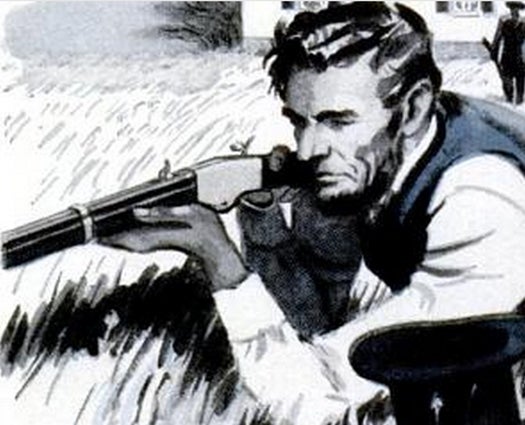
In between shots of soldiers meeting their brutal end and Sally Field being the most perfect Mary Todd Lincoln of all time (besides maybe MTL herself), the trailer for Steven Spielberg's Lincoln, a war drama in theaters everywhere November 16, presents Honest Abe as an honest badass. "I am the President of the United States of America...clothed in immense power," he declares, because if you're going to abolish slavery you have to be the toughest dude in the room. In our 1957 issue, PopSci celebrated Lincoln as the awesome war scientist he was. We wrote about how the great emancipator tested out and helped create at least a rudimentary form of most of the weapons we knew in the mid-20th century.
Lincoln's crowning achievement in the history books is the Emancipation Proclamation--even though the executive order didn't actually make slavery illegal or give slaves any rights. The fact remains that Lincoln won the Civil War and kept the union together, and catalyzed the dissolve of slavery.
It wasn't just dumb luck. Lincoln took his title of commander-in-chief seriously, helping develop modern weapons to give the North a fighting chance. The president was really into inventors. He talked to them, encouraged them, and tried out their weapons until they produced the desired result. During the war, Lincoln's government issued 16,000 patents while the South only issued 266.
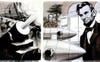
See Lincoln hanging out with these cool weapons? The president knew a thing or two about tinkering and technology because of his log cabin background. Growing up in the backwoods primes you for being creative with tools. That's why Lincoln was down to whittle gunsights for Spencer Carbines, a long-range gun, and test them to see how useful they would be for soldiers. On the right side of the above image, Lincoln turns a crank on a machine gun that he calls the coffee-mill gun. The Union used this weapon in 1862 against the southern cavalry, who totally forfeited the game and ran away.
Read the full article, How Lincoln Modernized The Science Of War.
Five amazing, clean technologies that will set us free, in this month's energy-focused issue. Also: how to build a better bomb detector, the robotic toys that are raising your children, a human catapult, the world's smallest arcade, and much more.


Online Content Director: Suzanne LaBarre | Email
Senior Editor: Paul Adams | Email
Associate Editor: Dan Nosowitz | Email
Assistant Editor: Colin Lecher | Email
Assistant Editor: Rose Pastore | Email
Contributing Writers:
Rebecca Boyle | Email
Kelsey D. Atherton | Email
Francie Diep | Email
Shaunacy Ferro | Email
Who knew all this other stuff about President Abraham Lincoln, WoWzers. Nice repost of an old article from PoPSCi. I enjoyed and will search more about the President online!
Damn right, Lincoln was a badass. He didn't wait for the approval of Congress to go to war (a first for a US president). He just did it. Then he went before congress and said, "yeah I totally exceeded my authority, you got a problem with that?" He ate generals for breakfast too. He fired six over the course of the civil war for lack of "badassery". "My way or the highway, bitches" Then he used his war powers to free 3.1 million slaves. "So you rebels like to keep slaves, huh? Where are your slaves now?"
The Agar Gun, or the "coffee-mill gun" didn't see much use, sadly. However, it was a nice precursor to the Gatling Guns.
___________________________________________
We progress only at the rate of the slowest
@Democedes, the Senate, meeting in special session called by outgoing President Buchanan in March 1861 authorized the calling up of troops. Indeed, on the 28th of March 1861, the Senate: "Resolved, That, in the opinion of the Senate, the true way to preserve the Union is to enforce the laws of the Union; that resistance to their enforcement, whether under the name of anti-coercion or any other name, is encouragement to disunion, and that it is the duty of the President to use all the means in his power to hold and protect the public property of the United States, and enforce the laws thereof, as well in the States of South Carolina, Georgia, Florida, Mississippi, Alabama, Louisiana, and Texas, as within the other States of the Union."
http://memory.loc.gov/cgi-bin/query/r?ammem/hlaw:@field%28DOCID+@lit%28sj05289%29%29:
This was before the attack on Fort Sumter and only 24 days after President Lincoln was sworn into office. In another special session in July 1861--called after the attack on Fort Sumter--passed a number of bills in support of the war effort, including the Suppression of the Rebellion Act, which was implicitly, if not explicitly a declaration of war on the Confederacy.
So, to say that Lincoln acted unilaterally, without the permission of Congress, is to ignore the historical record.
Abraham Lincoln Vampire Hunter, it explains everything!
Cookiees453,
WoWzers, now your comment is really going off on a tangent and I should know, lol.... Snort.
Soldier-Cynic
I'm not saying Lincoln acted unilaterally. I am saying he exceeded his authority as president. Congress was not in session at the time. He did what he did out of necessity and with full expectation that congress would authorize his actions after the fact.
"These measures, whether strictly legal or not, were ventured upon under what appeared to be a popular demand and a public necessity, trusting then, as now, that Congress would readily ratify them." Abraham Lincoln, addressing congress, July 4, 1861.
Probably the number one invention Lincoln supported was the use of hot air balloons for observation--sad to say the generals would have none of it.
Stan
Slavery didn't end, it just went from skin color to economic condition and prison labor.