Scientists Discover An Exoplanet So Massive They’re Not Even Sure It’s A Planet
Kappa And b could be a super-Jupiter, or it could be a brown dwarf--the exoplanet orbiting a nearby star is so big scientists aren't quite sure what to call it.
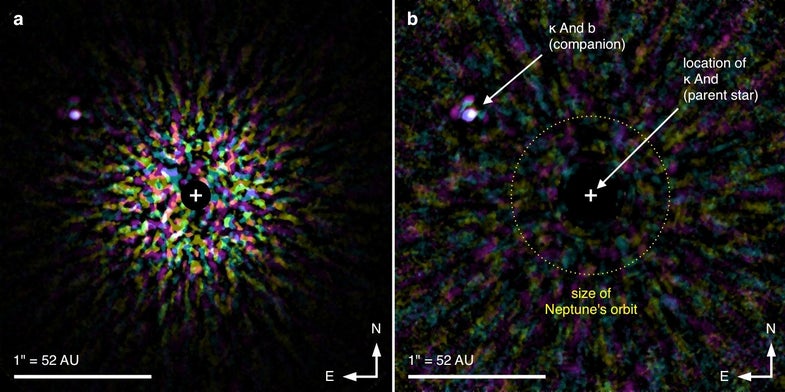
You know we’ve found something new and interesting when scientists don’t really know how to classify it. Using the Subaru Telescope an international team of astronomers has discovered a “super-Jupiter” so massive that it seems they’re not quite sure whether to call it a planet or a low-mass brown dwarf (in other words, a star that failed to fire). Located roughly 170 light-years from Earth, the host star is roughly 2.5 times more massive than the sun and its planet is about 13 times larger than Jupiter, making this the highest-mass star to ever host a directly imaged orbital companion–especially one of this size.
Kappa Andromedae is part of what’s known as the Columba stellar moving group, and at just 30 million years old it is relatively young (our Sun is estimated to be more like five billion hears old). That’s significant if only for the mode of discovery–young stars are good targets for directly imaging exoplanets because their planets (also young) tend to retain more heat leftover from the formation process and thus reveal themselves more readily via infrared emissions. That’s how the researchers were able to zero in on Kappa And b, the super-Jupiter orbiting Kappa Andromedae at a distance about 1.8 times Neptune’s distance from the Sun, over the glare of its host star.
All of this is scientifically significant because according to the way we understand both star formation and planetary formation there are parameters that determine whether objects of certain masses can do certain things, and both Kappa Andromedae and its orbiting super-object sit at interesting places within these parameters. In theory, Kappa And b probably falls just shy of being massive enough to trigger internal fusion–it is right on the brink of potentially becoming a star (hence the speculation that it might be better classified as a brown dwarf).
And as for Kappa Andromedae, its 2.5 solar masses demonstrate that stars its size are capable of producing these huge orbiting bodies–super-planets relative to those found in our solar system–in their planetary discs. That’s something that some theorists thought impossible due to the massive amount of radiation these stars put off (the idea is that this radiation would interfere with the normal planet formation process that takes place around smaller stars like the Sun).
So the strange case of Kappa Andromedae and super-Jupiter Kappa And b gives astronomers some things to think about. The team that discovered it plans to keep the Subaru Telescope trained on it for awhile to better defines the planet’s chemistry and orbital characteristics, which will further their understanding of exactly what is going on over there.