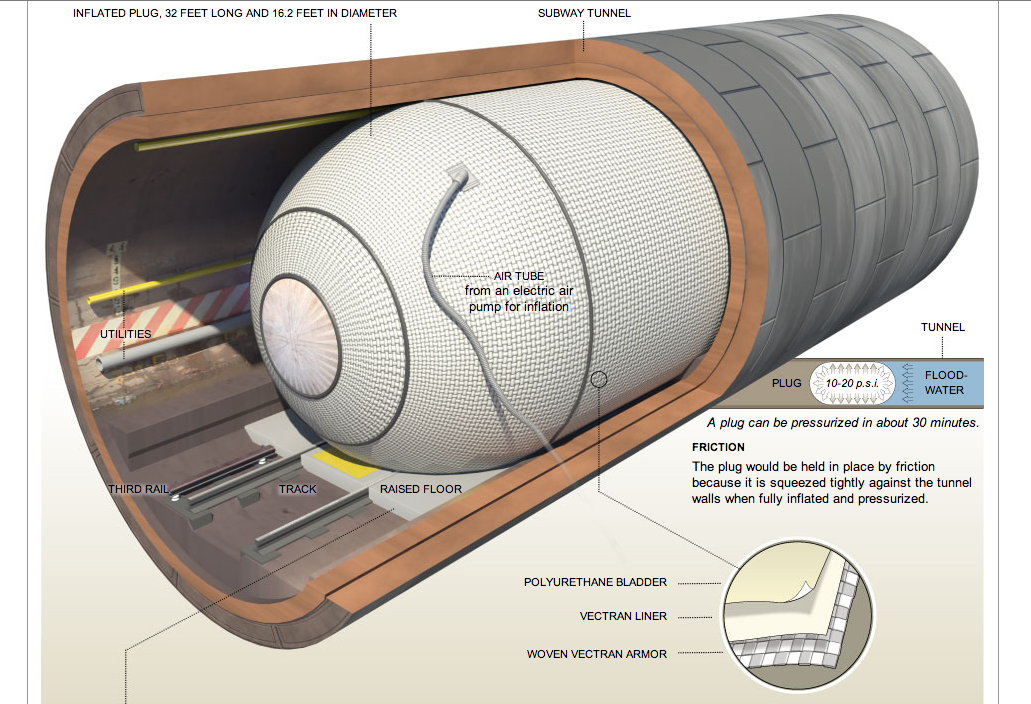
How It Works: An Inflatable Tunnel Plug MIKA GRÖNDAHL/New York Times

When Hurricane Sandy struck New York City a few weeks ago, seven of the 14 under-river subway tunnels flooded as a result of the storm surge, halting operation of some subway lines for more than a week. One possible future safeguard for this kind of disaster: huge, inflatable tunnel plugs. At the University of West Virginia, researchers working with the Department of Homeland Security are testing a massive balloon made of high strength material that could potentially be used to plug subway tunnels during future calamities--be they weather- or terrorism-related--keeping water out and important infrastructure functional. Catch a video of this technology inflating over at the NYT.

[NYT]

9 Comments

Great idea! Of a supple enough external component it would seal around all perturbations in the tunnel, long enough and it would provide enough friction to hold it in place against nearly any mass of water.

Great idea!

@ shutterpod; No, I think they'll be playing it safe with these, and placing in areas where they get maximum blockage, which tends to correspond with places where you don't have to hold back as much water. Near main access.

lnwolf41
Actually saw a video of this on youtube several months ago if not longer. ie before sandy, a combination of both water and air. water to give it weight and the air to provide the actual inflation.

wouldn't need weight given enough surface area for friction.

At first glance, this seems to be a good idea; however, I know why it will NOT work.

This kind of simple "solution" is something a child would conceive of, but the world is never as simple as it would seem; there are a lot of built-in roadblocks from this being a viable solution, mainly because the system is not a self-contained environment.

There are penetrations in the tunnels & ancillary facilities in the system that provide ingress/egress to humans and supply air, electricity and communications. The smaller penetrations are supposed to be sealed, but not the supplied-air/exhaust system, or the human-access parts. If these expensive subterranean blimps are developed and deployed, they will likely only be known for trapping water within the tunnels and as a waste of money.

Bottom line: You cannot overcome mother nature.

"Condemnation without investigation is the highest form of ignorance"
~Albert Einstein

I think inflatables could be made with frames for the different types of entry-egress routes of the subways, but they'd have to work by pressing the frame outward when compressed. You'd have what? 6 or 7 types of balloons? The lower access points are supposed to be designed for flooding, correct? Since day one?

Do you suggest to just roll over and die?

This should work fine as a 'perfect' seal is unneccesary. These tunnels all have pumps already so the idea is to slow down the water flowing in to where it can be matched by water being pumped out. Losing ground slowly enough that after a long storm the water is only a couple of feet deep at the lowest points would be a huge improvement.

There are two solutions:

(1) Make the tunnels impermiable - so that they can be closed and sealed such that even a surface flood cannot penetrate inside of them. At which point, inflatables like these would serve as critical safeties to seperate sections in case of a regional failure (making the failure limited, rather than system wide).

(2) Make the tunnels water tollerant and able to be pumped quickly from gravity filled basins. Then the system can be allowed to submerge, drained, then washed down clean in short order.

The first option would cost billions, be rife with failures, but would swiftly restore service.

The second option would cost much less up front, cost more after each storm (water and personal to wash down the system), and take longer to restore service.

Considering the current state of the system, option 2 seems like the wiser path.


June 2013: American Energy Independence

Five amazing, clean technologies that will set us free, in this month's energy-focused issue. Also: how to build a better bomb detector, the robotic toys that are raising your children, a human catapult, the world's smallest arcade, and much more.


Online Content Director: Suzanne LaBarre | Email
Senior Editor: Paul Adams | Email
Associate Editor: Dan Nosowitz | Email
Assistant Editor: Colin Lecher | Email
Assistant Editor: Rose Pastore | Email

Contributing Writers:
Rebecca Boyle | Email
Kelsey D. Atherton | Email
Francie Diep | Email
Shaunacy Ferro | Email

circ-top-header.gif
circ-cover.gif