BigPic: The Northern Lights Like You’ve Never Seen Them Before
Hyperspectral images capture the mysterious beauty of this phenomenon.
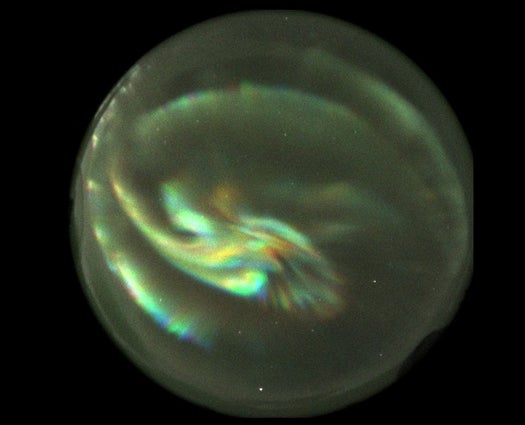
In pictures and in person, the Earth’s aurora looks sorta like wispy clouds made of emerald fuzz. That’s gorgeous and all, but we need a clearer picture for scientific study. Auroras, which happen when charged particles from the sun enter Earth’s magnetic field, could reveal a lot to us about how the Earth and the Sun interact. Most cameras just swallow all the light into one image when you take a picture, so researchers would have to use filters to study specific bands of the spectrum.
The NORUSCA II Hyperspectral camera switches among 41 spectral bands in just microseconds, and researchers can combine specific bands into one image. In the one above, there are three bands–one red, one blue, and one green. This makes it easier for scientists to research, but it’s also pretty cool to look at.