
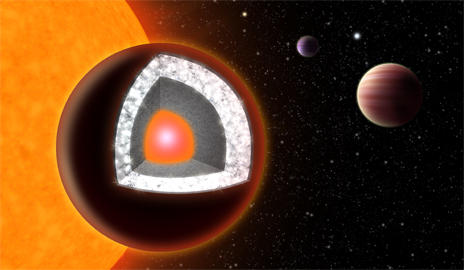
A super-Earth-sized exoplanet in a nearby planetary system is likely made mostly of carbon, which means it is made partly of diamond, according to a new study. The main reason this paper is interesting: It upends the assumption that distant rocky planets might have similar chemistry to Earth. But also: A diamond planet!
The planet is called 55 Cancri e and is one of five worlds orbiting a sun-like star about 40 light years away. Its radius is twice that of Earth but it has eight times Earth’s mass, and it screams around its star every 18 hours. Also, its surface is about 3,900 degrees F. Other than that, though, this planet initially seemed like it might be similar to our own. But astronomers’ early assumption that it had water now appears incorrect.Yale postdoc Nikku Madhusudhan and colleagues confirmed that substantial amounts of carbon and silicon carbide were in its solar neighborhood when the planet formed. They also measured its size, which allowed them to infer what it’s made from by calculating all the possible combinations of ingredients that would yield a planet of that size and structure. It's mostly graphite and diamond, with some iron and possibly some silicates, they say. At least a third of its mass, so about three Earths’ worth, could be diamond.
Perhaps someone should tell the folks over at Planetary Resources, who are planning to hunt down asteroids and mine them for a variety of material.
The findings show that astronomers studying distant rocky worlds should not assume they’ll be Earth-like, Madhusudhan said. A paper describing the planet was just accepted for publication in the Astrophysical Journal.

Five amazing, clean technologies that will set us free, in this month's energy-focused issue. Also: how to build a better bomb detector, the robotic toys that are raising your children, a human catapult, the world's smallest arcade, and much more.


Online Content Director: Suzanne LaBarre | Email
Senior Editor: Paul Adams | Email
Associate Editor: Dan Nosowitz | Email
Assistant Editor: Colin Lecher | Email
Assistant Editor: Rose Pastore | Email
Contributing Writers:
Kelsey D. Atherton | Email
Francie Diep | Email
Shaunacy Ferro | Email
Looks like they found a diamond in the rough.
I will see now astronauts with blin blin
Rappers will be rapping about diamond planets now..... Damnit.
Interesting, but generally worthless. Diamonds are nothing more than carbon atoms assembled tightly in crystaline structure.
By the time we have fabrication techniques sufficient to move between the stars, the value will be in the carbon itself (since our food and bodies are made of carbon, carbon would be an element sought out as an interstellar resource) - and carbon in diamond form would be one of the most difficult to access and make useful (it would likely have to be broken down with heat to CO2 and then the CO2 could be used in hydroponic bays or added to large habitat systems).
The graphite, silica, and even iron core would likely have greater value by that point in human development.
Of course, mining a planet is always an exercise in size reducing value (as additional energy is needed to pull material from gravetational forces). I would also expect that by the time humans are an interstellar species mining planets our first step would be to find a way to blow them apart into an orbiting cloud of smaller, more useful chunks of material.
if we're gana use heat to cut it why not cut it into a solid ship's hull and make a dimond armored ship
"It also shows that planets can be more complex to study than stars."
Uhh, put me in the "no s@!#" category. Planets don't beam their information to us like stars. So yes, planets will always be more complex to study than stars. A person without a giant flaming torch is also more difficult to see in a dark room....
"Bravo, Lois. The last horse finally crosses the finish line" -Stewie