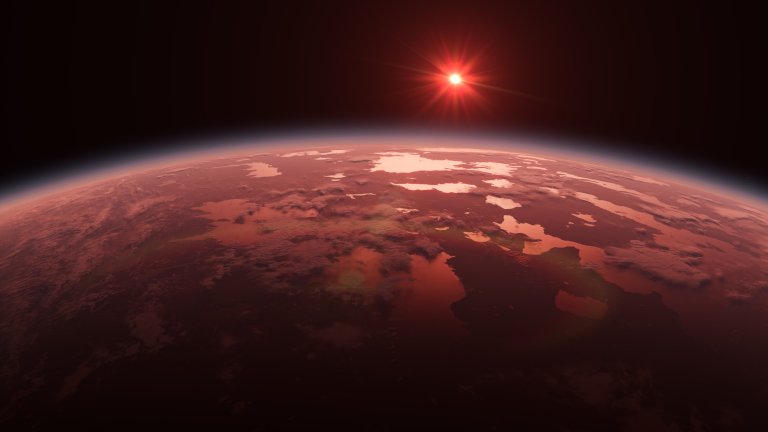
We knew temperatures at the Martian surface were volatile, but it turns out the barometric pressure regularly fluctuates as if a hurricane were passing over.

The Weather on Mars Earlier this year the Mars Reconnaissance Orbiter captured this image of a whirling dust devil twisting its way across northern Mars. NASA/JPL-Caltech/UA

Mars Rover Curiosity is above all a robot geologist, but that’s not stopping it from tracking weather on the Red Planet as well. And what strange weather it is. The latest exciting result from Curiosity: atmospheric pressures at some places on Mars swing wildly throughout the day.

We’ve long known that temperatures on Mars can vary widely over the course of a single Martian day, as its thin atmosphere and lack of stabilizing oceans make it particularly sensitive to the coming and going of the suns rays. But what we didn’t know (though we previously have theorized) is that barometric pressures change radically throughout the day as well, at least in certain places.

During a Martian day, the pressure can deviate from the daily average by as much as 10 percent. Comparatively, Earth’s pressure on a normal day might swing one-tenth of 1 percent above or below the average pressure. The kinds of pressure swings recorded regularly on Mars are akin to those that only occur on Earth when an extremely strong hurricane rolls through a region.

Researchers have theorized that at certain points on Mars--at two “action centers” along the equator on opposite sides of the planet--pressures would fluctuate like this. Curiosity happened to land right in the middle of one of these zones, apparently confirming this theory. These pressure swings could provide an explanation for some of the other strange Mars weather we have observed, like massive dust storms that envelope large parts of the planet from time to time or even Mars’ periodic dust devils like the one seen above.

[PhysOrg]

5 Comments

I wonder how Mars two moons, Phobos and Deimos, effects the weather?

Mars' moons are very small and probably have little effect.

It does, however, mean from a terriforming perspective that a large quantity of temperature regulating material (like water here on Earth) would need to exist before any attempt of developing an atmosphere - otherwise the shifting weather extreames would make the planet too volitile to land upon.

Thus, in the mass addition stage of terriforming Mars, asteroids with transitive elements in the current temperature gradient would be necessary and would also need to be progressive (starting with ice would not work, since it would vaporize in the day leading to an over-abundance of weather).

How about just go underground? We could start out below the hurrican pressure and move our way up. Try Valles Marineris, pressure is already high as would be wind, but we would be lower and have SOME protection form the Martian storms.

We could start mining operations as homestead ops, and use craters and such for launch and landing platforms. Besides, we can always do what we're best at: pollute!

Get your facts first, then you can distort them as you please.
Mark Twain

The high pressure zones that are unstable are the easiest source to harness for surface power, considering the damage solar collectors take in that environment.


June 2013: American Energy Independence

Five amazing, clean technologies that will set us free, in this month's energy-focused issue. Also: how to build a better bomb detector, the robotic toys that are raising your children, a human catapult, the world's smallest arcade, and much more.


Online Content Director: Suzanne LaBarre | Email
Senior Editor: Paul Adams | Email
Associate Editor: Dan Nosowitz | Email
Assistant Editor: Colin Lecher | Email
Assistant Editor: Rose Pastore | Email

Contributing Writers:
Rebecca Boyle | Email
Kelsey D. Atherton | Email
Francie Diep | Email
Shaunacy Ferro | Email

circ-top-header.gif
circ-cover.gif
bmxmag-ps