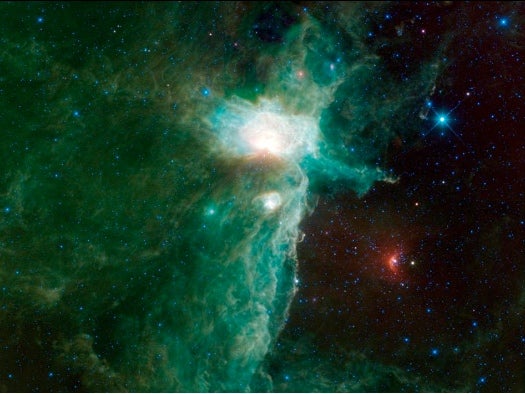
NASA’s Wide-field Infrared Survey Explorer may be running out of coolant, but its infrared sensors are still capturing some amazing infrared views of the cosmos. Today in pretty space pics: the Flame nebula, a burning candle lighting up the larger Orion complex close to its well-known belt.
This newly released image is part of WISE’s most recent data dump representing its second full scan of the sky. WISE wrapped its primary mission last March, providing one of the most comprehensive views ever taken featuring infrared images of more than half a billion objects. Its second scan is icing on the cake, allowing astronomers to sharpen and double-check the data from the first scan even as WISE’s coolant--necessary for keeping its own heat from interfering with the IR sensors--slowly runs out.
In the image above, different colors represent different wavelengths of infrared light shining through the dense clouds of dust feeding a star-birthing frenzy. Huge stars within the cloud are carving out a cavity there, giving us the cosmic candle you see above (one central massive star, 20 times heavier than our sun, is responsible for a good deal of this glow). This first batch of data from WISE’s second sky scan cover about one-third of the sky.
[PhysOrg]
Five amazing, clean technologies that will set us free, in this month's energy-focused issue. Also: how to build a better bomb detector, the robotic toys that are raising your children, a human catapult, the world's smallest arcade, and much more.


Online Content Director: Suzanne LaBarre | Email
Senior Editor: Paul Adams | Email
Associate Editor: Dan Nosowitz | Email
Assistant Editor: Colin Lecher | Email
Assistant Editor: Rose Pastore | Email
Contributing Writers:
Rebecca Boyle | Email
Kelsey D. Atherton | Email
Francie Diep | Email
Shaunacy Ferro | Email
Can anyone tell me why "coolant" is needed in the freezing temps of space? Wouldn't a basic heat exchanger (IE fins) work?
Playing Devil's Advocate since 1978
"The only constant in the universe is change"
-Heraclitus of Ephesus 535 BC - 475 BC
I imagine you need some sort of media, to transfer heat flow. How gas, being vented to space.
A typical heat exchanger on Earth has the benefit of using water, air or the ground to transfer the heat too. In space, how do you transfer heat to vacum?
"freezing temps of space" only exist on a spacecraft if it is not exposed to the sun's light. Satellites need solar power to operate, so they will inevitably be heated by the sun (or even the sun's light reflected by the earth). Since WISE's sensors needed to be very cold (12 Kelvin) to achieve its mission objective, cooling was required.
WISE's coolant was solid hydrogen, which maintained the sensors at 12K by slowly evaporating. It was a passive system... no pumps.
Yeah did some reading over on NASA.gov after I saw this...it's a shame we can't delete our own posts... oh well.
Althought with shaded space being around 3K, wouldn't a shield and a passive cooling system with the radiator being in the shade would leach heat away, maybe not down to 12K but it would absolutly assist and could have slowed down the evap losses that the current system is experiencing with out TOO much added bulk... which leaves me to wonder what the trajectory distortion would caused by constant heat exchange in 1 general vector.
Playing Devil's Advocate since 1978
"The only constant in the universe is change"
-Heraclitus of Ephesus 535 BC - 475 BC
ugh, everytime i hear of WISE i can't help but think of that comic called Psyren...
i am seriously starting to think that space pictures are finally becoming over played, I'd rather see them close up, when are we going to have our interstellar space ships dammit?!
to mars or bust!
Heat loss occurs by radiative cooling so you don't need air or water to absorb the heat, but the sun is a doosy, raising temperatures a ridiculous amount. maybe we could build one of these send it far out enough that it could function in the coolness of deep space... I not sure how far you have to go, but maybe a nice flat rock in the asteroid belt could be used as a solar shield.
@CodeZero
There was already a sun shield on WISE. The first problem is that because of your solar panels, there will inevitably be heating of your spacecraft. Whether it be heat transferring through the metal frame, or sunlight reflected off the panels and bypassing the sun shield, the spacecraft will heat up.
The second problem is that things like avionics and communication systems can't operate at 3K, or 12K, they need to be in the high 240-320K range to function reliably. So WISE's cooling system only cooled its sensors. Its sun shield kept its solid hydrogen reserve from heating up, and the rest of the spacecraft was built like a normal satellite: designed to exploit various coatings and materials (and maybe even heaters) to keep the temperature of the electronics somewhere between -40degC and +60degC throughout the orbit.