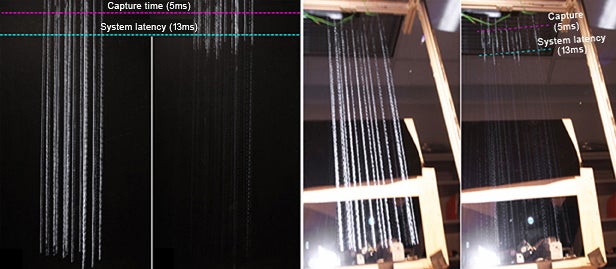
Researchers at Carnegie Mellon University have figured out how to thwart the weather when you’re behind the wheel by looking straight through the rain drops or snow that create that white-out effect when headlights meet heavy precipitation at night. By detecting and tracking individual rain droplets or snow as they fall through a car’s headlight beams, they’ve created a system that can “dis-illuminate” them by adjusting the headlight beams to only shine around them rather than on them.
The system works out to roughly 13 feet in front of the headlights, the range in which heavy snow or rain reflecting headlights can obscure a driver’s vision. A digital projector illuminates incoming raindrops for a few milliseconds, long enough for a camera mounted on the side of the projector to capture their positions and trajectories. Software then calculates exactly where those raindrops are headed and sends a signal to the headlights, which adjust so that the light rays that would hit that raindrop are switched off.
In other words, in the middle of a downpour (and while moving) the system tracks raindrops in realtime and adjusts light rays just as quickly as those raindrops can fall. The system isn’t perfect--in heavy rain accuracy is at 70 percent (that is, it removes 70 percent of the rain from view) at roughly 18 miles per hour. At 60 miles per hour, that drops to just 15 or 20 percent. But even 20 percent is a fairly good bump in visibility--certainly better than zero percent. The next step is to make the the system better at accounting for car movements that aren’t simply straight forward (presumably compensating for turning or lane changes and the like).
Five amazing, clean technologies that will set us free, in this month's energy-focused issue. Also: how to build a better bomb detector, the robotic toys that are raising your children, a human catapult, the world's smallest arcade, and much more.


Online Content Director: Suzanne LaBarre | Email
Senior Editor: Paul Adams | Email
Associate Editor: Dan Nosowitz | Email
Assistant Editor: Colin Lecher | Email
Assistant Editor: Rose Pastore | Email
Contributing Writers:
Rebecca Boyle | Email
Kelsey D. Atherton | Email
Francie Diep | Email
Shaunacy Ferro | Email
The seizures happening in the multiple oncoming cars are just coincidence.
This is really neat tech tho. It would be nice if it wasn't a feature of the headlights, but a feature of the windshield. That way light is still shining consistently, and the windshield ignores the water droplets for you. It would be a bit like the dimming rear view mirror.
Of course, the problem with my little set up would be that the windshield needs to know exactly where your eyes are, and your eyes only.
In conclusion, these people have thought this out waaaay better than I have.
So as I understand this device correctly, as it senses rain and makes syncro adjustments to its lights, it turns the lights off, so the driver does not see reflective light glare.
Ok, if the rain is extreme or the sensing unit gets blocked or the syncro breaks, the driver is now with NO lights.
Hopefully, there is an over ride switch. ;)
Robot,
It works like a LCD projector. It darkens only the pixels where it thinks the rain drops are. So the light shines around the raindrops.
I think a better use of this would be to detect the headlights of oncoming traffic, determine where the driver of that car is likely to be and dim the lights at that spot.
Either that, or make bat signal headlights, that would be cool too.
@Robot incorrect. The light is always on, but a projector LCD (or similar) selectively blocks light on pixels where that light would hit the rain drop or snow. For your theory to be correct, it would have to be a solid wall of water or snow - which just doesn't happen, and if it did - you are probably better off not driving at all.
Looks like previous commentator didn't exactly get the scenario and the situation.
Problem: In heavy rain, it's about how far out you see in front of you. the heavier it gets you visibility drops. e.g. from 100 fee to 50 feet, or even 10 feet!
Driving at night with headlights, it makes it worse. as the water droplets right in front of the headlights will act like a wall. The analogy will be similar to a movie projector (card headlights) and a screen (water droplets).
and thus, our brain cannot see through the wall (depending how hard the droplets fall).
Solution: they are saying LIGHT RAYS! meaning they are controlling the light rays (like the way they do it in movie projectors). So the projector (car headlight) will be a special type, that can send individual rays.
So for the droplets that are very close to the car, the projector will not send a ray. So this way, the will increase the distance of this imaginary projector screen.
Also the incoming cars, will probably see the headlights the way we see the movie projectors when we walk into movie theaters.
I still think it is valid to have an over ride switch, since from my experience with electronics and their associated devices eventually fail, I like the ability to turn the 'dang' lights on, if I choose.
I wish everyone a happy 4th of July. I am a proud veteran and patriot. GOD BLESS ALL THAT SERVE and USA!!!!!!
@Robot
*
I agree with your sentiment. Once I had the lights go out for 5 seconds while I was driving down a dirt road at night (even the dash lights). It was pitch black, I could see nothing. That was a very tense 5 seconds.
*
I'm not sure if is worth the increased visibility, making the headlights even slightly more prone to catastrophic failure. At the very least I would not recommend being an early adopter for this technology.
Great idea but seems a bit complicated. How about simplifying your system to hundreds of little lights in a honeycomb tube pattern, like a handful of mini drinking straws. (fiber optics?)
-Each individual light dims independently when a raindrop reflection bounces back through each individual tube.
-Make your reflection sensors differentiate between true raindrops reflections and false reflections like oncoming headlights & sign reflectors.
-Also having a limit on % of lights that could be dimmed at any one time would prevent accidental blackouts and calm the fears of techno-phobes.
(Fiber optics would be ideal if you could receive relfection information back through the fiber itself without flare) but this sort of system seems a lot simpler and effective to me.
Just a thought.
@kamydon: how do you think projectors work?
By selectively blocking light. They used to do it with film, but now it is done with either a selectively reflective mirror or with an LCD device that allows light to pass or not based on if the pixel is on or off.
Oh dear. Yet another gadget to give some people a false sense of invincibility and, in this case, encourage them to drive too fast for the conditions. Better a gadget to limit the speed of the vehicle in adverse conditions.
Better yet, just use a 5 megawatt laser and evap the rain/snow before it gets into your headlights way, then no one will need to plow the roads either AND lucky homeless folks will get fried bird to eat, see it's win win!
Playing Devil's Advocate since 1978
"The only constant in the universe is change"
-Heraclitus of Ephesus 535 BC - 475 BC
Ok, now all the crazy ideas have been used up,
What about dimming the headlights and using an alternative tried and tested sensing technology. Like radar, sonar etc?
KISS - Keep It Simple Stupid
Wonderful! I now can see better during a hard rain and drive faster, with my enhance head light system. In no time at all, I will be hydroplaining down the highway for a quicker demize!
Gotta agree with robot. What's really wrong with slowing down a bit in downpours or snow storms? And what does "the system tracks raindrops in realtime" mean? Or "Please login"? How about writing your stuff in english instead of backwoods. You were probably shooting for "real time" and "log in" and you missed. Turn your spell checker on and look for the wiggly red lines. They indicate misspelled words.
superb idea.
rumbuddy.com