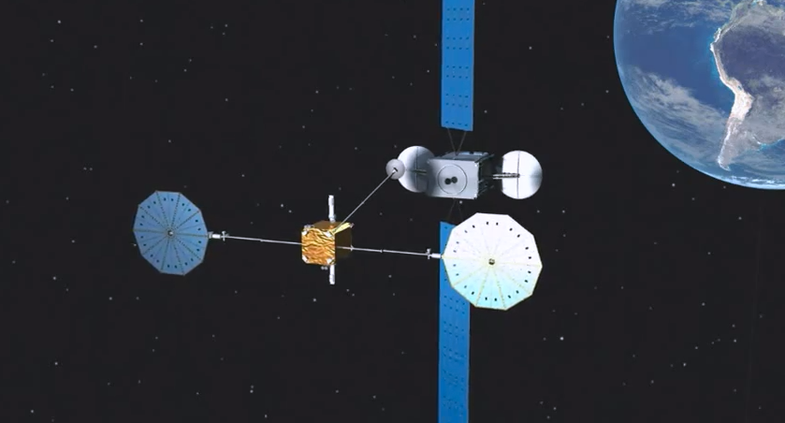
Mission Extension Vehicle A ViviSat Mission Extension Vehicle (front, gold satellite) approaches an ailing geostationary satellite and prepares to dock. ViviSat

Aside from a couple particularly nasty collisions, dead satellites comprise the bulk of our planet’s space junk problem — as they die, get fried by radiation and become zombies, or are decommissioned, there’s nowhere for them to go. ViviSat aims to change that by servicing satellites where they are, pushing them into new orbits and allowing them to live longer.

ViviSat, which was founded last year, says it is in contract negotiations with satellite providers to work as a sort of on-call satellite doctor. When a satellite ends up in the wrong orbit or needs extra power to maintain it, ViviSat can launch a Mission Extension Vehicle to rendezvous with it.

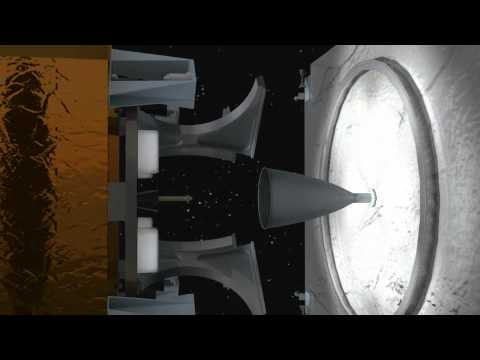
It would launch on an ATK rocket, which could fit two at a time. Once it reaches orbit, it unfurls a solar array and sensors to track down the satellite it's meant to assist. When it reaches its target, it uses proximity sensors and other tools to dock with the ailing orbiter, and then it could push it into a different orbit. It wouldn’t add fuel or take anything off the host satellite, which ViviSat says is a plus, because satellite builders may not want a third-party company tinkering with its massively expensive spy array or whatnot.

About 350 satellites orbit Earth in geostationary paths, and every year, about 25 of these run out of fuel, according to the company. Maybe 10 of those 25 are good candidates for an MEV servicing — not a huge number, but one that could still cut down on space waste.

ViviSat is a partnership between rocket launcher ATK and U.S. Space, which will manage the missions. At a conference this spring, ViviSat officials said government and private entities are interested in their services. The company just released this animation explaining how its MEV would work.
3 Comments

Perhaps, one of its first task this space robotic doctor tool box may fix is Envisat!! There is time to accomplish this task too. Envisat is predicted to stay in orbit 150 plus years. But currently is dead.

.............................
Science sees no further than what it can sense, i.e. facts.
Religion sees beyond the senses, i.e. faith.
Open your mind and see!

Maybe a serviceable Mothership satelite for a base station that houses accelerant packs that mount to satellites to supply boost. Mothership hunts down satellites on call, then mounts a pack to the clients hardware, each with a programmed use for that satellites future needs. Mothership moves on to the next customer.

Service can be accomplished quite easily, send up refuel pod, Mothership finds it and an automatic reloading system does the rest. The skeletal remains of the delivery vehicle can have a small booster to deorbit itself, if not its way better than multiple launches anyway. Of course the Mothership exchanges her tanks with the delivery, eliminating that waste. Cheap and green, private companies like it better that way. Less crap to spend profits on.

If the packs are essentially a rocket with a small brain to navigate, then they could be cheap enough to deorbit scary dead satellites before a 20 ton behemoth fall on a playground, or it could become the way to deal with our trash up there so billion dollar toys can fear less. It won't take a lot of boost to deorbit, those can be made for pennyies on the dollar. Couple grand at most for a deorbit seems right

For the hardware, not my business how much they charge for the rest of the operation. But cheap hardware makes absurd ideas probable, and likely. There are a lot more goofier ideas out there in action already. This whole thing seems like it was all just a matter of time before we got here. Hope it becomes a reality sooner than later, lots and lots of crap up there.


June 2013: American Energy Independence

Five amazing, clean technologies that will set us free, in this month's energy-focused issue. Also: how to build a better bomb detector, the robotic toys that are raising your children, a human catapult, the world's smallest arcade, and much more.


Online Content Director: Suzanne LaBarre | Email
Senior Editor: Paul Adams | Email
Associate Editor: Dan Nosowitz | Email
Assistant Editor: Colin Lecher | Email
Assistant Editor: Rose Pastore | Email

Contributing Writers:
Rebecca Boyle | Email
Kelsey D. Atherton | Email
Francie Diep | Email
Shaunacy Ferro | Email

circ-top-header.gif
circ-cover.gif