
Presuming Planetary Resources builds a fleet of prospecting space telescopes, locates mineral-bearing space rocks, gets to them and successfully mines them, then what? Can a corporation lay claim to these protoplanetary leftovers, and can they really sell them? Or are they part of our common celestial heritage, priceless pieces of early creation that should be protected?
For a lot of reasons, the legal ramifications of today’s asteroid mining announcement are almost as complex as the technological ones.
“As far as law is concerned, there’s nothing inherently in the space treaties that prohibits this [mining],” said Henry Hertzfeld, a research professor at the Space Policy Institute at George Washington University and an associate professor of space law. “But there are a heck of a lot of unanswered questions.”
First of all, there’s an important distinction between ownership of land or property and ownership of resources. It’s the difference between owning the oceans, which you can’t, and owning the fish that you take out of them, which you can. For now, it sounds like Planetary Resources is operating under the latter scenario, and is not laying claim to real estate or seeking property rights on the asteroids it seeks to mine.
“The United States went to the moon, took hundreds of kilograms of moon rocks, and the U.S. owns those moon rocks,” noted Art Dula, an attorney in Texas who teaches a space law course at the University of Houston law school. “The taking of minerals does not require a claim of sovereignty.”At the heart of the space asset ownership debate is the 1967 Outer Space Treaty, a Cold War relic that prohibits establishment of colonies or sovereign rights on the moon or other celestial bodies. Private companies are not necessarily prohibited from establishing settlements, but the treaty also holds that states oversee and regulate these putative companies and their activities, and assume liability for any bad scenarios. (Speaking of which: We’re still waiting to hear more about the safety aspects of this new plan, because slurping up or mining an asteroid would conceivably affect its orbital trajectory.... and that could be bad.)
This liability factor, as well as Federal Aviation Administration licensing requirements and safety concerns, will be at issue as Planetary Resources develops its plans, Dula and Hertzfeld said. To Hertzfeld, the company’s potential public partnerships — with NASA or other agencies — could be key. Space visionary and entrepreneur Peter Diamandis, co-founder and co-chairman as well as founder of the X Prize competition, said Tuesday the company will serve the public as well as private enterprise, which Hertzfeld noted with interest.
“If you can convince the government that there is a public mission, a public purpose, in doing a project of this sort, and be your partner, this is business as usual,” Hertzfeld said. “If the government is going up, it doesn’t need a license. It supervises itself, and assumes certain liabilities and risks.”
Some space colonization advocates argue that guaranteeing ownership of celestial real estate is a necessary precursor to developing that real estate. Just last month, the Competitive Enterprise Institute, a libertarian think tank, proposed that the U.S. recognize off-planet property rights to spur space development. But Hertzfeld calls this a red herring.
“How many companies own the land their buildings are on? A lot of them lease it, and behind that is a government guarantee that says this lease is valid,” Hertzfeld said. “We can do something like that in space. ... Whether it’s a UN system, a bilateral or multilateral agreement, that doesn’t matter as long as the investors know they can maintain their return on investment. That’s all that counts. The ownership of land is secondary.”
Dula, who spoke with PopSci before giving a lecture on asteroid mining at the law school, also said resource ownership is clearly allowed. “If you risked your life and treasure to go into space and obtain rocks or minerals, there’s no reason they wouldn’t belong to you, just like the Apollo samples belong to the United States,” he said.
As of now, the U.S. is the only entity to bring space objects home that would be of any value. The Japanese last year retrieved some space dust from the Hayabusa asteroid lander, but its value was purely scientific, not commercial. Bringing home loads of platinum, water or any other resource would be a different story, and there’s no jurisprudence on that yet.
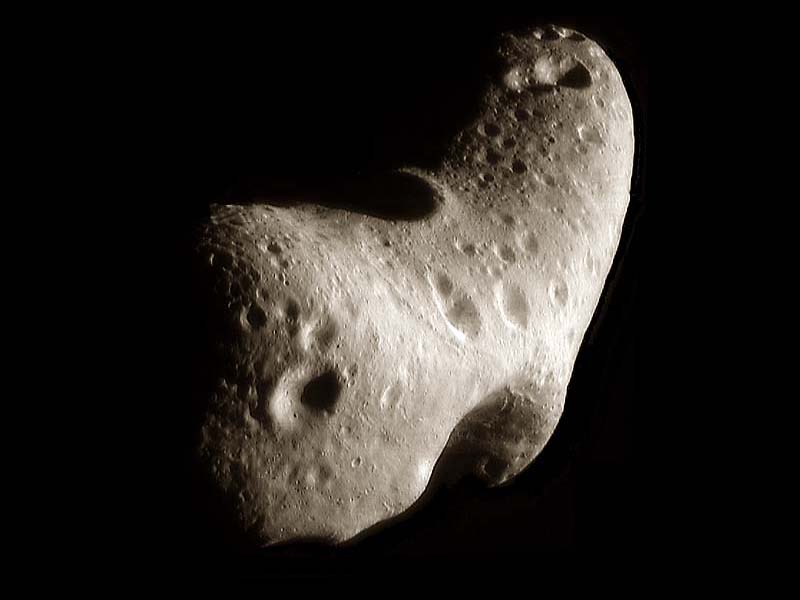
Regarding property rights, the case of Gregory W. Nemitz and the Eros Project offers some perspective. Nemitz claimed ownership of asteroid 433 Eros, one of the largest asteroids in a near-Earth orbit and one with abundant supplies of aluminum, iron, potassium and magnesium, among other metals. The Eros Project seeks to establish a mining colony on the asteroid and develop these materials, according to its website. In 2000-2001, NASA’s NEAR Shoemaker spacecraft orbited the asteroid and eventually landed on its surface. Nemitz sued NASA for parking fees. His case was dismissed, but NASA’s arguments and reference to the Outer Space Treaty notes that space and space objects are “not subject to national appropriation.”
As long as Planetary Resources doesn’t try to claim ownership of the asteroids it mines, this argument may not arise. But it’s not a far leap to imagine what the company will do if competitors try to jump its mining claims.
Both legal experts said the law is still immature, and would continue to develop as Planetary Resources moves forward and forms more specific plans.
“We need to know what the ‘it’ is first, and we don’t,” Hertzfeld said. “Their near-term plans are sort of standard space exploration stuff, science stuff. It’s what happens after that, and what they actually want to do.”

Five amazing, clean technologies that will set us free, in this month's energy-focused issue. Also: how to build a better bomb detector, the robotic toys that are raising your children, a human catapult, the world's smallest arcade, and much more.


Online Content Director: Suzanne LaBarre | Email
Senior Editor: Paul Adams | Email
Associate Editor: Dan Nosowitz | Email
Assistant Editor: Colin Lecher | Email
Assistant Editor: Rose Pastore | Email
Contributing Writers:
Kelsey D. Atherton | Email
Francie Diep | Email
Shaunacy Ferro | Email
I bet Aliens own our solar system.
This legal question is similar to the 'Book of Life', when the Earth was made 4.7 Billion years ago, then later came humans.
In the 'Book of Life', they were no rules and no person own anything and everything was available. The original 'Book of Life' has blank pages and it was us humans that wrote in it and create the rules.
So if a human found something, it was just up to the human to get and keep it. So who owns what in the cosmos assets: no one; and who can have the thing they find: anyone. The person that can acquire any useful asset from the cosmos should be able take it for the grabbing and then it is up to him to keep it.
If you have a space ship filled with some exotic recourse, yes you might be attack by space pirates. There is no police in outer space and no laws governing property. If the space pirates land on Earth and sell your recourse, you are screwed.
Perhaps, this will cause space mining operations to have weapons. The old wild wild west will happen in outer space, once an extreme valuable recourses is found.
About the only thing the law can do, it make sure nothing liable happens as they bring this recourse back to Earth. Scientifically it has been said, part of the biology of life came from the seeds of asteroids. Now if a mining company brings some wonderful exotic mineral from space back to Earth, he best not brings a bacterium that harms life on Earth.
.............................
Science sees no further than what it can sense, i.e. facts.
Religion sees beyond the senses, i.e. faith.
Open your mind and see!
I like how all these issues are coming to light when we can barely get ourselves off the planet right now. We had more capability in the 60's compared to now.
Oh yes, if space aliens show up and steal from you, your valuable cosmos recourse, what ya gonna do, call your local police, lol.
Perhaps the aliens will torture you or follow your home planet and then make the decision to take Earth as their valuable recourse.
They begin the cosmic wars!!!!
.............................
Science sees no further than what it can sense, i.e. facts.
Religion sees beyond the senses, i.e. faith.
Open your mind and see!
Space is the new Wild Wild West where anyone who has the resources to move there first can claim his rights over the resources as there are no laws governing it. If you have deep pockets, consider mining the moon, but can you afford the resources to do that?
Firefly!
Legal? Whoever gets there and can hold onto it owns it. Now if people start fighting over it, then we have a moral issue, not a legal one. There is no governing body over it. And even if one claims they are over it, what will they do when somone just declares their independence?
Let coperations go and claim asteroids and moon property. Let them call themselves their own nations. If they can get there and maintain operations, good for them.
We don't have to worry about messing up any environments there. If anything we should worry about messing up the aesthetics of the near side of the moon. Mine away. Bring resources back to earth and sell them. It's a better stweard of our resources.
The problem is the cold war treaty was meant to diffuse a sticky situation. When the astronauts from the USA planted their flag on the moon they could have done so and claimed all this land for the United States. Now to avoid war over a land we really didn’t want to settle anyway, and more importantly the space over our heads, the governments came up with this treaty to not lay claim to the moon or anything in space. War averted and we can still spy in peace on each other from space. Win-win.
Something will have to be established though and recognized globally if there is a space gold rush of sorts to other bodies. It could get dangerous in a hurry, mostly for space robots at first I would think but anger spills out though. If there is no governance then space pirates, pollution issues(robot guts and rocks everywhere in low Earth orbit), and general corporate mayhem also come to mind. Who collects the Import taxes? Do non-space fairing nations have a claim to a cut of revenue? Perhaps there will be war afterall.
Just a random thought but If the Eros guy can simply file a court doc and claim to own an asteroid then I think we also have a new breed of patent troll for the books.
It is too soon. For now let corporations race to the resources available. States will get in the way and stifle the rapid expansion we need to harvest the resources in our solar system.
We have 15% real unemployment in the U.S. and it it worse in other parts of the world. We need a new a industry to drive growth and jobs and space provides potential for ever growing industry and a near endless source of new jobs.
Once actual competition for those resources in space begins, then we can talk about how to divvy up what's out there. It takes tremendous resources just to get into space at this point. Let those taking the huge risks and making the giant investments reap the reward.
Firefly exactly!
.............................
Science sees no further than what it can sense, i.e. facts.
Religion sees beyond the senses, i.e. faith.
Open your mind and see!
@kurtj
I disagree. I think the point of this article is to explain how asteroid mining will ENCOURAGE space travel / space entrepreneurship
I say go for it. I doubt there is anything of great historical or technological significance out there. If something of interest were found I would hope that those who find it would share it with all of humanity (a naive hope, I know). Beyond that, I think its better to blow up rocks in the Kuiper belt before we get to the point of blowing up national parks.
I predict that if we send Columbus to some new world, he will return with horrible diseases to wipe out Europe.
Better we stay at home and play in the mud.
Pretty scary what fear and the false promise of zero risk has done to the spirit of man.
I think the centuries old standard still applies pretty well: If you can get to it and hold it, it's yours.
DS13,
You DO know what clears NEO asteroids from Earth's orbit... right?
It's not mining robots... yet. It's something much closer to home. Something that's been clearing out our orbit for billions of years.
If these asteroids are not mined and brought to Earth piecemeal, the Earth will bring them here intact.
I am no so sure if the finders keepers rule is the right way to go. Just because something is centuries old doesn't make it a good idea. There have been centuries of wars because of this rule. If I were the first man to land on Mars, could I claim all of Mars to be mine? War comes down to two things. Religion and resources. This is very scary.
On the other hand, I do not know of a better way. Any suggestions?
There is no element or mineral valuable enuf to be worth a space mission to mine and retrieve it. Nor can I even imagine one in the future. The mining of asteroids may be necessary for the survival/growth of outer space colonies in the distant future, but as far as bringing stuff back here, nope.
bob clemintime,
The Earth is said to be 4.7 billion years old. How old is humanity by comparison. We humans had nothing to do with Earths creation. Still a person arrives, draws some boundaries and declares some ground is his. Then time passes and yes he has to fight to keep it from others. Since society found it acceptable to make boundaries, we then later we found it acceptable to buy and sell land.
But who really owns the land. No one!
The joke is on the buyer, when a piece of it is being sold. But the joke is forgotten and we find it acceptable to pay someone for a piece of land they never created.
It was 100% illegal the American Indians losing their lands. Our government declared it basically legal on the grounds they were not strong enough to keep it.
Hmmm, legal stealing, who knew?!
Of course with history, this kind of stealing has been going on thousands of years by Kings. The King declares this land is his and since he is King, it is legal and well the King is always right, at least in his mind.
.............................
Science sees no further than what it can sense, i.e. facts.
Religion sees beyond the senses, i.e. faith.
Open your mind and see!
I agree it was horrible and illegal what we did to the Native Americans. This is why we are still paying reparations to them today. Funny how we use a small portion of our GPD to pay for our stolen land and the killing of thousands.
Its also interesting how we can claim land to be our own. I have heard that some Native American tribes did not view land as their own, but as something to be shared among all.
That aside, not sure if you had any other point?
On a random note. Why am I usually flagged as spam by the system?
We're stuck on a grain of sand and we're arguing about dividing the whole beach.
From my standpoint, as much as I'd like the idea of mining asteroids, I have to consider the idea that I don't want to see our planet or it's environs become even more weaponized. That said, if a person could prove feasibility and capability, then yeah, file claim on your first asteroid. Yeah, that's right. No claiming something you can't return with, and no filing for a second without successful discharge of the first. Only humans to be considered as owners or filing applicants. No corporations. A purely personal business endeavor, whereby the person assumes all risk. You wanna go live on yer asteroid, and if you live there long enough to set it up for habitation, you can legally sell it as a qualifying discharge of responsibility. Something like that. Look at it like this. This IS going to happen, but there might be a way for it to happen without a spacewar that could lead back here to world war.
I wonder how much thought Russian President Vladimir Putin and Co or Chinese Premier Wen Jiabao and his crew would give to the “Legality” of the mining of space resources issue if one of their companies was in a position to engage in such an endeavour.
Just see that this is a cool idea. You people are over thinking this. If they do get to the point of moving an asteroid, then they'll be able to move it out of a collision course with arth, especially since they're gonna be monitoring these asteroids. All this talk of doom and war is way far fetched. It would be a race, no a war. And it would just spur the development of newer and better technologies, furthering safety and human ability to explore and create. Some be has to be a pioneer, why not planetary resources.
What happens when a company from one country does this and in bring it back they goof and accidently dump it into someone else back yard.
That country could sew for damages and keep the valuable metals too.
.............................
Science sees no further than what it can sense, i.e. facts.
Religion sees beyond the senses, i.e. faith.
Open your mind and see!
paperpushermj
Two points in regard to this article:
Catch as Catch can.
.
and.
.
Possession is Nine Tenths of the Law.
The only way were ever gonna git off this rock and have a "Permanent" presents in space is make space flight turn a profit. Asteroid mining is one way to do this maybe my grand kids will see it
In 2006, president Bush science adviser John Marburger delivered the Goddard Memorial lecture...and articulated Bush Vision....
"...As I see it, questions about the vision boil down to whether we want to incorporate the Solar System in our economic sphere, or not..."
In my opinion, the moment you light those engines and rise up above the globe, we become a new species, transcending homo sapiens sapiens to become homo sapiens cosmicus.
Now, common heritage of Man and such aside(very much a debate for the man trapped on Earth), I think PRI is following this expanded horizons vision.
Good luck to them !
Simple. Look at Europe's expansion into the Americas, they faced pretty much the same problems we would face with space colonization, so it seems only natural to look at how they handled it and come to a conclusion from there.
That said, I will not be suprised when the martian colonies rebel against the crown (or whoever).
electric38
The ideas for exploration agreed on shall be approved by a world council. #1 nobody owns it or its minerals. #2 = no man made boundaries or separations of any kind will be allowed. #3 Everyone (worldwide) shares equally according to their needs with any profits from minerals or gasses. #4 The World Council shall rule on what language is spoken on Mars and everyone shall be required to learn that language. #5 Children born on the planet will become everyones responsibility upon birth. #6 No religion shall be imposed on any person in any form. Any religion that is found to cause any harmful differences in any two persons shall be barred from the planet. #7 There shall be no cost for health care for any person establishing residence on Mars. #8 There shall be no law made that entitles any person from profiting from their ideas (or patents). It is understood that everyone contributed to your intelligence and everyone shall share as their needs call for, in a fair manner. #9 Persons breaking these and other similar rules will be sent back to Earth as punishment. Sentencing will be according to seriousness of crime up to, but not limited to life. #10 Persons found to be lacking in a suitable sense of humor will be also be sent back to earth. #11 Fees for loaning money or supplies shall never constitute more than 10%. Every new year shall mark the end of every financial debt for each and every person. #12 Citizens will bear no weapons. Persons violating this rule will be subject to item #9.
I think some of us are missing the crux of this issue.
Lets say a country, conglomerate, entity etc.detects a body in space with valuable resources...lets say solid gold.Just for grins...They note for the record date time and region in space as well as it's projected path of travel.
Now lets say this"entity" has limited or no access to beyond atmosphere travel.Now since they were on record as to being the discoverers of this body and yet are unable to reach it should everyone be restricted from utilizing this resource.
What if they reach it and then for whatever reason abandon(or appear to abandon" does this mean others can claim salvage or"dirty seconds"?
What if it is declared that the first one there has first rights?
Or what about bodies large enough to support the mining efforts of more than one entity?Should other be excluded just because they were not the first to find it?
If there are no"claims"then we would risk having the issue of disagreements over mining rights.If there are "claims" then the exact terms and conditions need to be agreed upon universally world wide.
It needs to be all or nothing.We cannot hope for everyone to play fair.
Good fences make for good neighbors.
and good rules for good society.
first of all, we humans don't OWN anything except ourselves. This idea of ownership of land and property is stupid and causes so much ridiculous conflict. We only SHARE resources during our limited time in life. Only a primitive culture like the one today, mainly originated from the Eastern Culture, have such flawed and impractical practices as 'ownership' of things.
is it illegal? who the fuck makes the laws? we do. and anything we do is inherently imperfect. it's just an act of human arrogance. of course it not illegal. do it if you can. simple as that. oh but what if we fight for it, well GROW THE FUCK UP.
Laws for owning properties in space will have to evolve based on actual achievements, not just proposals. Just getting a private spacecraft into orbit and back has yet to be done, let alone getting a fleet into space.
Once private space exploration begins to become feasible, countries will sit down and work out new treaties regarding claims for mineral resources as well as how to regulate what is brought to the Earth and how it will be handled. We really don't know that much about the makeup of asteroids.
It will take decades if not generations before asteroid mining becomes technologically feasible. The world can change a lot in that amount of time.
I agree with Raynre. If you've set up shop on a rock, who's to say "Hey!! That's my spot!". But I'd like to hear that conversation.
---------------------------------------------
I like nonsense, it wakes up the brain cells.
In order to claim ownership you should have to go and live on the rock for a period of time.
my roomate's aunt makes $83/hr on the laptop. She has been without work for 8 months but last month her pay was $8682 just working on the laptop for a few hours. Read more on this site...NuttyRich.com
OK, I think I have this figured out...... According to an earlier article, it will take $2.6 billion to mine an asteroid. The minerals and water are worth about $10 billion. I now realize that by the time you pay the lawyers and EPA officials for permits and impact statement fees, there is another $8 billion in costs. It won't happen. Cost too much.