China Takes Off
The largest nation on Earth is flying more people more places than ever before. Its struggle to do so without (further) destroying the environment could show the rest of the world a greener way to travel
When discussing any environmental issue in China, it’s always a struggle to decide which deserves more emphasis: how dire the situation is, or how hard Chinese authorities are trying to cope with it. China’s skies, waters and even sources of food are some of the most poisonously contaminated on Earth. Its efforts to curtail pollution and develop cleaner energy sources are some of the world’s most ambitious.
This tension also informs China’s plans for aviation. The immediate threat posed by airline emissions in China is less obviously dire than, say, the particulate pollution that so often makes big-city air opaque, or the heavy-metal tainting of food and groundwater supplies that has contributed to China’s current cancer epidemic. But airplane emissions are significant and will become more so, especially as aerospace grows faster than most other parts of China’s economy.
Demand for air travel has grown little in the Western world in the decade since the 9/11 attacks, but it has increased fourfold in China, and is growing in the rest of the developing world too. The U.S. and all the countries in Europe together have fewer than 10 new commercial airports now under construction; China is building perhaps 100 new ones and expanding many more. Boeing and Airbus base their major sales hopes for the coming generation of airliners in China. Meanwhile, the Chinese government is investing heavily in the aircraft that may eventually compete against them, Comac’s regional ARJ21 and long-haul C919.
Like so many aspects of China’s growth, all of this will have serious consequences for the environment. The world’s airliners produce about 2 percent of the world’s CO2 emissions and play at least twice as large a role in climate change because the effect of CO2 and some other greenhouse gases is greater at high altitude. Aviation’s share of global emissions has been rising, and China’s share in the aviation total has been rising faster still. If the current trend were to continue, efforts to reduce emissions elsewhere could be swamped by the sheer increase in air travel in the skies over China.
The aviation industry is long past the point of denial on emissions issues. Its European and U.S. leaders have realized that for reasons of appearance, as well as because of impending legislation and to forestall reaction from customers, they must act. They also have strong economic incentives. Fuel represents the largest single expense for airline companies. Every gallon they do not burn makes their flights more profitable.
The world’s airlines and aircraft makers, which operate on decades-long timetables rivaled by those of dam builders and designers of power plants, have resolved to cut their net carbon emissions by 2050 to half of what they were in 2005, even as total passenger miles traveled increase threefold or much more. China is the market where new planes are most rapidly being bought, deployed, and flown. It is therefore where the aerospace industry is doing the most interesting work to make aviation more sustainable.
Click here to view this article on a single page, or continue to page two below.

Beijing, China
Last spring, my wife and I went with a young Chinese friend and her fiancé to an Eagles concert in Beijing. The Eagles are big in China and drew an enormous crowd to what in 2008 had been the Wukesong Olympic Basketball Arena and is now the MasterCard Center.
The concert lasted three hours, with the audience on its feet from the halfway point (when Don Henley began singing “Hotel California”) onward. When it was all over, it took another few hours to travel what would have been at most a 10-mile straight shot from the arena back to our apartment. My wife and I had no car (or driver) in China and usually traveled by subway, but our friend, wanting to show off her new Chinese-made Audi, had given us a ride. The jam in the parking lot, which had only two narrow exits for several thousand cars, was bad enough, but our routing across town was the real problem. Because of Beijing’s freeway-like ring-road layout and numerous one-way streets, we had to circle far around the city before we could head back in the right direction. And in addition to taking extra time, we used far more gas.
That wasteful car trip was an analogue for the exceptional wastefulness of air travel in China. The military’s control of the airspace around even the biggest commercial airports is the equivalent of having just a few narrow exits for a jammed parking lot—that is, planes must line up for a chance to pass through the narrow military-authorized corridors. And the military’s control of nearly all the airspace between Chinese destinations means that flights within China, even by the favored national carriers, sometimes must fly indirect routes that are the equivalent of going all around the city on a ring road.
Inefficient air-traffic control and airspace use is the main reason flights are more often delayed in China than in other major aviation countries; why their scheduled travel time, per mile flown, is much longer than in North America or Europe; and why they burn up to twice as much fuel per passenger mile in some stages of flight as their counterparts in Europe or North America.
China is the market where new planes are most rapidly being bought, deployed, and flown. It is therefore where the aerospace industry is doing the most interesting work to make aviation more sustainable.Let me say that again: For reasons of sheer pointless inefficiency in routing, airlines in China can sometimes burn twice as much fuel and emit twice as much carbon as they would “have” to if they could fly more directly, with fewer delays. Commercial air travel in China could significantly expand with no increase in emissions if the air-traffic system there worked the way it does in the rest of the world. The situation is similar to the burden created by China’s legacy building stock—the architectural remnants of the Mao era and the early reform years that were so cheaply built and poorly insulated that they take twice as much energy to heat and cool as their Western counterparts. Replacing all those old buildings with greener modern structures will take many years, and billions of dollars. Relatively speaking, wasteful airline routing could be corrected cheaply almost overnight.
There is one more fuel penalty imposed by military control of the airspace. Modern airliners generally work more efficiently the higher they fly. With their great speed and enormous mass, they generate disproportionate drag if they fly through the relatively thick atmosphere below about 20,000 feet. More of their fuel goes simply to overcoming wind resistance. Everywhere else in the world, commercial jetliners spend their cruise time at 30,000 feet or above. In China, military restrictions may keep jets at 10,000 or 15,000 feet, where they become the equivalent of gas-guzzlers.
Ending this sheer waste will require the cooperation of the Chinese military, but it will also be sped up through a new technology for navigation based on a particular application of the GPS revolution that has transformed all other forms of travel. When the first “instrument flight courses” were created in North America in the 1920s, they were open bonfires, or flares in baskets, whose light the Lindbergh-era aviators could try to follow from one waypoint to the next. By the early 1930s, airplanes had their first true, if crude, instrument guidance. This was the “four-course radio range,” in which groups of towers broadcast the Morse code for either the letter A or N—A being dot-dash, N being dash-dot—and pilots judged their direction by which letter they were hearing (a solid tone—the A and N combined—meant that they were on course). By the early 1950s, this was replaced by the then far-superior VOR (for “very high-frequency omnidirectional range”) system, which is still a mainstay of navigation in most of the world. This is a network of beacons that send out a different signal for each of the 360 degrees of the compass, so that planes with the right equipment could fly, for instance, the 90-degree “radial”—due east—from one of the stations, or the 270 radial—due west—from another. But with the coming of GPS, a true revolution in air travel was possible.
For cars, GPS simply means that we no longer have to get lost (even if people who know a neighborhood can often improve on the suggestions of the voice in the device). For air travel, GPS offers a series of related improvements. An obvious one is more-direct routing, cutting the corners off the indirect, jagged courses marked by VORs, with consequent savings in time, fuel and carbon emissions. Another is reduction of the airport nuisance factor in big cities. The combination of very precise real-time GPS readings, which can locate even a fast-moving airliner within a space of a few feet, and sophisticated new autopilot systems that can follow a very tightly defined path, now allows planes to fly slalom-style courses through the sky that were once inconceivable.
With older VOR-based navigation, which prevailed around the world until the early 2000s, the “airways” that ran from one point to the next were eight to 10 miles wide. That was the margin of error allowed planes on cross-country flights. Now the paths that airliners can fly—on departure, to avoid noise-sensitive areas of a big city, or on descent, to avoid hills and towers on the way to a remote or difficult landing site—have a margin of error of a wingspan or two, or a few hundred feet rather than tens of thousands.
Why does this matter? Noise abatement for one, since the planes can more precisely follow paths that minimize neighborhood disruption. But the fuel savings are also significant. When the new path has been calculated to let the plane glide continuously down toward the runway, the final-approach stage of the flight, which involves leveling off several times in a stair-step descent, requires only a third as much fuel as the conventional method.

Xinjiang
These benefits apply anywhere, and airports in Western Europe and Australia have taken the lead in installing them (American airports lag behind). But the revolution in aircraft guidance has one more implication that matters a great deal in China: It promises to bring China’s most remote (and politically sensitive) areas within feasible air reach of the rest of the country.
The western half of China, from Xinjiang in the north to Tibet and Yunnan in the south, is forbidding terrain. It includes some of the world’s most mountainous territory, and it is dangerous to fly over for obvious reasons: peaks, violent storms, gusty winds. But there is also a less obvious reason. The navigational tools that have let aircraft find their way through bad weather and threatening terrain, and that have let controllers monitor their progress, have long depended on installations on the ground. It is no problem to have radar stations and navigational beacons dotted at intervals of a few dozen miles all across the East Coast of the U.S.—or the East Coast of China as well. It is a huge challenge amid the mountains and high plateaus of Tibet. Radar beams and ground-based navigation signals travel in straight lines, so they can’t reach into the valleys between mountain ranges. Air-traffic controllers looking for airplanes, and pilots looking for navigation signals, are both effectively blind when a mountain sits between a radar site and the airplane.
Real-time GPS readings and sophisticated new autopilot systems now allow planes to fly courses through the sky that were once inconceivable.Much of western China has thus until recently been effectively beyond the range of reliable air travel. Navigation was so difficult that planes would often fly only in clear, calm weather—and the weather was rarely clear or calm. GPS offered the first prospect of guidance to remote areas without building a network of radar stations and beacons along the way. The more recent advent of the high-precision systems collectively known as required navigation performance (RNP) is almost as important in allowing safe (and fuel-efficient) approaches, in any weather, to the most isolated and forbidding airports in the world. Naverus, a small company based outside Seattle that is now part of GE, has played a major role in the opening of these western Chinese airports. This is another illustration of the underpublicized integration of the U.S. and Chinese aviation systems.
In the 1990s, Alaska Airlines captain Steve Fulton worked with the FAA and Alaskan officials to design the first RNP approach in the world. It was for the Juneau airport, which is so closely hemmed in by mountain ranges that in bad weather (which is frequent), it was all but unapproachable. Traditional navigational systems were not precise enough to keep airplanes clear of the mountains as they dropped down toward the runway. Since no roads connect Juneau with the rest of Alaska or North America, the frequent airport closures were a big problem. Fulton’s new RNP approach for Juneau, which plotted out a precise set of waypoints for the airplane’s autopilot to follow as it wound its way through treacherous terrain, allowed safe descent through clouds and served as a proof-of-concept for making other “impossible” airports more accessible. Soon he and his team had applied 30 more RNP approaches for Alaskan airports.
In 2003, with another Alaska Airlines captain, named Hal Andersen, and high-tech entrepreneur Dan Gerrity, Fulton founded Naverus to develop RNP approaches for other airports in difficult terrain. They won contracts in Brazil, Canada, Australia, New Zealand and the U.S. But they were determined to make inroads in China. When I first met the Naverus people, in Beijing in 2007, they had just completed one historic project and were preparing for another. The achievement just behind them was an approach to what was then one of the highest and most difficult airports anywhere on Earth: Linzhi, in Tibet. Linzhi’s runway was at 9,670 feet of elevation, about the same as the highest airport in North America, in Leadville, Colorado. But Leadville is a tiny ex-mining settlement of perhaps 2,000 people, while Linzhi is a major conurbation of the Tibetan plateau. For about 300 days of the year it rains in Linzhi, and the rest of the time the weather is still rarely good enough to land under Visual Flight Rules, or VFR, which require enough visibility that pilots can find their way without instrument guidance through the 18,000- to 20,000-foot escarpments alongside the narrow valley in which Linzhi sits.
Lhasa is the next airport to the west, 200 miles away. Bangda, an even more remote Tibetan setting that has the highest-altitude commercial airport in the world, is about 200 miles to the northeast. Because the surrounding territory is so impossibly steep, only a few light airplanes had ever landed at Linzhi; no “transport aircraft”—airliners or cargo planes—had ever touched down on its runway. As with so many infrastructure projects in China, the big, new Linzhi airport with its broad runway had been built first, with practical questions about its feasibility coming second. “They just picked a location and built an airport,” Fulton told me in Beijing. “Only after that did the operational people look around to see whether anyone could actually fly there.”
After Fulton and his team persuaded Chinese aviation officials to let them try an approach for Linzhi, he got his first in-person look at it. He flew to Lhasa and made the 10-hour drive eastward, by way of twisty mountain roads, to Linzhi. The airport itself proved to be beautiful and modern, with a long, well-paved runway. But the terminal was practically vacant. “They had their fire trucks, their jetways—but no action,” he said. His next step was to use his own handheld GPS to begin making precise measurements of the location and elevation of significant areas around the airport. Foreigners are in theory forbidden to do this kind of mapping in China, because of holdover national-security concerns. Fulton explained that he had to make the measurements because the official Chinese maps were so imprecise or wrong. “Through this process, I think the Chinese themselves began to see the importance of accurate terrain information,” Fulton said. “If it’s wrong, you crash.”

Air China
After 18 months of work, the approach was drawn up, and the autopilots had done fine—in simulations. But no real airliner had flown the course in real circumstances. On July 12, 2006, Fulton joined a group of Chinese pilots and aviation officials crowded into the cockpit of an Air China 757 as it made a historic first test flight into Linzhi.
You can watch the last six minutes of that approach on YouTube, and they are riveting. The crew is talking in Chinese the whole time, but you can hear Fulton’s voice in the international language of aviation, English, calling out altitudes as they head down. Because this was a test flight, and no one had proven that the autopilots could keep them from running into a mountain in the clouds, they were required to conduct the flight under VFR conditions. Fulton had carefully arranged with the Air China crew the circumstances under which they would break off the flight if it turned out that the mapping was wrong or the autopilots didn’t work or the weather got too bad.
“As we turned each corner in the valley and went into each new segment of the approach, we kept being just under the clouds,” Fulton recalled. Indeed, that is what the video shows—the cloud level coming down, and the plane descending just enough below it so that the pilots could still see ahead of them. “It was a kind of ballet down the river valley, with sweeping turns back and forth.” Then, at 200 feet above ground level—practically landing, from the layman’s point of view—the plane’s autopilots made an S-turn around a crag that sat between it and the runway. The plane automatically veered around the final obstacle, aligned itself with the runway, and touched down exactly on the center line. The 15 people jammed in and around the cockpit—including brass from Air China and the Civil Aviation Administration of China (CAAC)—gave a round of applause. “Captain Jiang, the senior Air China pilot, turned to me and said, ‘I have full confidence in this technology!’ ” Fulton later told me. “We all knew that people from the minister on down would have been fired if we’d crashed.”
Algae-based fuel could,
in principle, allow airplanes to fly on something closer to a “carbon-neutral” basis.Instead, the CAAC vice minister proclaimed that “the future looks good for RNP technology in China.” Six weeks later, the first regular commercial airline flight ever to reach Linzhi touched down, guided through clouds and difficult weather along the RNP path. Naverus won contracts to develop several more approaches in China, starting with Bangda, at its unmatched 14,219-foot elevation, and then for another Tibetan airport, Nagqu, which when it opens in 2015 will be even higher. The business boomed so much that in late 2009 the Naverus company was acquired by GE and is now known as GE Aviation PBN Services. Boeing and Airbus now have their own subsidiaries working on RNP approaches. There is a race to cover China with these new navigation systems that will make travel to remote areas safer, more reliable and more fuel-efficient.
“The point is that they can navigate to any airport in the world with absolutely nothing on the ground,” Sergio von Borries, a pilot from Brazil who had become a vice president of strategic development at Naverus, told me at a conference in China. “These truly are the highways in the sky, and we are the highway engineers.”

Beijing Haze, February 2011
The other potential solution to the pollution problem was hard for me to take at face value, but eventually I became semi-convinced: shifting to algae as a major future source of jet fuel. And here China may actually be in the lead.
In the effort to develop lower-carbon sources of aviation fuel, China has become the locus for efforts by Boeing and others to extract fuel more efficiently from biological sources. The concept is not a mystery. Algae, like some more complex plants, produce hydrocarbons that can be converted to a form of oil. (Many algae produce a kind of waxy paraffin with a high oil content. Normal fossil-fuel deposits are only rarely the remains of dinosaurs; much more frequently, they come from ancient fossilized algae beds.) The trick is growing algae and harvesting its oil at a large enough scale and a low enough cost to be a plausible substitute for regular petroleum. Projects toward that end are under way around the world. Most within the U.S. have been sponsored and supported by the Department of Energy or the Pentagon, which has viewed its reliance on imported petroleum as a serious security risk. In China, the major effort is jointly led by Boeing and the Chinese government.
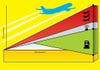
Al Bryant, a veteran Boeing engineer, moved to Beijing shortly after the Olympics to oversee the company’s R&D effort in China. He became famous in aviation circles for his role as a traveling proselytizer for the importance of biofuels in general and algae in particular. His presentation centers around a graph that projects likely emissions from airline travel through the year 2050. This chart has been the premise for Boeing’s argument that it is time for an all-out push for practical biofuels, especially from algae. The chart’s green wedge, showing the hoped-for carbon improvements from biofuels, would not simply keep the aviation industry from grossly increasing CO2 emissions as traffic goes up but actually reduce them to less than their 2009 level.
When an engine burns fuel from algae, it emits CO2 just as if it were burning fuel pumped straight from the Persian Gulf. But the algae would have removed at least as much CO2 from the atmosphere while it was growing. So in principle, and with allowances for inefficiencies and fuel costs in the production process, algae-based fuel could allow airplanes to fly on something much closer to a “carbon-neutral” basis, also sometimes called operating on a “current carbon cycle” (versus the “fossil carbon cycle” of burning coal or oil).
The aerospace argument for new biofuels takes full account of America’s ethanol disaster in the 2000s. In one of the worst policy mistakes of modern times, the U.S. government subsidized farmers to grow crops, mainly corn, that could be converted into ethanol and blended into gasoline supplies. This made no sense in energy-efficiency terms. (It took more energy to plant, fertilize, harvest, and process the corn than the ethanol yielded.) It made no sense in economic terms, except as a subsidy to the farmers and agribusiness. It made no sense in moral terms, since it diverted crops that could be used for human or animal feed into transportation fuel. So the aerospace standard is to find biofuels that don’t directly or indirectly compete with the human food supply; that represent true carbon savings as corn-based ethanol never could; and that can be sustainably grown and harvested without depleting water supplies or doing other long-term damage.
Whatever biofuel the aviation industry creates must have the same “energy content” as current fuels, so that aircraft as big and heavy as today’s can fly at comparable speeds. It must be compatible with the design and technology of current jet engines. It must be compatible with the existing worldwide infrastructure of fuel storage and distribution. And—trickiest of all—it must be interchangeable with today’s jet fuel, which is stockpiled at airports around the world. “You need to be able to leave Beijing with a tank full of biofuel, go to Lima, Peru, refuel there with normal fuel, and fly back,” Bryant told me in Beijing. “You can’t have an airplane stuck in Lima because it can’t use regular fuel.”
By process of elimination, these criteria have led mainly to algae. In principle it can produce five to 10 times as much fuel, per acre of surface area, as oil palms (which are largely grown on land where tropical forests have been clear-cut), soybeans, corn or other crops that can be used for biofuels. It grows and produces the oil many times as fast as more-complex plants—an algae crop cycle is a matter of days rather than weeks or months. It can be grown on land that is otherwise too barren or unusable, and in water that is too polluted or brackish for any other human or agricultural purpose. “The world’s entire aviation-fuel needs could be taken care of by algae facilities the size of Belgium,” Bryant said. (He waited for me to make the requisite joke about the highest and best use of Belgium’s landmass, which I did.) Other American and Chinese scientists I interviewed were skeptical that algae farming could become practical that quickly, or affordably, or at the needed scale. Nonetheless, Boeing’s calculations assume that a sustained world oil price of $90 per barrel or above would make algae-based fuel economically practical, once production techniques are improved. World oil prices peaked at above $140 per barrel just before the world financial collapse of late 2008. During the crash they fell to as low as the mid-$30s, then climbed above $80 by early 2010 and remained there through 2011.
Boeing is now working with a variety of state-owned research facilities across China on sustainable-fuel projects, especially involving algae. Chinese universities and technical institutes are among the world’s leaders in algae research, especially the descriptively named Chinese Academy of Sciences Qingdao Institute of Bioenergy and Bioprocess Technology. Here is where the world’s hopes for making aviation more environmentally sustainable may lie. Much of the worst—and best—news about the world’s environment is coming out of China. It’s worth noticing the good.

China Takes Off: Path
The Path Not (Yet) Taken: Increasingly refined navigation techniques have made landing patterns more efficient. The sweeping radar-guided path is the one most airplanes have flown at most airports in the world through the past half-century. The RNAV (for “area navigation”) approach relies on GPS and is closer and more efficient than radar guidance from controllers—but still not quite direct. The RNP (“required navigation performance”) path is the flight performance that new software and autopilots already make possible at most airports. Finally, the Optimized RNP path shows what is possible at the airports that have been most
carefully instrumented and set up with the approaches mapped to their precise geographic and urban setting.
China Takes Off: Emissions
Zero Net Emissions by 2050?: As flights increase in China, India and the Persian Gulf region, carbon emissions will rocket past 2009’s already troubling baseline. Replacing older, heavier planes with newer models [the red bar] and improving routing and other air-traffic-management procedures [gray bar] could cut the rate of growth in half by 2050. But using aviation biofuels [green bar] made from CO2-eating algae could do more than reduce the rate of growth. If production systems are put in place (and if they actually work), it could reduce net carbon emissions to a rate that is actually lower than that of 2009.
James Fallows is the author of China Airborne, which will be published by Pantheon this month.