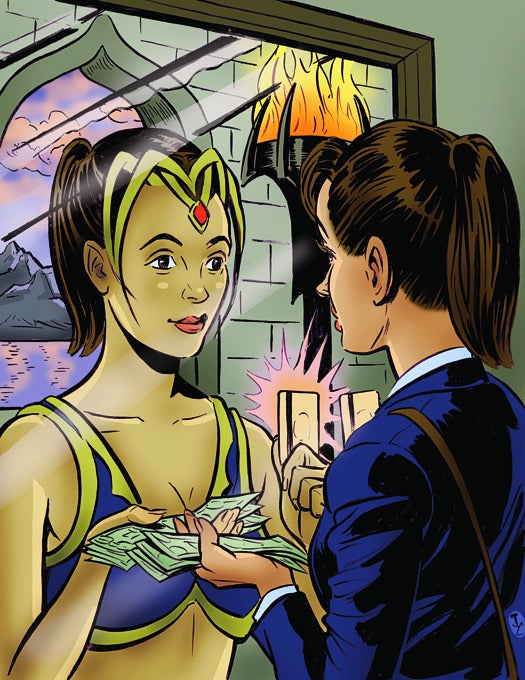
Money In The Mirror Jonathan Carlson

On October 3, 2008, President George W. Bush signed the Troubled Asset Relief Program bill into law, delivering $450 billion to failing banks on the premise that it would prevent their collapse and stimulate a faltering economy. Like millions of Americans, Dmitri Williams, an associate professor of communications at the University of Southern California, found TARP troubling—not because the bill provided too much or (as many economists argued) too little, but because it was unscientific. “We did a half-a-trillion-dollar experiment with the economy and had no control group,” he says. Setting up a test bed for a program as complex as TARP might be difficult, but it wasn’t impossible. Williams had found just such a petri dish in videogames.

Williams, a sociologist, had always based his research on data gathered by clipboard-wielding graduate students. But when people know they’re being watched, they change their answers with startling regularity, so much so that the behavior has a name, the Hawthorne effect (for the factory in Chicago where it was first observed). Four years ago, just before the economy imploded, Williams and his colleagues found a way to counteract the Hawthorne effect. After asking permission from the game’s manufacturer, Williams was able to access 4.5 terabytes of player data from the “massively multiplayer” online game EverQuest II. The data set was enormous; it chronicled every action, exchange and decision made by nearly five million players. By comparison, the General Social Survey, the benchmark for sociological research in the U.S., consists of some 800 questions answered by about 5,000 people. The game data also drew on behavior that was, at least from the perspective of the players, unobserved. 

Now Williams had to determine which behaviors were true in both the real world and in games, a process called mapping. He and a team of computer scientists looked at five months of economic data from EverQuest II, in which players buy and sell roughly two million items every month: a real economy at work. Williams then set about studying the data from two different servers, where two groups of people—a test group and a control—played the same game with the same conditions. The control group was filled with people who had already been playing EverQuest II, and the test group was made up entirely of new players. “It would be like taking a copy of the U.S. and removing the people and then seeing if you’d get the same country, with the same behavior when you repopulate it,” Williams says. Players’ activities in EverQuest II mapped theories of money that had never before been tested on such a large scale. Unsurprising though it may seem, the fact that as more gold coins were added, prices in the game rose, proved that the communities of EverQuest II could be a stand-in for the American economy—and a way to safely field-test those billion-dollar bailouts before any real money changes hands.

16 Comments

The end game of capitalism is to gather all the money in the world in one humongous bank account using 1 cent transactions.

Play money and games is our crystal ball into the future. While it did not collapse the system by bailing the banks out; it is my opinion the villains won and the poor sheep that got lead into risky loans by widening credit rules were abuse, kicked and some butchered! So these poor sheep that only wanted to buy a home lost their homes or gave up on their homes as the economy sank. What is their opportunity for the future via our government playing games with economics, they get to pay rent the rest of their lives for a poor credit rating now called badly. But that isn’t the end result, oh no, we give bank CEO bonuses.

Now let’s really back this story up fairly. Who set the rules for banking and terms of risk; answer our friend the government.

Between 2005 and now has inflation for all other items in this country come down, no. Everything else continues on in inflated and rising. Unemployment continues too in a high scale. Basically this whole economic game just furthers the gap from the rich and the poor and allows less people to own property.

My house built in 2005 was worth 153k. It was a model home and the builder sold it last need to sell it quick in 2009. I bought my home for 100k. Currently in my community 14 homes are left abandon and the value of my home is around 43k. I continue living there simply, because what I pay in house payments is less if I were renting in the community. It is my belief since everything else in the economy continues to rise via inflation and rents too, my home will gain its value back, but it will just take years for it to happen.

In the big picture, I feel our government represents big business and the rich and the middle class and lower is something to exploit.

I am for our USA country and the government that is written down in laws, our constitution. But I sure like to clean house of who currently is in the government now making decisions.

.............................
Science sees no further than what it can sense, i.e. facts.
Religion sees beyond the senses, i.e. faith.
Open your mind and see!

Thank you Robot for the irrelevant rant and information regarding your home.

Now about the article:
I like the idea of studying human behavior using videogames, but even using the control group of experienced players vs inexperienced, I'm not convinced that the economies will be a reliable analog of the real world. The key difference in my opinion is that players know they are playing a game and not real life. For example in Everquest a player will be willing to spend every last penny they have on an item while in the real world we make sure we have some cash to fall back on since the repurcussions of going broke are far more serious. Also the absence of complex financial instruments has to make a huge difference, right?

Silverjeff,
I posted my real life as making my points revelant to society as you are doing now with people do not spend all their money to the end. But pay attention now and you might learn something, people of low income were goated into believing they could aford a property they could not afford when the balloon payment came due in 3 years. So in other words, they spent all their money to the end. Now these people looking at super high payment on a home that lost value and walked away. Now it was obvious this scheme was open to the loan office who work on commision and so the invention of the robot document signers was invented, pushing through a lot of loans for people fast as they could all for that commision check.

Being poor is not a crime and the way people of low income or low credit was exploited was a crime. I understand the mentality of why so many people walked aways from their house when a bank and the institution you do not understand, but is suppose to protect you and make wise loan decisions confuses you and exploits you. These people are looked down on as dead beats, when in fact they were exploited and just need financial guidance. So who does our government bail out, the banks. The same people they gave the easy loans guide lines.

The low income and poor credit and easily confused were scamed, by both the banks and our government and now they profit off them paying rent the rest of their lives.

.............................
Science sees no further than what it can sense, i.e. facts.
Religion sees beyond the senses, i.e. faith.
Open your mind and see!

BG strikes again...........

Hey science isn't just counting numbers for the sake of counting numbers. Science has a human goal and reflects back onto us all; including this game scenario.

.............................
Science sees no further than what it can sense, i.e. facts.
Religion sees beyond the senses, i.e. faith.
Open your mind and see!

"Unsurprising though it may seem, the fact that as more gold coins were added, prices in the game rose, proved that the communities of EverQuest II could be a stand-in for the American economy"

Although it is comforting that such a simple theoretical result can be reproduced in a virtual economy, it will take more to show that virtual economies reflect the subtler behaviors of individuals in the real economy.

I wish real world economics were as simple as game economics. One of the main ways to make money in games like that is go find a monster, kill it, pick up loot, wait for monster to respawn, repeat. In the real world money does not just materialize out of thin air-unless your the government printing it.

@cholin3947

not all game economies are so unrealistic. in some, the monster drops something which has to be sold and farming the same material will cause an oversupply and the price will drop. in some, the cash needed to buy health potions and repair equipment will balance the cash gained by farming

This article is about making decisions of 450 billion dollars and other future economic decisions that have and will be made for the benefit of our economy and the use of game simulations to help make those decisions. I see people being sheep or cattle and giving away all their money and rights to elected votes and remote government leaders. They eat their curd or grass; go to work and oblivious to the world around them.

I wish more people with a background in economics and simulations would comment in this article.

As much as people are shy to comment on POPSCI for fear they ridiculed, a great many do read and learn. This article in so many ways does affect our REAL life!

As I read the news yesterday, the only economic solution for balancing the budget is to admit it is impossible to balance the budget, with hopes things might change 20 years in the future in the ability to make laws and political decisions. All we can do now is attempt to stay afloat and cut as much as possible from the budget as the years go by.

Rather grim.

.............................
Science sees no further than what it can sense, i.e. facts.
Religion sees beyond the senses, i.e. faith.
Open your mind and see!

I hate that most comments sections quickly turn political. Not just popsci.com, but everywhere. Facebook posts too. Less is more. Enjoy the articles. Have a good day. Leave Britney alone. Wait, what?

This would be good for huge microeconomic studies, but macro trends have been able to be modeled for a while. Austrian (economic theory) think tanks were only wrong in their predictions in that they thought collapse was going to happen sooner and more dramatically. I saw these predictions in college in 2003-4, but I don't remember the source. They were using calculus to model the market for loanable funds. The plus side of this is that maybe we can finally test the validity of Keynsian practices.
The problem is not big business. They will fair better in troubled economies just as large boats fair better in troubled waters. The problem lies with trying to control the waters-it will only make the currents more unpredictable.

@vmaldia:

other than monster drops, some cash and rare items can also be obtained through questing and not just through trading, so there still exists cash and items that were just created out of thin air.

This feels like only half the article. It never answers the question of the title: "what did the video game tell us about real world economies?"

What was the result of the study?
What "theories of money that had never before been tested on such a large scale" were tested?
What were the results of those tests?

This article is intriguing, but provides absolutely no real information.

CleverHuman,
You are so correct, sir! ;)

very interesting, but merely whets my apetite, the comments provide a more filling read. Is there a part 2? (as CleverHuman pointed out)

I feel obligated to remark that pumping more money into the system doesn't fix the system, as MMO players know, adding gold without a gold sink only causes inflation (WoW -> traveler's Tundra)

Now, presumably, currency isn't printed as quickly as it's generated in games via drops, and some of the printed currency replaces older currency. Also, we can account for lost/destroyed currency though that can be likened to inactive accounts on MMOs (more or less) what's presumably missing is a stabilizing agent, some deflation to counteract inflation and vice-versa. limitations which becomes completely theoretical in real life.

Games can put limits on how fast currency can be farmed. This sets a standard for the value based on time spent. Something that takes 15-20 hours to get would presumably have a cost of currency farmable in that amount of time.
When humans become involved everything becomes theoretical. Truncating my post for brevity.


June 2013: American Energy Independence

Five amazing, clean technologies that will set us free, in this month's energy-focused issue. Also: how to build a better bomb detector, the robotic toys that are raising your children, a human catapult, the world's smallest arcade, and much more.


Online Content Director: Suzanne LaBarre | Email
Senior Editor: Paul Adams | Email
Associate Editor: Dan Nosowitz | Email
Assistant Editor: Colin Lecher | Email
Assistant Editor: Rose Pastore | Email

Contributing Writers:
Rebecca Boyle | Email
Kelsey D. Atherton | Email
Francie Diep | Email
Shaunacy Ferro | Email

circ-top-header.gif
circ-cover.gif