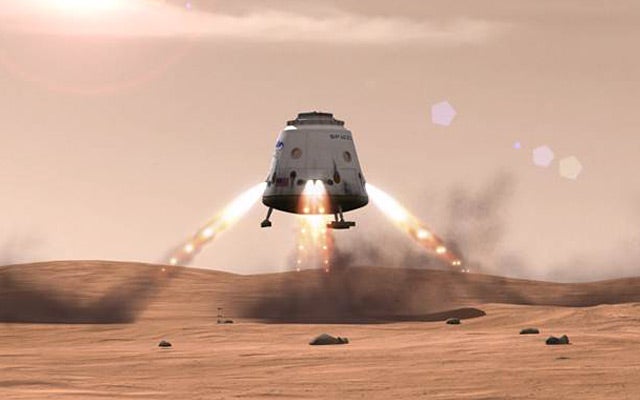
SuperDraco's Could One Day Allow Propulsive Landings on Other Planets SpaceX

SpaceX’s dream of fielding a spacelaunch system that is completely reusable is inching forward with the successful test-firing of its new SuperDraco engine. The powerful new SuperDraco will be installed in the side walls of the next-gen Dragon spacecraft and provide up to 120,000 pounds of axial thrust, enabling not only on orbit maneuvering, but emergency escape from the rocket tower should something go awry during launch.

The Draco engines currently used on the Dragon spacecraft allow the robotic resupply capsule to maneuver on orbit and orient itself during reentry, but SpaceX has bigger plans for a system that will one day be able to return all elements--including rocket stages--to Earth intact for reuse in later missions. That’s a tall order and a long way off. But the SuperDraco is a step in that direction.

More powerful than the Draco, the eight SuperDracos that will reside in the side walls of the Dragon can essentially propel the Dragon capsule on their own, making it possible for astronauts on board to abort at any time during a launch and separate from the rocket--that is, the controlled explosion--hurling them skyward. That’s a huge advantage over previous launch abort systems, which could only be triggered successfully during the first few minutes of a launch.

They can also be restarted multiple times and can be used repeatedly, meaning they wouldn’t have to be completely re-serviced each time a capsule went into space. During the recent tests at SpaceX’s Rocket Development Facility in Texas, the SuperDraco underwent full thrust firings, full duration firings, and a series of deep throttling demos, passing each test, we’re told, with flying colors. We’re still a ways away from that space capsule that can navigate itself back to the launchpad under its own propulsive force but as the video below shows, we’re getting there.

[SpaceX]

13 Comments

What happens when only 1 of the 4 motors fails to ignite? Pretty sure that design is relying very heavily on a perfect scenario every use unless a tail-spin is considered a back-up plan.

@ToomeyND
The article says 8 engines. If they are grouped in pairs, like in the picture, one failure could be compensated for.

If this ever flies to the moon, will it NOT make smoke and NOT make crater holes in the ground, and NOT kick up any dust on the landing pands of the lander, just like the Appollo Lander did NOT do too?

.............................
Science sees no further than what it can sense.
Religion sees beyond the senses.

Nice try @Robot, but folks that think that the moon landings were faked aren't the type to be convinced by evidence or rational arguments. They will say the footage was altered by NASA or SpaceX is a puppet of the NWO.

...then what happens if *those* rockets fail, not the big ones underneath? oops.

I cannot wait until we have the ability to put people into space again. I cannot stand having to rely on the Russians, but as I understand, their program is now on hold due to recent problems too. So for the second time in 4 months, NASA is discussing possibly having to temporarily abandon the ISS. This is why its not good to only have one way into space.
Science always asks "can we," but doesn't seem to ask "should we."

@robot
trolling or serious?

i am sure they have some kind of back up parachute system

lanredneck,
I did not confirm or deny about moon landings.
I have watch the Appollo moon landings and notice the rockets of the lander do not make smoke, do not make craters, do not kick up dust on the landing feet.
I did not say anything more beyond this.
You and others can draw you own conclusion.

.............................
Science sees no further than what it can sense.
Religion sees beyond the senses.

@Robot
The lunar landers used liquid fuel which was often smoke-less. And it never made craters because the lander had a throttle. It was lowered once the ship came in low. Imagine this; The moon is 1/6 gravity of Earth's right? Well, you don't need very much power in low gravity. Also, the astronauts commented that the moon was basically rock with a thin layer of dust.

GarudaX,
If the fuel is compressed, yes it is liquid fuel. It be liquid is not the point. The rockets used are actually the same ones they use on the space shuttles. If you watch video of the space shuttle jetting around, you can see the thrust and yes the smoke in the vacuum of outer space.

You should read the commentaries of concern about the lunar dust and what it may do, as it get on and in and about the lunar Lander. They were crazy concerned about the lunar dust in words. They even worried about the lunar Lander sinking into the lunar dust.

Have you seen the size of the center lunar Lander rocket? It is BIG! The center rocket under the lunar Lander did not make a crater, did not put dust on the landing pads.

Just do some research about the lunar dust and the worries NASA had about the lunar Lander landing on it and what the dust may do if it gets inside the astronaut suits and Lander. The NASA worries and concerns are not what you see in the videos of the Lander itself.
The video does not match the concerns!
The video does not match the reality of the moon and its dust.

.............................
Science sees no further than what it can sense.
Religion sees beyond the senses.

That blast didnt look right ill do some test on the image!

Regarding Robots reply to GarudaX:

Here is a bit of knowledge to help clarify your misinterpretations - which cause your doubts.

The views we have of the LEMs (LM) during the final stages of the landing sequence are taken from the interior looking outward through the window. As the LEM nears the ground you can clearly see dust and debris being blown away from the LEM. The lack of atmosphere leads to zero suspended dust particles. The smallest dust particles travel and settle in the same manner, and just a quickly, as larger rocks - a parabolic trajectory. As the rocket nozzle is mounted above the foot pads, it in fact blew all the dust off of the pads as it also cleared off the thin layer of dust off of the underlying bedrock.
The large size of the rocket nozzle has an effect opposite of what you perceive. It disburses the exhaust/thrust over a larger area thus also intentionally preventing the creation of a crater which may have been created by a smaller nozzle and would have thrown debris upward toward the LEM potentially causing damage.
The Aerozine 50/nitrogen tetroxide fuel blend ratio used in the LEM descent engine produces negligible visible exhaust and, viewed against the detailed lunar surface with the ejected particulate matter (dust) would not be visible.
Nasa was concerned about the depth of the dust but it turned out to be a very thin layer over hard rock.

A bit of research will show the errors in the remainder of your observations as well.

Creating conspiracies behind the moon landing is not even necessary - It's pretty darn fascinating in real life!

For the record;

8 SuperDraco's mounted in pairs but separately controlled. If one fails it can be compensated for by re-throttling the others. There are also 3 parachutes, of which only one is needed for a safe landing. Also; landing only requires 20-25% throttle, so there is redundancy and margin to burn.

DocM


July 2013: The Future Of Flight

The incredible innovations, like drone swarms and perpetual flight, bringing aviation into the world of tomorrow. Plus: today's greatest sci-fi writers predict the future, the science behind the summer's biggest blockbusters, a Doctor Who-themed DIY 'bot, the organs you can do without, and much more.


Online Content Director: Suzanne LaBarre | Email
Senior Editor: Paul Adams | Email
Associate Editor: Dan Nosowitz | Email
Assistant Editor: Colin Lecher | Email
Assistant Editor: Rose Pastore | Email

Contributing Writers:

Kelsey D. Atherton | Email
Francie Diep | Email
Shaunacy Ferro | Email

circ-top-header.gif
circ-cover.gif
bmxmag-ps