First test fire of new prototype is a success

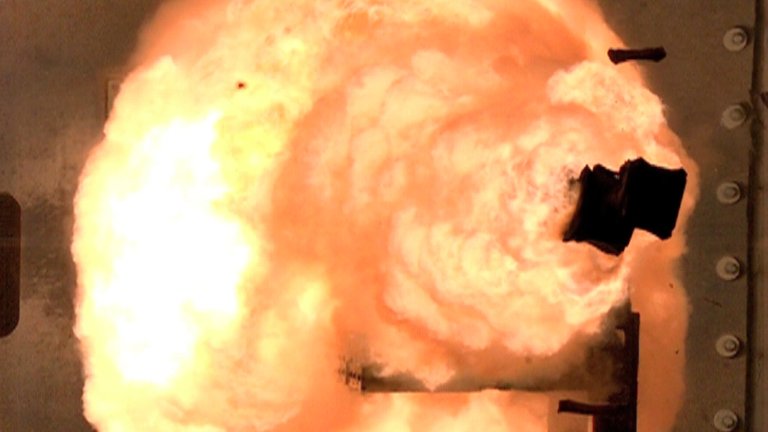
Railgun Blast The Navy is testing its newest electronmagnetic railgun, the first of two industry-built launchers to be delivered. Office of Naval Research

A new prototype of the Navy's weapon of the future just completed its first test, blasting a chunk of metal through the air at speeds up to 5,600 MPH. Watch below as the Navy's electromagnetic railgun spews a formidable jet of orange flame.

The best part is when the air behind the speeding projectile blurs with heat!

Defense giant BAE Systems delivered the prototype railgun Jan. 30 and the Naval Surface Warfare Center Dahlgren Division just started testing it. The Navy has tested other designs in the lab, but this one is the first industry-built model. Tests will last two months, during which the Navy will check out the railgun's structural integrity and barrel life. Another model, built by General Atomics, is due to be delivered in April.

This one is a 32-megajoule demonstrator, according to the Office of Naval Research — for comparison, one megajoule of energy is equivalent to a 1-ton car thrust at 100 MPH.

The eventual goal is a ship-mounted 20- to 32-megajoule weapon that shoots a distance of 50 to 100 nautical miles. It shoots projectiles using electricity instead of chemicals, which would theoretically be safer because you would not have to tote dangerous gunpowder on a ship. It uses an electric field to accelerate a metal conductor between two rails and launch a projectile.

Here's a video of a previous test.

16 Comments

Nice! Getting hit by one of these would be the inertial equivalent of being rammed by an Abrams tank going full speed. That is an assload of energy!

This was news in 2008.

That 's not heat. It's the shock wave from the hypersonic projectile. The "sonic boom" if you will.

That is pretty amazing. That is a massive amount of energy used to propel that object. I wonder how they plan on powering such a weapon on the battle field. Maybe a really long extension cord? I don't imagine batteries or generators would be useful in a prolonged engagement. What I am looking forward to (decades away I'm sure) is some sort of hand held rail gun. Something like the Tesla Cannon from Fallout, yes please!

Aircraft carriers have near unlimited power. Perfect platform for a little railgun action. Maybe it's a good excuse to commission some new nuke destroyers/cruisers too.

32 megajoule isn't that much. Current ships easily have enough power but it is easy to add in an extra turbine power pack.

Not like it needs that much power for more than a bit of a second.

Can I order one of these in a machine gun style?

Is there a smaller home version I can buy online?

Since it’s not technically a weapon yet per say, can I mount this on my car?

Has NASA looked into using this for asteroid deflection?

What happens if the at the end of the gun, the closing hatch does not lock properly? Does the guy standing behind the gun having a steel belt buckle get sucked into the gun as it's fired?

Are there plans for a smaller version I can build at my home?

IS the FBI and Home Land Security reading my question as this moment on POPSCI?

..........................................
See life in all its beautiful colors, and
from different perspectives too!

Space:
Machine gun style, no. Railguns are pretty much always going to have to be single shot weapons due the friction/heat on the rails which could result in damage to them. Coilguns on the other hand which also use electricity to fire rounds could be made to be auto-fire weapons presuming you had ample capacitors and current.

Idk about buying one, but you can build one. instructiblesDotcom has guides for coilguns and railguns.

It is a weapon. Don't mount it on your car.

If you had a big enough one to fire into orbit, the round would likely just punch a hole through the asteroid or cause it to explode, not helping the situation in either case.

Not possible. The rear hatch has no true function in guns of this kind other than to keep stuff out of the barrel. There is no explosion going on so you could fire it with the rear hatch open.

See above.

As evidenced by the article earlier regarding the DHS, probably.

The technology is impressive. Hats off to the engineers that made it a reality.

However, in this day and age of guided missiles and drones, how applicable is it? What kind of shell would it be delivering at a range of 50 to 100 nautical miles? Also, what kind of target(s) would be considered its primary mission?

A lesson that was learned in WW2 is that the days of battleships slugging it out on the high seas were numbered. The biggest battleship of the time, the Yamato, was sunk by airplanes. Also, it was an Airplane, an old swordfish torpedo bomber, that damaged the rudder of the Bismarck and made the ship unable to manoeuvre thus allowing ships of the British fleet to close in and sink her.

About the only advantage I can see is that an incoming shell is harder to shoot down ( almost impossible) than an incoming missile. However, there are other weapon systems that have a range far greater than 100 nautical miles that would be firing on the ship before the rail gun came close enough to the enemy to be employed.

I still think it is a cool technology. But I do not see what weapon system that is already in service that this new system will augment or replace.

Nasty! Now I know why railguns in the old Mechwarrior games were so devastating.

If it only uses electricity and no gunpowder, what's with all the flames? Is that a special effect just so it looks cool?

the flames are from the friction of the projectile going from standstill to well over mach 2 at least. that and also you have a very high current very low voltage, you can hear that afterwards in the first video when it sounds like there's a bolt of lightning AFTER the gigantic explosion. that's the plasma making a connection from one rail to the other, something it couldn't normally do because it's probably only 110 volts.

if it's anywhere near 100 volts to 120 volts then it could charge on the domestic power grid. i don't think this is much of a ship to land weapon as i think it's a land to ship weapon. the ballistics alone would require such a low level of inclination that it would bust through any kind of house or building that went up against it and after what it was supposed to hit.

the news is that they've changed the design, if you look at the two videos the second one is gigantic compared to the one in the first video. that means that they've made it smaller already and it met the higher half of their 20 to 32 megajoules energy goal.

this is crazy, i bet they are already using it, the ballistics of this must be completely insane!

to mars or bust!

@matsci1...at that speed a projectile is all that is needed, the advantage is the short time to target, eliminating any evasive maneuvers by the target, which could be land or sea based(the target), check out the free electron laser, it will take offensive and defensive operations to a whole new level, cheers

Hello Dr. Chuck,

Even though the weapon can shoot 100 nautical miles it can not be used as a direct fire weapon over that distance because of the curvature of the earth. At a distance of 15 miles this has an effect.

http://www.howstuffworks.com/question65.htm

I saw a video on youtube about navel gunfire that also made this point but I can not remember the title of it. Even though it has a lot of kinetic energy at the muzzel, it can only be used as an indirect fire weapon at those distances and I would imagine that the shell would lose some of its velocity.

The weapon is impressive. However I still do not see it replacing any of the existing systems that are already deployed.

BOOM!
My bullet is unstoppable and your dead!

......................
SPOOKY!...... Life is

@ matsci1 i believe you mean the Coriolis Effect, correct?


140 years of Popular Science at your fingertips.


Popular Science+ For iPad

Each issue has been completely reimagined for your iPad. See our amazing new vision for magazines that goes far beyond the printed page


Download Our App

Stay up to date on the latest news of the future of science and technology from your iPhone or Android phone with full articles, images and offline viewing


Follow Us On Twitter

Featuring every article from the magazine and website, plus links from around the Web. Also see our PopSci DIY feed


February 2013: How To Build A Hero

Engineers are racing to build robots that can take the place of rescuers. That story, plus a city that storms can't break and how having fun could lead to breakthrough science.

Also! A leech detective, the solution to America's train-crash problems, the world's fastest baby carriage, and more.


Online Content Director: Suzanne LaBarre | Email
Senior Editor: Paul Adams | Email
Associate Editor: Dan Nosowitz | Email

Contributing Writers:
Clay Dillow | Email
Rebecca Boyle | Email
Colin Lecher | Email
Emily Elert | Email

Intern:
Shaunacy Ferro | Email

circ-top-header.gif
circ-cover.gif
bmxmag-ps