In October, manufacturing 100-watt incandescent lightbulbs will become illegal under the U.S. Energy Independence and Security Act. As part of the same legislation, 60- and 40-watt ones will be banned by 2014. Compact fluorescents (CFLs) are the simplest-to-make replacement but contain the neurotoxin mercury, have a bluish hue, and don’t illuminate instantly. The regulations are prompting lighting companies to develop new, environmentally friendly ways to produce light that have none of CFLs’ downsides.
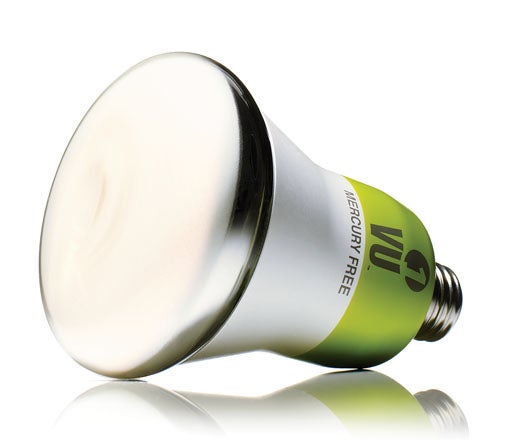
The Electron Stimulated Luminescence (ESL) bulb, pictured top, produces the soft light of an incandescent but is far more efficient. The bulb shoots a beam of electrons through a vacuum toward the glass’s phosphorescent coating, similar to how old cathode-tube-based TVs work. The first ESL bulb, an R30-shape for recessed ceiling fixtures, uses just 19 watts to produce the same amount of light as a 65-watt incandescent. Bulbs appropriate for household lamps will come out later this year. Vul R30 ESL $15
LED bulbs are 75 percent more efficient than incandescents but can short out if they get too hot. Fried circuits are common if the bulb is installed threads-up, because rising heat overwhelms its heat sink. The company Switch uses a food-grade liquid to cool its LED bulbs, allowing them to work in any orientation. In the bulb, the liquid pulls heat away from the LEDs and causes it to dissipate through the glass. The resulting bulb cools 40 percent better than other LEDs. The placement of the LEDs gives an incandescent-like, omnidirectional glow. Switch Switch75 $25
The greenest lighting would use no electricity at all. The Bio-Light concept from Philips Design could generate a negative carbon footprint by turning waste into light. Glass containers of bioluminescent bacteria suspended in liquid would be connected with tubes to an anaerobic digester that processes household waste. As the organisms ate the sludge or methane gas from the digester, they would softly glow. The bacteria could be genetically engineered to shine in various hues and to start producing light when they sensed that it was dark out.
Five amazing, clean technologies that will set us free, in this month's energy-focused issue. Also: how to build a better bomb detector, the robotic toys that are raising your children, a human catapult, the world's smallest arcade, and much more.


Online Content Director: Suzanne LaBarre | Email
Senior Editor: Paul Adams | Email
Associate Editor: Dan Nosowitz | Email
Assistant Editor: Colin Lecher | Email
Assistant Editor: Rose Pastore | Email
Contributing Writers:
Kelsey D. Atherton | Email
Francie Diep | Email
Shaunacy Ferro | Email
afaik, incandescents will be banned as 'light' bulbs. they will continue to be sold as 'heat lamps'
40 and 60 watt bulbs aren't going to cut it we need 100 watts or more.
hollycow,
In my home, we don't use a single 100W bulb. In my opinion, they are far too harsh and bright. I walk into public places, or other peoples' homes and am blinded by the intense light. Yes, there are some places that need extreme light, but most people seem to think that their house must be completely bright enough to read in. If you're not reading in the corner, you don't need 100+ lux there.
Simply turning off lights when you don't need them, and using 'weaker' lights in the places that you do need light, you can save a ton on energy costs even without switching to 'efficient bulbs' (living in Canada, I prefer to use incandescent bulbs in the winter as they lower the need to use a furnace).
the only problem with some of these newer lights is their price tag. maybe the bio light wouldn't be too expensive, but I'm not counting on that.
--------------------------------------------------------------------------
why learn from your own mistakes, when you could learn from the mistakes of others?
“The most incomprehensible thing about the universe is that it is comprehensible” -Albert Ein
I can't stand the "soft" or "yellowness" to incadescent bulbs or even normal CFL's. I like the "daylight bulbs" which are typically around 5500K (color temp)
I it should be all LED, and also don't forget about CCFL. Thats not a typo, CCFL are different then CFL, although technically a CCFL is a type (or sub-type) of CFL just like todays "LED" tv's are really just a different type or "sub-type" LCD tv's.
Aaaa, at least I can still have my oil lamp with its gentle flickering warm light, heavy sigh.....
I really do hope they perfect the LED lights and get rid of Florissant lights. I have such a worry in the long run; it will fill our environment with mercury. Florissant lights are fine in business as long as they dispose of them correctly. But, I just imagine all those home users tossing those broken lights with the trash!
.............................
Science sees no further than what it can sense.
Religion sees beyond the senses.
Modern CFLs don't necessarily come in a blueish hue and they do illuminate instantly. This new type of bulb sounds interesting. Does it produce X-rays? The CRT does, and this sounds like it's a simplified CRT.
I have been very happy with common CFL lamps. Over the years they have saved me a lot of money on electricity and didn't have to change them very much. I agree the mercury issue is bad. The latest ones instantly start and I use it in the fridge. Nice and bright and cool.
I did however waste my money on the so called latest LED and it takes about 1-2 seconds to start. Flickers and doesn't look correct.
I personally like the cold cathode CFL I use as a tv light. It uses like 3 watts and seems maybe as bright as a 20wat or 25 watt incandescent.
I might just try one of these vue lamps tomorrow.
I have been buying CFLs for years but I have yet to find one that works with a dimmer switch. Do any of these?
Also, I've never had a CFL to last as long as the packaging indicates. Some have only lasted a few days. Considering the difference in cost and the environmental issues, pitching CFLs in the trash is more painful.
I prefer to buy double-life bulbs over CFLs for some areas of my house because of the above. Are those going to disappear too?
You can find dimmable(indoor use only)CFLs at many stores. I got a few dozen at Costco. Cheaper bulbs seem to me to be slower to full brightness.
Lowes and Home Depot gladly advertise and take old ones for recycle and may even replace those that die too soon, save receipts.
Your trash company (check your bill for info too) and municipal govt may also offer simple recycle. Web lists several for profit recyclers for your area.
CFLs in ceiling can lights or in tight fixtures will die sooner due to rising heat in fixture over heating the base.