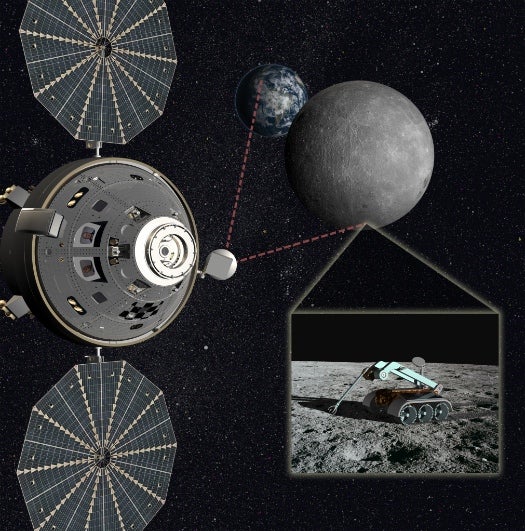
An Orion Capsule Directs Traffic on the Moon From the Far Side in this Concept Lockheed Martin via SPACE

The NASA budget that went to Capitol Hill yesterday dashed any plans to initiate new Mars exploration missions in the next few years, but amid the belt-tightening SPACE reports that NASA is exploring another idea that, while much closer to home, is still quite ambitious--the building of a manned waypoint (read: space station) at the Lagrangian point EML-2 on the far side of the moon. This international space station (but we’ll have to think of a better name) would serve as a jumping off place for new science missions as well as a gateway to other destinations like asteroids, Martian moons, and--eventually--Mars.

NASA, its Mars ambitions on hold for now, is viewing such a waypoint as a near-term exploration asset with the capacity to deliver new science and technologies within the decade. It would incorporate NASA’s core next-gen capabilities--the planned heavy lift rocket known as the Space Launch System (SLS) and the Orion Multi-Purpose Crew Vehicle--as well as technologies contributed by international partners.

And in the near-term, it could put humans further out into space than they’ve ever been--the kind of superlative mission the agency as lacked since the glory days of the Apollo Program.

According to a recent memo, NASA is fielding a team charged with developing a plan for exploring Earth-moon libration point 2 (Earth-moon libration point is equivalent to a Lagrange point, but specific to the Earth and moon), a point in space where the pull of two bodies roughly balance out, making it possible to more or less “park” a spacecraft there.

From EML-2, on the lunar far side, humans aboard a station could direct telerobotics on the side of our satellite that has been rarely studied (new lunar science!) while also conducting research into long-term deep space habitaiton (new human spaceflight science!) while giving NASA’s next-generation manned space vehicles a destination (a new place to go!).

The idea, of course, being to build on the station. Start with some lunar science and some new deep space science enabled by being in the “quiet zone” on the far side of the moon. And after learning a bit about the effects of habitation so far out in space, use the waypoint as both a technology test bed and eventual enabler for exploration further and further into space.

Of course, this all sounds really, really expensive. Which brings us back to NASA’s core problem this morning--a lack of funds for big flagship projects. We’re ducking out on commitments to the ESA and cutting costs elsewhere this week. But talk is cheap enough. A group of ISS partners is meeting in Paris this week and will likely talk through the idea. The study is due back to NASA by March 30.

[SPACE]

13 Comments

Could we do a space crane on the moon? At least we could set up a larger platform with some gravity for astronauts to work? Would give us more of a handle on how the crane would have to work. Think of it as small scale testing.

I'm sure this option has been considered and dismissed for a good reason, but I'll ask because I'm curious as to the reason why you couldn't move the ISS to the Lagrangian point? I'm guessing it would be impossible to move it without structural damage? I would think the further you get from LEO the less strain on the structure? Or is it logistical, ie resupply and crew rotation of that quantity becomes problematic at that range?

This is more of the same circular, self-propagating Govt agency thinking that has wasted the 40 years and $500 billion since Apollo..

NASA justified it's $1.5 billion/flight shuttle to service the Space Station... then justified the otherwise useless $160 billion Space Station as something for the Shuttle to do..

Net result? No American has left low earth orbit in 40 years since Apollo... and we are begging rides from Russians, praying to be rescued by SpaceX private enterprise..

There is a reason why all the previous space stations were junked, de-orbited.. Almaz, Salyuz, Skylab, Mir, etc... and why NASA wanted to de-orbit ISS as soon as it was completed..

Unmanned satellites/probes do science/observations far better/cheaper than humans.. a space station in any earth orbit gets us nothing..

We can orbit vehicle modules separately, combine/fuel them in orbit and send them on their way with zero need for a space station.

Private enterprises like SpaceX prove they can produce space hardware/capability for pennies on the NASA dollar.. SpaceX can get us lunar colonies, Americans on mars far cheaper/sooner than NASA ever will.

So now, NASA has started it's SLS/Orion without a purpose.. and wants to invent a ISS2 to justify it and give it something to do...

We need to kill the shameful earmarked pork, unneeded/unwanted SLS/Orion $60+ billion decade long boondoggles..

@ winterulz

Not entirely sure what you mean by space crane...

@ Intrepid Design

There are a few Lagrangian points to consider. It would probably be easier to move the ISS to L4 or L5 instead of maneuvering around the moon to get to L2. For that reason, I'm curious why the farside was picked as opposed to the alternatives. With regards to MOVING the ISS I guess it could be possible with a few modifications (it needs a few thrusters that will uniformly apply pressure to the entire station). It might just also be as expensive as building a new station...

@ ameriman

Strangely, I agree. NASA has been rather uncompelling and ineffective at advancing a comprehensive space strategy. It seems like a mish-mash of random ideas that get to ride along on very expensive rockets. I'm more in favor of the agency pursuing 2, and only 2 very limited goals: (1) Establishing long term habitation of space in both orbiting facilities and lunar structures. and (2) Establishing the first human outpost on Mars.

NASA needs to go back to that 'hedgehog' concept of the early Apollo programs where it focused on one thing, not a bunch of seemingly random experiments. Weather research? Leave it to the USAF, they operate their own space program. Experiments? Sorry, you guys have to fly private. This will eliminate a lot of waste there, and allow the agency to retain only the most talented individuals that will focus on a single, unifying goal.

This is actually started with an idea by Bleing in this proposal -

http://www.nasa.gov/pdf/604659main_6%20-%20Panel%203_Raftery_Final.pdf

NASA is exploring the idea, and it makes a lot of sense; it uses mostly leftover modules from the shuttle program and ISS construction plus (possibly) a new module as a habitat (Russian, Bigelow etc.)

Sending ISS there is out for 2 reasons: it's mass woule make it har to move that far and its logistics require frequent maintenance missions.

The Exploration Gateway could be outfitted for interrmittant manned habitation, and it would be launched in smaller parts moved to L2 by ion thruster tugs and assembled in place.

Once there it would provide a low-fuel/low energy jumping off point to the moon (just send it a reusable lander), the moon of Mars (how about a Gateway in Mars orbit?), asteroids, or where ever. Not only that, but being at L2 it could be used as a base for sevicing missions to satellites & telescopes also near L2 - including the James Webb Space Telescopee.

DocM

I think its more of a logistics thing along with a safety reason why the ISS isn't moved further out. It would probably also need more shielding against radiation as its further out. And besides, we really don't have anything that can get out there any more. NASA really needs to be given direction like JFK gave it direction. I realize back then it was just about beating the Soviets and now it's all about science and exploration, but I think NASA has too much on its plate right now and is going off in too many directions. Like JFK said, "not because it is easy, but becasuse it is hard." We need a challenge to rise up to and set high goals and then we need to beat them and raise the bar, only to beat that goal as well. I am excited about JWST, but if it is more than twice its cost, something needs to happen. How much are we going sacrifice for it? It better be so damn good that we can look in the window of an alien's house and see what they are watching on TV.

Science always asks "can we," but doesn't seem to ask "should we."

ISS would be impractical for a number of reasons I'm sure. But more than impracticality, it would be unlivable for long duration stays without a significant added shielding from radiation. EML2 is actually the wort point I believe, spending the most time outside the Earth's Magnetosphere.

It'd be safe for maybe a few weeks or so, but you'd build up a sizable dose on longer stays and eventually run into complications from exposure.

Seems NASA has a super ambition to put a space station behind the moon, so we can keep an eye on the goings and comings of our alien moon base friends!

What better way to get money and project funded for NASA, but to scare the people about the mysterious dark side of moon, ewwwwwww!

In reality, it does not matter what President is in office now, our economy has moved to the edge of default and yes NASA and all the other special projects are going to be cut.

.............................
Science sees no further than what it can sense.
Religion sees beyond the senses.

@ Intrepid Design

NASA studied raising the orbit of ISS, even if just for disposal. The amount of thrust that could be applied without structural damage meant that it would take literally years to raise the orbit to near the moon.

@ ameriman

NASA had a somewhat coherent architecture and program goal with Constellation but that was cancelled. It was Congress who directed them to do Orion and SLS. NASA knows full well that the programs Congress handed them lack an overall goal and that’s why they’re trying to manufacture one now. Don’t blame NASA, blame the earmarks and directed spending from Congressmen. If NASA was given their budget without all the directed spending in individual districts and allowed to establish the simple goals that lawsonrw advocated, they could achieve a much better result.

Contoria,
The active life of most current propulsion technology tends to be closer to minutes than years, so the technology investment cost would be high. It's not necessarily a bad thing, just a factor in the decision.


June 2013: American Energy Independence

Five amazing, clean technologies that will set us free, in this month's energy-focused issue. Also: how to build a better bomb detector, the robotic toys that are raising your children, a human catapult, the world's smallest arcade, and much more.


Online Content Director: Suzanne LaBarre | Email
Senior Editor: Paul Adams | Email
Associate Editor: Dan Nosowitz | Email
Assistant Editor: Colin Lecher | Email
Assistant Editor: Rose Pastore | Email

Contributing Writers:
Rebecca Boyle | Email
Kelsey D. Atherton | Email
Francie Diep | Email
Shaunacy Ferro | Email

circ-top-header.gif
circ-cover.gif