Feature
First, build a telescope the size of planet Earth
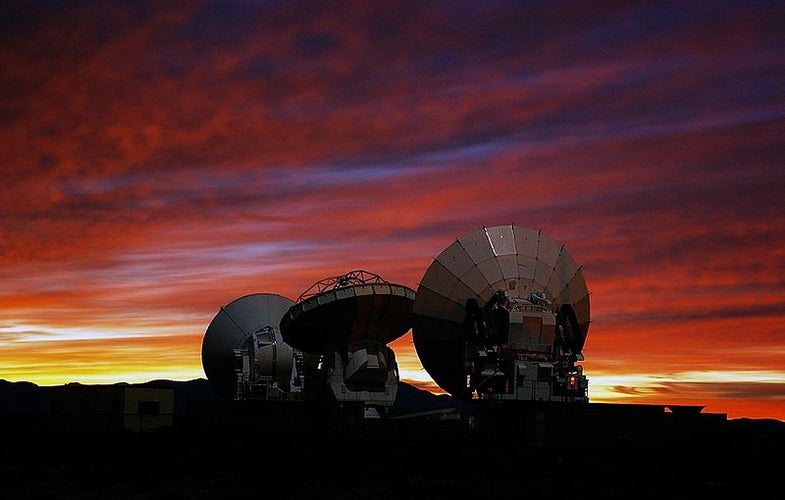
ALMA Prototype Radio Antennas ALMA (ESO/NAOJ/NRAO)

For something that might not even exist, black holes do a whole lot of work for modern physics. These regions of compact mass--so dense that not even light can escape their gravitational fields--are a major underpinning of general relativity, and inform much of what we think we understand about how galaxies work. It’s a lot to ask of a phenomenon that we've never actually seen.

Then again seeing a black hole is, by definition, a difficult idea to execute. The absence of reflected light makes black holes invisible, and the fact that the really interesting supermassive ones hide obscured at the center of galaxies compounds the problem. You would need to build a telescope the size of planet Earth to capture an image of a black hole. And that’s exactly what Sheperd Doeleman, assistant director of MIT’s Haystack Observatory, and his colleagues at the Event Horizon Telescope (EHT) are trying to do.

A virtual telescope with a data-gathering surface the size of the planet.The EHT is an international project aimed at taking the first picture of a black hole, specifically of Sagittarius A*, the site of the black hole that is believed to be lurking at the center of our Milky Way galaxy. Einstein’s theory of general relativity says it is there, and other observations of nearby galactic structures strongly hint at its existence as well. Einstein even told us what it should look like. But actually seeing it for the first time will tell us all kinds of things about the very nature of spacetime itself, and it will also tell us if relativity is breaking down at the core of our universe. Essentially, capturing an image of a black hole is a test of general relativity itself--a test of modern physics as we know it.

“Black holes are still theoretical constructs, they’re kind of like the unicorns of the cosmological world,” Doeleman says. “There’s very good evidence they exist, and our best test case is at the center of our galaxy where it’s fairly certain there’s a 4-million-solar-mass black hole lurking. But we haven’t seen it yet. To ask whether Einstein is right, you have to go to the most extreme environment in the universe, which is the boundary of the black hole.”

Getting there will require a blend of new technology, old tricks, and the anointing of a brand-new radio telescope array that will come online over the next few years. But Doeleman and the various collaborators building the EHT are now confident that what wasn’t even thinkable just a few years ago is now within reach, as technology has turned a time-tested astronomical technique into a tool that should give us our first glimpse of Einstein’s vision of gravity’s most violent manifestation.

That technique is very long baseline interferometry (VLBI), and it’s what allows the EHT team to build a telescope the size of Earth without actually building anything at all. By feeding data from radio telescopes around the world into a supercomputer, they can create a telescope with an imaging area the size of the entire planet, allowing them to capture images in radio wavelengths at resolutions that should let them see straight to the heart of the Milky Way.

Trucks Work On The Same Principle As Telescopes:  courtesy EZtruckstore.com
Think of VLBI like this: You’re standing at the center of the galaxy, looking at Earth, which is way out at the Milky Way’s fringe. Now, imagine Earth as a mirror, but only the places where there are radio telescope arrays on its surface are polished--the rest of this planet-sized mirror is blacked out. These polished spots are the only places on the mirror that can collect data. This sparse mirror wouldn’t provide a very complete picture to someone peering through the other end.

But now imagine the Earth rotating. The polished portions of the lens--the parts collecting data--begin to slowly move across the blacked-out areas of the mirror, collecting data from different points on its surface as rotation and the seasonal tilt of the planet continue. Eventually, the telescopes--and there are many scattered all over the globe--have collected data from positions all over this lens, just not all at the same time. Over months and years, this data is sufficient to stitch together a rather thorough view roughly equivalent to that captured by an Earth-sized telescope mirror.

That’s VLBI. By linking the data from many telescopes together, the EHT can generate a virtual telescope, with a data-gathering surface the size of the planet. Their data is time-stamped by a hydrogen maser atomic clock, ensuring that given enough computing power, all the radio data can be neatly stitched together into a single picture. And given enough time, and as more radio telescopes come online, that picture grows clearer and clearer.

Up to a point, at least. VLBI has been employed by astronomers for decades, but an undertaking like the EHT wasn’t possible previously. The technology simply wasn’t there yet. It’s really not even there now, but it’s so close that Doeleman and his EHT colleagues can begin gathering data.

“We have the opportunity to make measurements that weren’t possible five years ago,” Doeleman says. “In the last five years, we’ve developed instrumentation to carry out VLBI at the highest frequencies where you get very good resolution. We can also now swallow large swaths of bandwidth. Instead of a couple of hundred megahertz, we can now swallow many gigahertz. You can think of that as being more energy, more photons from the black hole itself. That means our sensitivity goes way up. So it’s a combination of higher sensitivity and more telescopes around the Earth that’s letting us do what we couldn’t five years ago. The technology is at a point now that it’s a matter of implementation rather than building new systems.”

A big piece of this technological advance is the new Atacama Large Millimeter/submillimeter Array (ALMA) coming online in northern Chile over the next few years. ALMA’s 66 precision antennas will be tied together into one huge radio telescope--a sort of microcosm of VLBI--that will be the most sensitive submillimeter facility on the planet.

“That, in one stroke, is going to increase the sensitivity of the Event Horizon Telescope by a factor of ten,” Doeleman says. “And it’s going to increase our ability to see very small detail by a factor of two.”

But when observing a black hole, which allows no light to escape, what will the EHT be observing? How can it image something that seemingly cannot be imaged? Einstein has an answer for this too.

“The black hole’s gravitational field is so intense that it draws all this dust and gas and matter to it,” Doeleman says. “But it’s trying to force all that matter into such a small space that it gets very, very hot and begins to radiate--in X-rays, in the optical, and in the radio. It’s a very bright source of emission across the spectrum.”

In other words, Doeleman says, we’ll see the black hole because it is a messy eater--it will be ringed in radiating matter, a “luminous soup” that hasn’t yet fallen into the black hole but is glowing at the event horizon. But exactly what this will look like is uncertain, and this will be the exciting check on relativity because relativity tells us exactly what it should look like. At a black hole, the gravitational force should be so intense that it lenses light around it, Einstein theorized. So while some of the light we see from that luminous soup will come to us naturally from the front side of the black hole, it will also bend light around itself, exposing us to light from the backside that, under normal circumstances, would be going the opposite direction.

If relativity is correct, the image produced should show a perfectly circular ring of light--a halo of lensed light bending around the black hole--wrapped around a dim space in the middle. Einstein called this dark spot in the center the “shadow.” At a recent meeting of EHT partners in Tucson, all the physicists and theorists present concurred that finding that shadow--and verifying or disproving Einstein’s prediction--should be a top scientific priority, Doeleman says. After all, with one image we could not only finally prove the existence of black holes, but could confirm or completely upend everything we theoretically know about what takes place at the heart of our galaxy and galaxies elsewhere in the universe.

“We’re after an image that will show these strong gravity effects, we’re after this shadow,” Doeleman says. “When we finally do take a picture, if we see this shadow, it will be an amazing, mind-altering result.”

25 Comments

Holy crap! We found it!
Where, right there!
I do not see anything!
That's it! We see the black hole!
Are you sure, I just see nothing!
Nothing is what we are looking for and we found nothing!
Yea! We found it!!!!!
Another year of government grants!!
WooHoo!
Hurray for finding nothing!!!!
Well, we didn't have to look to outer space to find a black hole. We have the USA debt!
Oh that, well that’s not actually a black hole. It’s more like the ice berg that sunk the Titanic
and our government ego believing we are infallible.

..........................................
See life in all its beautiful colors, and
from different perspectives too!

why are they saying that black holes are theoretical, we've already studied them for a while now and we've already decided that yes in fact they are real.

was this written when i was 9?

to mars or bust!

would it take a bigger telescope as you try and take a picture of smaller black hole, or is it the other way around that it would need to get bigger for bigger black holes?

-Knock knock
-Who's there?
-The Doctor.
-Doctor Who?
-Yes

Thank you Clay, an unusually balanced article. Sadly it has become so common to hear that "the black hole is proven, case closed". Unfortunately so many eggs have been put into the Einstein basket that it is hard to see astronomers changing their minds - even if contradictory evidence is staring them in the face. More often than not the theory is adapted for each new contra data, rather than re-evaluating it.

I'm sorry but my impression of the Standard Model is no better than an adult fairy story. How anyone can believe in so many imaginery constructs which have no laboratory-testable properties, it's beyond me! I think we are doing our young scientists a disservice by insisting that little is left to discover. Mathematics is no longer a tool to explore sound ideas. It has become the means and end, far removed from reality.

Let's hope the truth will dawn, before funding ceases for these extravagant schemes of endeavour. I believe a far more integrated picture of the universe will eventually emerge. Showing a cohesion from subatomic to galactic scales, we will realise how our solar system is integral to an ever evolving circuit of energy. Importantly, a circuit that can change suddenly too.

"It's the thunderbolt that steers the universe!" Heraclitus, 5th century BC

I've seen video of stars orbiting around a spot in space at our galactic center, a spot that contains to visible source of light, no source of gravity... these orbits are highly elliptical... There are many stars orbiting this point in space in many different orbits, all swinging around this single point....isn't this proof? Or is it just evidence?

And considering the plane of our galactic disc, and us being inside that plane, the rotation of the disc of the galaxy would necessitate that the black hole and its ring of shining debris would be rotating in the same plane as our galaxy is in... so how would it look like a perfect ring instead of a perfect line of light?

Now, if we could image the singularity in the core of a galaxy that was face-on, instead of side-on to us... we would see a ring...

Does this make sense to anyone, or am I losing my marbles?

I think this shit is great and by mastering this we would be on the perfect path for finding E.T, cause if we can create a telescope that can follow the path of light& matter as it's being compressed,can you imagine the spectral data we'll have. Nothing we ca build on earth will give us more knowledge about what type of mareials that are really possible.. Then if you can see somthing exteamly dark & thousands of lightyears, imagine a star a litte closer for a few months..

@shutterpod,
It make sense. there should be an accretion disk in the plane of the galaxy and not accretion sphere around the black hole.

No, no, no, that's not what I meant at all... of course there'd be an accretion disk around a black hole, the shearing forcing probably couldn't do anything but rip friable mass apart as it went in. What I meant was, the disc, since the hole is part of this galaxy, would have an accretion disc in line with the galactic plane.... so that we likely would only be able to see our own galactic core singularity's accretion disc edge on....

But then I realized that the star that initially formed our galactic core singularity (forever after referred to as our 'GCS') didn't necessarily have its equatorial rotation in line with our galactic plane, and when it went supernova whatever its plain of rotation was probably dictates today what our GCS's plane of rotation is.

IS THERE AN ASTROPHYSICIST IN THE HOUSE???

We need better founded theories than my wanderings!

Those pesky aliens, we listen and listen and we listen now with the presence of the whole earth as an antenna and yet we do not hear intelligent life chattering about in the cosmos. We humans with our current technology are detailed and observation. And better still, I think our outer space aliens are 1000 times better at communicating TOWARDS us, should they want to establish a conversation at all. So why do we not hear them, these pesky allusive outer space aliens? Let us consider our own stealth technology as we develop to watch our neighbor countries and try to remain hidden. Then I can only imagine our outer space alien friends that are watching us 1000 times are better in technology and stealth technology and means of communication to be hidden. Imagine if you could in technology put in the mind of an observer all is normal in what you see, then a outer space alien could be flying above, walking our streets, doing anything it wants, as long as our minds believe our normal existence persist and all is well, we be no wiser we are being watched.

.............................
Science sees no further than what it can sense.
Religion sees beyond the senses.

Supposing that alien communications are based on something more sophisticated than a laser, I believe it'd take quite a lucky stroke to 'catch' one of their transmissions...

Despite the power of stars, all of them were completely invisible to us except for in the visible spectrum right up until the advent of the radio telescope. Can we really expect to be able to hear communications from alien civilizations who are quite unlikely to communicate with enough power-output to get passed the din of their home stars without some inter-stellar-ly cohesive form of transmission? Isn't it likely that any interstellar communication that we might hear have to be directly aimed at us? I can't imagine a technology tight enough to maintain a beam of communication compactly enough to hit a planet our size from a different star system(but that doesn't preclude such technology existing)... They'd have to either scream so loudly as to be unimaginable, or know precisely where our planet was going to be in orbit around our star before they sent the transmission, or yea, scream really loudly, louder than any star. Gamma-ray burst, anyone? Maybe a quasar?

And hearing us? We've been making some noise for roughly 80 years or so, not very powerful noise either, so weak in fact that even WE have to use directional antennas, generally speaking, to hear ourselves... and our radio output isn't comparable in any sense to our star's radio output.... wouldn't our transmissions just be lost in the noise?

My opinion is that we're highly unrealistic in our expectations...

Damn all the friggin' typos to hell! Whole wrong words get passed me for lack of a reliable grammar check.

my roomate's aunt makes $83/hr on the laptop. She has been without work for 8 months but last month her pay was $8682 just working on the laptop for a few hours. Read more on this site...Nuttyrich . com

And if tomorrow rather for a goal we choose not to spend millions or hundreds of millions or say even a billion for an spec of particle to be visualize in the deepest part of the cosmos and we just spend some time tomorrow and actually help a person in need.

YOU CAN MAKE A DIFFERENCE! JUST DECIDE TO MAKE A DIFFERENCE AND HELP SOMEONE'S LIFE BE A LITTLE BETTER; HELP SOMEONE TOMORROW!

.............................
Science sees no further than what it can sense.
Religion sees beyond the senses.

I was hoping that anyone would take any effort to answer any of the questions I posed in my previous comments.....

I don't think it is a question of "Are black holes real?", more a question of what is a black hole and what do the laws of physics do when pressed to such extremes?

Everything in this universe moves, so what happens when it is compressed and can no longer move at a subatomic level? This universe is fantastically stable, so what happens around an object that destabilizes the laws of physics that we are getting to know so well? A statement we may need to retract at anytime.

All that we know is on paper and in computer algorithms we made, what does the real world have to say about all this? This universe has never failed to show us something beyond our wildest dreams and I doubt very much it only has a few more whoppers left to show us.

"For something that might not even exist, black holes do a whole lot of work for modern physics."

Way to sit in the fence there.

Shutterpod, as for your question about the expected apearance of a "ring" I believe it's due to the intense gravitational lensing that would occur around the event horizon. The hole bends the light around itself, light that would normally move away from us is bent around the edges, creating the illusion of a ring No matter what position your looking from you would see the same ring with a dim spot in the middle due to the hole "pulling" back the light coming straitout of it.

I fantasize that it looks like a giant mass effect field.

If I'm understanding shuterpod correctly, I would agree. It make sense that we would be on a horizontal orbit around the blackhole, which, if in fact we are, we would see a light line, not a light ring. It would be like holding a plate (face up)at eye level expecting to see the plate as a whole (ring), instead, you see the plate edge (line). I don't know enough to guess what type of an orbit we are actually on with the blackhole, but it make sense to me that we would be on a horizontal orbit.

Of course, that is if it's not a ball. If it is a ball shape and not a disc, then no matter the orbit, the image would be a ring.

@shutterpod

The black hole would be surrounded by a sphere of disintegrating material. We would see the energy released as a ring because the collective energy from all around the object that is 'lensed' by the gravity field is greater than the direct energy emission we would see from the facing side alone. Also, just because the galaxy has a disc-like structure does not mean that its component systems will be so. By the logic expressed in other posts our own sun should appear to us as a band of light, since our solar system is also essentially planar.


June 2013: American Energy Independence

Five amazing, clean technologies that will set us free, in this month's energy-focused issue. Also: how to build a better bomb detector, the robotic toys that are raising your children, a human catapult, the world's smallest arcade, and much more.


Online Content Director: Suzanne LaBarre | Email
Senior Editor: Paul Adams | Email
Associate Editor: Dan Nosowitz | Email
Assistant Editor: Colin Lecher | Email
Assistant Editor: Rose Pastore | Email

Contributing Writers:

Kelsey D. Atherton | Email
Francie Diep | Email
Shaunacy Ferro | Email

circ-top-header.gif
circ-cover.gif
bmxmag-ps