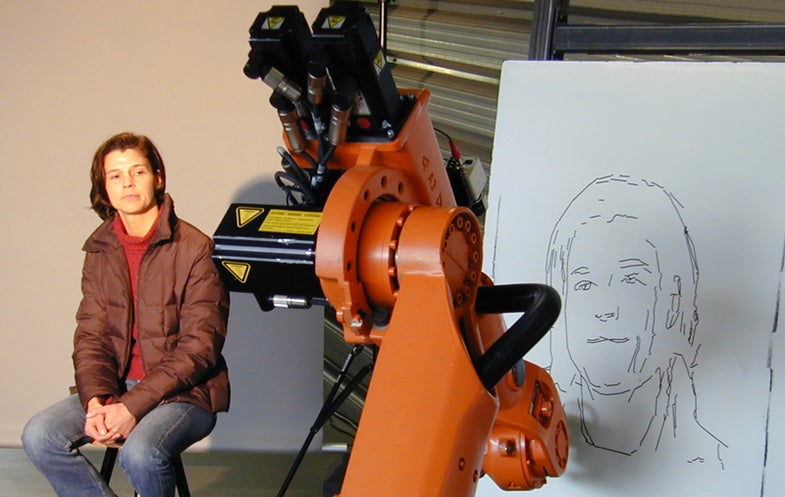
Though he was destined for manual labor, countless days spent toiling in the factory could not dampen this robot's dream. He was built to examine how objects reflect light, but he never failed to see the beauty in the patterns of light bouncing off a mundane object, say a child's backpack. He always wanted to be an artist, he just needed the chance!
Now the robot has been reassigned, fulfilling his ambitions to make awkwardly flabby line drawings of his human masters.
Researchers at the Fraunhofer Institute for Optronics, System Technologies and Image Exploitation equipped him with a camera and image processing software. Algorithms translate contrasts in the picture into robotic pencil strokes. The robot was even programmed to overlook a subject's tiny wrinkles, making the portrait-sitter look much more youthful.
The sketching industrial robot will be on display at a conference in Hanover, Germany, next month.
The incredible innovations, like drone swarms and perpetual flight, bringing aviation into the world of tomorrow. Plus: today's greatest sci-fi writers predict the future, the science behind the summer's biggest blockbusters, a Doctor Who-themed DIY 'bot, the organs you can do without, and much more.


Online Content Director: Suzanne LaBarre | Email
Senior Editor: Paul Adams | Email
Associate Editor: Dan Nosowitz | Email
Assistant Editor: Colin Lecher | Email
Assistant Editor: Rose Pastore | Email
Contributing Writers:
Kelsey D. Atherton | Email
Francie Diep | Email
Shaunacy Ferro | Email
I'd like to see it in action, can it only make straight lines? what is it's "hands" range of motion 360 degrees?
or does it create multiple straight lines in different angles to curve?
please advise
also what is the pressure at the tip, does it require special paper or does it rip normal letter paper
Crapple,
I'm an industrial robotics technician. That looks like an ABB 1400 robot from what I can see.
Most industrial robots (especially this one) are 6-axis machines. The Tool (in this case the pencil) would be able to be manipulated almost with the degree of touch that a human could. The robot can vary pressures of the tool on the medium (paper) to create lighter/darker lines, and very accurate curves and angles. In other words, robots can be delicate enough to change the diaper on your newborn (but obviously wouldn't happen), or can punch a hole in concrete (I've done that). It's all in the programming methods. They are remarkably versatile machines.
The problem is that the robot code (that is programmed by a human) has to "read" the vision data, then translate that into motion, not a very easy task to do. It can be done, but I would imagine the simple lines that you see have more to do with the programmer not having the time nor patients (sp?) to write a more detailed code for the extra "resolution" of a human face, if that makes any sense.