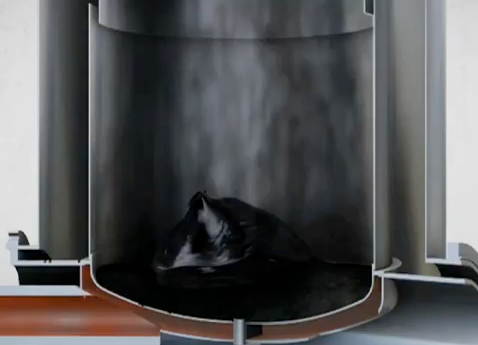
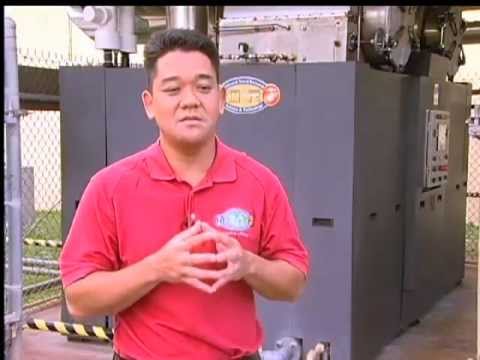
A new, compact gasification contraption can dramatically compress the things our armed forces leave behind, turning trash into ash. Marines at Camp Smith, Hawaii, are testing the new unit to verify whether it could be used at forward operating bases to cut down on landfill. The Micro Auto Gasification System, or MAGS, can bake 100 pounds of garbage and compress it into 5 pounds of ash, while creating more energy than it consumes.
It could someday handle the daily waste needs of 1,000 Marines at a forward operating base, according to the Office of Naval Research.
The system uses a controlled pyrolysis process, which gasifies garbage in a contained, sealed drum. The system will accept any kind of organic material, from food waste to plastic. Temperatures in the drum reach 1,300 degrees F, and chemical reactions yield a gaseous mixture of carbon monoxide, hydrogen, carbon dioxide and methane, which is itself combustible. The system recycles this mixture to further the process and sequester the gases. The result is a small pile of inert ash that can be thrown away, and any glass and metal pieces are left intact to be recycled.
The material doesn’t burn in the traditional sense of the word, so there are no carbon emissions, which is both good for the environment and good for expeditionary forces who don’t want plumes of burning garbage smoke to give away their positions.
Gasification in and of itself is not a new idea, but the MAGS’ small scale and easy operation is unique. Terragon Environmental Technologies Inc., based in Montreal, developed the MAGS system in conjunction with the Office of Naval Research and the Canadian Department of Defence. Its ideal use would be for naval vessels, shore facilities and isolated areas like FOBs that need to cut down on the size and scope of garbage. Learn more about this in the video below.
Eight Marines tested it for two weeks in Hawaii and were apparently pleased with the results. Testing is scheduled to continue at the U.S. Marine Corps Forces, Pacific (MARFORPAC) through March, and next summer the Marines will test its portability.
Lt. Col. Mike Jernigan, a Marine combat engineer who recently commanded a logistics battalion in Afghanistan, said in a statement that battlefield waste disposal is a problem. Marines have to be sure their waste disposal practices don’t leave anything of value behind, and that someone scavenging through it would not be harmed.
“Right now, there are really only two solutions: burn it or bury it,” Jernigan said.
Now they can add "bake it" to the list.
Five amazing, clean technologies that will set us free, in this month's energy-focused issue. Also: how to build a better bomb detector, the robotic toys that are raising your children, a human catapult, the world's smallest arcade, and much more.


Online Content Director: Suzanne LaBarre | Email
Senior Editor: Paul Adams | Email
Associate Editor: Dan Nosowitz | Email
Assistant Editor: Colin Lecher | Email
Assistant Editor: Rose Pastore | Email
Contributing Writers:
Rebecca Boyle | Email
Kelsey D. Atherton | Email
Francie Diep | Email
Shaunacy Ferro | Email
"While creating more energy than it consumes" ...come on Popsci really???
whats to hard to understand its basicly burning stuff without flames, which produces heat which produces energy
@Aldrons Last Hope
I think they mean that the second burning would use less energy than the first because of the methane emissions from the previous burn helping the second. They really should have clarified however.
Plus, ignoring the fact that this doesn't "create" energy, I don't think the article says anything about harvesting the energy of any of this to help with an outside machine. So really the sentence "while creating more energy than it consumes." should not be in this at all.
@Aldrons Last Hope
Obviously the second law of thermodynamics forbids such a statement, but what they are meaning is that the energy contained in the initial gas to start the combustion(?) is less than the output energy contained in the transformation of the energy contained in the garbage. Just like most efficient HVAC systems can produce 5 times more energy than the electricity it consumes.
@NoConsequence3 I know eh? That sentence is only valid in Bizzaro world. Wow the military can do anything even create energy…LMAO.
But let’s just say they meant to say “releasing” more energy than it is consuming….that’s like me saying this match I just lit is releasing more energy than it is consuming (as I throw it in a pile of trash) SMH.
Aldron,
It doesn't take much energy to start a fuel on fire. One little match does the trick. That is not a violation of the Second Law of Theromdynamics, just because the ignited fuel produces more energy than the match. The 2nd law applies to a *closed system*, and this is not a closed system. New fuel is constantly being brought in from outside the system. However, the energy needed to produce the plastics, paper, etc, that fuel the fire almost certainly is greater than the amount of energy that can be extracted by burning them. So ultimately they're not getting a free lunch. We're just recovering some of the energy that it took to build these throwaway products.
My concern is that 1300F is not sufficient to destroy toxins such as furans and dioxin. The EPA says that the temperatures need to reach at least 1400-1500F for 2 seconds. http://www.epa.gov/apti/bces/module6/dioxins/control/control.htm
The fly ash itself is also quite toxic. If they operated up to 1800 then they could get hot enough to vitrify the ash, which locks in the pollutants and is much safer.
BTW, 1000 marines would also produce a lot of sewage. There are systems that process this at high temperature too and turn it into fuel. Again, there's no free lunch because we had to feed these guys lunch in order to get the waste stream generated to begin with.
I think this is a cool idea. Given the situation they are trying to deal with, burning the refuse would be the best way to go and the gasification process lessens the impact on the environment. While the process has been known for a long time I would like to see new uses for it. On an episode of Stuck with Hackett, Hackett was able to run a motorcycle engine off of gasified wood. With the billions of tons of trash in this country, could there be some possibility of using trash to produce electricity? Could we harness the methane and hydrogen to power turbines?
One night when Scotty had a we to much of scotch.
Captain Kirk calls to Scotty from the planet below
"Beam me up Scotty!"
Reply
"I-ee Captain!"
"Burn you up sir!"
Arg!!!!!!!!!!!!!!!!
.............................
Science sees no further than what it can sense.
Religion sees beyond the senses
@robot,
Religion hallucinates and sees what it wishes were there, not what actually is. Religion is pretending to be certain about things of which you actually have no clue.
Oh and Jimmy Doohan has been dead for a while. Unfortunately his ashes were aboard a SpaceX rocket that failed to make it into orbit.
@picassobro: Aldrons Last Hope has it right. This is supposed to be a science magazine. It should avoid using completely unscientific language -- especially about such basic concepts as the First (not the Second) Law of Thermodynamics.
Also, you state: "Just like most efficient HVAC systems can produce 5 times more energy than the electricity it consumes." Wrong, wrong wrong! Another clear violation of the 1st Law of Thermodynamics. What you "meant" to say was: "... can move 5 times more energy ...".
HVAC systems, such as heat pumps, have a COP (coefficient of performance). This measures units of heat output per units of work to operate the system. It is not uncommon to have a COP 3-5. However, clearly this is not creating energy, which comes from outside the system and therefore does not violate any laws of thermodynamics. The article should have said that the system is a *net power producer*, transforming the (chemical) energy in garbage into other usable forms, such as heat or electric power.
aarontco,
It is you that displays not a clue, when you pretend to know the minds of others and myself. What with all your negativity? You seem kind of troll-ish, are you bored?
.............................
Science sees no further than what it can sense.
Religion sees beyond the senses.
Robot,
You're the one making the false claim, on a science site, that "science sees no further than what it can sense." This is false because we also use logical inference as well as simulation. We still have to test those claims, however, whereas religion seldom ever produces a claim that can be tested and when it does it often fails those tests.
There is no evidence that, "Religion sees beyond the senses", and therefore I suggest that you are hallucinating. Faith, admittedly, is belief without or even in spite of evidence, and yet people pretend to have confidence anyway, without evidence for their claims. All of this is common knowledge based on the meaning of words.
Screw a shredder I want this thing!
@AdamWM
I think what you're thinking about is "Mr. Fusion" from Back to the Future Part II.
i think what robot ment is religion infers (or "sees") things that can't be accesed by the senses and therefor can't be proven. and it's just a signature no need to fuss over it.
aarontco,
It is an opinion.
.............................
Science sees no further than what it can sense.
Religion sees beyond the senses.
macmansa,
Your observation is most correct.
Now moving on and hoping for any comments about this article! ;)
.............................
Science sees no further than what it can sense.
Religion sees beyond the senses.
@aarontco who cares what the EPA thinks, they are run by a bunch of government bureaucrats. They keep raising the safe levels of the PPM of fluoride in drinking water. They have good people working for them, but unfortunately they don’t get management positions
http://www.fluoridealert.org/carton-affidavit.htm
But as for the Marines and their sewage. They should just eat it.
(see link on turning sewage into burgers MMM MM good)
http://www.youtube.com/watch?v=6OBOTre3U0k
I find it a highly dubious claim to say that this produces significantly less CO2 than burning it in a normal fashion. While there is the potential to sequester the gas, they made no mention of doing so in the video. Building the infrastructure to sequester CO2 in a forward operating base is a lot more work than they can afford to do in that situation. They'll sequester much more carbon by burying it outright.
Really, burning via pyrolysis and burning something the normal way will produce roughly the same amount of CO2. I believe that since burning via pyrolysis is a more complete combustion method, it will actually produce more CO2 (and less ash).
@picassobro I don’t think HVAC systems are over unity systems. They may move more energy than what is being provided by electricity. But there is also the refrigerants, water, heat transfer, fluid dynamics etc to consider. In a closed system input energy is accounted for from ALL sources, even when the system is at rest (zero point).
I think most of the comments are missing the point here. FOBs (like any community) generate a lot of waste. Water, food, and supplies are brought in at a constant rate to maintain the soldiers and contractors who live there. Most of that is converted into waste (I'll let your imagination determine how that happens). So that doubles the manpower required for everything brought in. Being able to significantly reduce our waste footprint would save taxpayer money AND minimize the amount of litter that is blown about it the harsh environment. I think affordable water reclamation would be the next development to focus upon.
@Ayreborn: Yes, your statement is absolutely correct-or would be if we were talking about any PRIVATELY OWNED AND OPERATED FOB. Being the case that what we are talking is a military owned by the Rulers Of These United States; the device will be COST PLUS or it will never be seen. Or have I missed something in the middle of the last hundred million or so scummy little deals that ACTUALLY go against the true wishes of the American people?
"there are no carbon emissions"... please.
They need to start making propaganda films in the format they used to and feed it to people that have no clue about anything. They have the same thing on a chicken processing plant to get rid of leftover chicken bits near by. There are a lot of places that this would work but only the military has enough money to waste to set this up. Perhaps having a place that eliminates dead bodies easily close by would come in handy.
buy stock in companies that make filters for this
and the next brilliant idea to follow this one.... why don't we turn the ash into pretty pebbles to decorate our bases. you know it's a good idea.
It is indeed a "no carbon emission" because this process is a gasification process. But what I don't understand its why it is using the term pyrolysis where in fact gasification and pyrolysis operates in two different ways. Gasification had higher operating temperature. But at 700centigrade @ 1200F, this temperature range can only be used on organic waste but not metal and glass, for optimum performance. This process will indeed generate much more energy that it could have used to reach that temperature. Since this system is a a closed system, pressure alteration will use lesser energy than it needs in atmospheric pressure. There are two points of concern for this:
1. How do they produce the energy to gasify the waste at the first place ?
If they use kerosene or any hydrocarbon-based products, this will not be green anymore and it is no longer zero carbon emission since carbon is already introduced/fed into the system at the first place. My guess would be using electricity to create high voltage arc between two node. And then supply high flow rate of inert gas passing through the arc, creating plasma cone that can reach 3000centigrade. Choices of inert gas ranged from oxygen to argon. For the latter method, then this process is a zero carbon emission, no carbon fed in the first place, the output carbon-based emission is derived from the waste itself. Classic plasma gasification method for municipal solid waste.
2. How do they feed back the high-temperature syngas into the system to produce energy ?
Syngas (synthetic gas) is actually mixture of gas that contain carbon dioxide, carbon monoxide, hydrogen and methane. These produced syngas had high temperature and two more crucial components, that is also green house gas, which dioxin and furan. At 1200F, no way they can disintegrate dioxin and furan. They will had no choice but to discharge into atmosphere once the heat exchange took its place. If at 2200F, says, dioxin and furan had successfully disintegrate, following the heat exchanging, dioxin and furan easily formed back. Unless they solve this problem, it will be a headache. Disregard the dioxin and furan, the heat exchanging can actually produce 40% more energy that it used for 1kilo ton municipal solid waste in the form of steam.
This method is the future for municipal solid waste disposal and also my dissertation during my final undergraduates engineering year.
@khinfai you mean "no carbon emission" only refers to elemental carbon being released? what if it's attached to a couple of pesky oxygen atoms to turn it into a gas?
they are decomposing hydrocarbons to get smaller chunks. but whatever carbon goes in it must come out. if you didn't want to release it leave it as it is as others suggested.... or don't claim "no carbon emission" because it sounds good and can get you funding.
even more ridiculous: "plumes of burning garbage smoke to give away their positions". we're not talking about a couple of persons building a campfire with the natives after them.
obviously waste disposal is a problem. they made these for aircraft carriers and they want to sell more. Why is that not reason enough?
@ khinfai; I suspect that they are using the electrical method you suggested, and quite probably with an internal shape that creates an air convection effect to completely consume all the trace gases that burn, leaving noble gases and just a tiny bit of carbon residue per operation.