The Space Launch System will be the next NASA-administered launch vehicle to take humans into Earth orbit and beyond
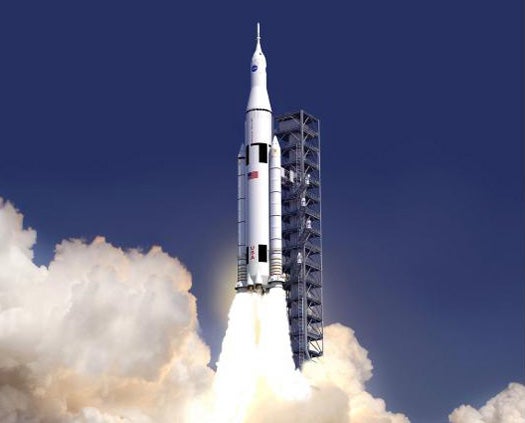
The NASA SLS NASA

Today, NASA officially announced the design of its forthcoming Space Launch System--a heavy-lift rocket capable of taking humans into deep space. It will be the primary vehicle to replace the Space Shuttle, but with significantly more power—enough to reach Mars.

Resembling the Saturn V in both format and capabilities, the SLS is based around technology developed and honed in the Space Shuttle program. Its core stage rockets are the same RS-25 the shuttle used for main engines, and its strap-on solid rocket boosters are also similar to those used on the shuttle; these solid boosters will be used for initial flights, but NASA hopes to develop cheaper liquid-fueled detachable boosters for later missions. The J-2X engine used in the upper stage is similar to one developed by Rocketdyne for the Saturn V.

The SLS's payload capacity will range from 70 to 130 metric tons, depending on launch configurations, making it the most powerful launch system since the Saturn V. By utilizing different combinations of the core, upper and booster stages, NASA will be able to efficiently adapt the SLS to a variety of mission types.

And of course, the SLS will carry the Orion multi-use crew capsule, an offshoot from the now-defunct Constellation project. It is capable of carrying a crew of four to six astronauts.

NASA released a computer animation of the new SLS taking to the skies:

32 Comments

FIRST COMMENT!!

Let the politically charged responses commence!!!

130 Tons..wow now that's impressive. This could be used to launch the Bigelow BA 330 into space, in 1 launch we would have the living space of the ISS

http://www.bigelowaerospace.com/ba330.php

Pretty interesting stuff. The future is near :-D

«a heavy-lift rocket capable of taking humans into deep space»

OK we know its not the rockets that were decommissioned...it was the shuttles themselves..

What about advancements in replacing the shuttle? are we going bigger shuttles? smaller capsules?

This document says..same rocket used as..

when you use the word same then there is no progress

I figured 'deep space rocket' was probably a euphemism but it doesn't really apply to me... I barely have enough rocket to reach the troposphere.

@Midoman

That was also the problem with the last program. Congress isn't funding progress. They're funding affordable. If they were serious about progress, they'd try to reinvigorate the original concept of the Space Transportation System Program; space tugs for orbital transitions, Utility space plane to replace the Space Shuttle (perhaps the Venture Star), An interplanetary vessel (preferrable in the form of Nautilus-X), and lunar orbital and surface laboratories.

That's progress.

@Aldrons last hope

The Bigelow Station is certainly interesting and a good development, as we really need to set up a true space station capable of holding hundreds. Think Ender's Game :)

I just read a similar report about this on BBC World News. It's possible this platform could incorporate the usage of the Nautilus-X concept. I hope NASA strongly considers it and Congress supports this concept later. It's time to stop thinking Apollo and start thinking Star Trek. Go big or go home (in this case, stay home).

What a joke the Ares I and V are more cost effective especially with SpaceX building the Falcon Heavy(117,000lb). NASA need to do what privet can't. The new SLS at 154,000lb does not fit, its a one trick pony for one time asteroid mission and would be wasteful for missions to the ISS where only Orion is needed. Ares I could go the ISS or privet station for rescue missions, a lot cheaper than a SLS. Ares V (400,000lb) would have launch 2.5 times what SLS would and 4 times the Falcon Heavy. Ares I & V together for a little more money than a Shuttle mission could go to an astroid, support a moon base, and build a ship for a maned Mars mission for the minium number of lifts. The SLS will be canceled the minute SpaceX finishes the Falcon Heavy.

@Midoman yes, private industry will revolutionize space. Think about it, we will have the living space of ISS in 1 launch…imagine the what the space station will look like in 30 launches? Truly an amazing time for space enthusiasts :- D
@phoenix1012…not sure if I already posted this link…but check it out…3 parts a lot of good info on the Nautilus-X. They are planning to test the artificial gravity centrifuge by 2012…a timeline we can all get excited about.
http://www.youtube.com/watch?v=2kkT4sskmM8&feature=related

@Penzor

Where you been at, man? I've been calling you out since I posted the FIRST COMMENT! Yeeah!

This program has the same aims and as the Constellation Program. Don't complain about it just because it didn't come from the administration of your choosing. Just be happy that there is (and always has been) a plan to move forward in the private and public industry.

BTW, the program got canceled because it was deemed inexpensive and (the major part) ill-conceived. A sentiment and testament shared by many project engineers.

@Aldron

That node was apart of the original design of the International Space Station. It was meant for micro gravity experiments. This concept was reborn when the Nautilus-X concept was proposed, for artificial gravity generation.

I wish to say thank you to all those NASA engineers. I really appreciate the rise and development of this amazing powerful rocket with all its thrusting power.

I really look forward to all the things you will bring in the future! Imagine all the amazing things this rocket will deliver to outer space! ;)

I clicked play on the video, watched the paid advertisements, then came the launch. The camera pans around the rocket next to it's platform, then ignition! The best part is that the exact moment the rocket engines fired up, one, my sound was turned way to high, and two, I received a text on my phone which vibrated my entire desk(which I was leaning on). Made this video in to one heck of an experience.

pheonix1012 what is political about getting a rocket that can do the broadest number of missions possible. If you look at the Saturn V could get 100,000lbs to Lunar orbit and landed only 35,000lbs. Orion is larger and heaver the Apollo capsule how can the same size rocket do more than Appollo. The political part was Obama and Congress killing Constellation to do a similar less capable program because W Bush was dumb

@Penzor

First off, Orion is the name of the capsule being developed also known as the Multi-Purpose Crew Vehicle. It is a command module (not a rocket) being built by Lockheed Martin. The syringe shaped Ares I rocket had design flaws that caused engineers to work tirelessly to make a bad concept work (and they made it work; goes to show that talented people can take crap and turn it into gold). The flight of the Ares I-X was pushed back several months from 2008 and finally took flight in October 2009.

While the Ares V concept was way better, Constellation was going to be hard pressed to work because of the poor design of Ares I, the drug out schedule of program progress, and the rising cost (it was a frikkin' module on top of an SRB it was too big for; hence the syringe look).

This concept is virtually the same as Constellation. The only difference is that NASA will use this concept to orbitally construct a space only vehicle for BEO crew transport (research Nautilus-X for an example). This rocket is meant to be a workhorse for NASA to a higher caliber than any other rocket ever built for NASA.

Nothing has changed from the plight of the Constellation program, only the design of the hardware meant to support the program. Your misplaced ill will is based on political sway, and you can not deny that.

BTW, FYI, it was Congress that past the NASA Authorization Act of 2010 into law and appropriated the funds for this heavy lifter. It was Congress that made the decision to stop funding the Constellation program effectively killing it. It was Congress that approved the inception of such a rushed and ill conceived concept such as the Ares I (not the Ares V), and it was Congress that killed the Space Shuttle program; first in 1986 downsizing the program from its primary scale of operation (over 100 flights per shuttle), and secondly in 2003 sealing a decommission date on the program following the second Shuttle disaster.

You want to put labels on a Presidential Administration?! Neither was responsible for the muddle NASA has found itself in. Both tried to push a path forward while Congress has been the primray factor behind NASA's stagnation since the 1970s.

Don't believe me! Look up STS and find out what was originally suppose to follow the Apollo program. Don't be a propaganda puppet.

Deja Vu
thought I was looking at old Apollo pictures

now lets go to Mars!!

_________________
The people of the world only divide into two kinds, One sort with brains who hold no religion, The other with religion and no brain.

- Abu-al-Ala al-Marri

If we wanted a heavy lifter we could have gone with a Shuttle Derived Launch Vehicle (SDLV), such as Shuttle-C, which is basically the two SRBs,an External Tank, and a wingless, side-mounted, non-recoverable cargo module strapped on in place of the Shuttle. I think the Shuttle proved that there are some things that are way more expensive to reuse than to throw away, like condoms and space planes, for example ;-). Shuttle-C was estimated to have cost a fraction of what we spent on Ares, and projected to take only about 5 years to complete, since it was mainly based on existing engineering for the Space Shuttle.

However, regardless of which Heavy Launch Vehicle we finally end up with, I doubt that they will be used for things like a manned asteroid mission. It or a mars mission would still be extremely expensive, on the order of hundreds of billions, probably. We haven't solved fundamental problems like shielding point source cosmic radiation that would fry a crew over long duration missions. The only existing solution is to loft lots of mass, which would add hugely to expense of the mission. There is also the issue of loss of bone and muscle mass even with fairly vigorous exercise, and techniques like centrifuges to simulate gravity. Then there is all the food and life support we would have to carry, because none of our current system can recycle at 100%, and we are still not confident that we can reliably grow food along the way.

So let's not fool ourselves that the only thing we lack is a vehicle. There are lots of technologies we lack because a mission like this has really never been a serious priority. Lots of people like to talk (and swagger) about it, but it's mainly turned out to be hot air.

What we need for a mars mission is cheap, reliable nanofabricators that can make strong, complex components. That is what people like Drexler have been arguing for several decades now. We also need non-rocket launch systems, like electromagnetic accelerators, and we probably also need plasma rockets like VASIMR. Without those kinds of things we are putting the cart before the horse. We might achieve a stunt mission, but it would not be one we could afford to repeat, and like Apollo, we will languish for another 40 years before we have the will to do it again.

I'm all for cheap and reliable spaceflight - except this is going to cost $20B-$30B before it flys. That's not cheap and if it's using old shuttle hardware there's no particular reason to assume it'll be reliable either.

Firstly, spaceX could probably put one or two THOUSAND TONS into orbit for the same price. Start including operating costs, and this just isn't economically sensible.

Secondly the more realistic RLV designs (the ones with MR<10) tend to cost in the $5B-$10B range. So they'd actually be cheaper to build. So as long as you ignore the ones that require miracle technology to work, and contract the work out on a fixed cost basis, then you wouldn't have and cost inflation. But...

@Penzor:
No, the political part is and always has been maintaining NASA's massive and redundant infrastructre and staff levels that were developed during apollo. And the spending in various congressional districts that infrastructure relates to. Changing or improving NASA in any way would involve cutting away a lot of deadwood, and redirecting that funding. And congress simply won't support that last one.

Not to burst anybody’s bubble and all, but this rocket is just a proposal and a really good cartoon video of a rocket blasting off. Factually has this things budget been approved for yet? You know the gang of whom-ever by December is going to cut all kinds of spending back from the government and if they do not make chosen cuts, automatic cuts will come into effect too.

Yes, I do sound like the grim reaper and all. So in my opinion I like to say, I hope this rocket gets made and YES the USA does put a many people on MARS!

Nice rocket video though!! ;)

pheonix1012 What I meant was that the lifting Orion(crew and service modules)heaver than Apollo versions and a lander on a rocket that lifts 156,000lbs is meant one mission O's asteroid. I hope congress will allow the upgrades to 130 tons(260,000lbs)when money runs out.

If Ares I is flawed why are we using the 5 segment SRB and why are Alliant Techsystems (ATK) and Astrium building the Liberty Rocket. Because US tax payer paid for all the R&D and solved the problems and will cost them nothing.

"Orbitally constructing a space only vehicle" must be done to go to Mars with SLS or Ares V. But only Ares V can lift a small 200MW nuclear reactor needed for the Ad Astra Rocket Company's VASIMR plasma rocket to get to Mars in 39 days. There's a 12 Mega Watt VASIMR powered craft could reach Mars in less than four months.

The NASA articles on here are so boring. I don't know why I even read them. So it's a new rocket? Well, kind of. Different method of propulsion? Well, no. But it's gonna go to Mars right? Well...

BORING. I'm gonna go watch a Seven of Nine focused episode now.

Sorry. That wasn't a very polite post. This site doesn't need anymore hate. I apologize.

What I meant to say was that I'm deeply interested in Cosmology, Cosmonogy and Astrophysics. Although I understand only a tiny fraction of it. And none of the math involved. It's more a philosophical interest I guess. It blows my mind when I look at the math that goes into that stuff.

That being said, without NASA we wouldn't know nearly as much as we do about these things. However small that amount of knowledge may truly be. So while I think that NASA has lost their way, they're still a group of really smart people doing really important things.

Now 7 of 9.

Sure looks like a Saturn launch vehicle with two Shuttle solid rocket boosters... bet that took billions to think up.

Emmahenrygus, I too wish science to continue and venture out to the outer space, moon, planets and stars!

new rocket? not really... in the 70's a nuclear rocket was produced that could get to mars. i understand the dangers of an accident during take off could have devastating affects but it does mean the idea should be completely trashed.

I just hope that they follow through with it this time. Thats all Im saying.

----------------------------------------
www.michaeltaylor3d.com

@Emmahenrygus

Now I wanna go watch a Seven of Nine focused episode. Thank you very much!! lol

Seriously though. I am thinking of watching one.

@Tamiko

If you go onto NASA's website you will find a file that contains the FY 2011 Strategic Plan and FY 2011 Budget. Both detail the cost and concept for Beyond Earth Orbit (BEO) manned exploration, specifically to the Moon, Near Earth Asteroids, and Mars.

The NASA Authorization Act of 2010 also puts into Law the creation of a (then unspecified) heavy lifter that would support BEO operations.

Short answer, yes. The budget was approved otherwise that cartoon wouldn't exist.

@Penzor

The 5 segment SRB you're mentioning was originally proposed for the Ares V as well as the Ares I, and will be used for the SLS (assuming this concept doesn't die either). Ares I was a bad idea because they were trying to put a larger than Apollo, seven crew command module on a lifting body that was not designed to stably support it (I did mention that it looked like a syringe). The design is top heavy and would require many maintenance adjustments to account for flight instabilities. Means that it's more complex, and not as safe.

Just because ATK and Astrium are trying to do exactly what Lockheed Martin was attempting doesn't mean that it will be any less expensive, difficult, or that it will work. They are being funded partially by NASA to achieve this. Time will tell if there version of the Ares I will become operational, but it doesn't make it any less of a bad design.

@aarontco

This rocket is not suppose to be an Apollo-esque vehicle. It's a workhorse. It's meant to ferry components for spaced based vehicles into orbit for construction and orbital launch. If NASA approves of it, this vehicle will be hauling components for the reusable, multi-mission servicing Nautlius-X design; which incorporates many of the technologies that you speak of.

While the article does not make any implications to the Nautilus-X, it and other articles from other sources implies that this rocket will in fact launch crew vehicle components into LEO that will be docked and used for missions beyond LEO.

People are not doing these research projects for no apparent reason. Franklin Chang-Diaz's VASIMR has made significant headway in electronic propulsion. With a successful demonstration to take place in 2013, this concept will be used to push people to Mars (it's the most cost effective course of action).

As for the issues of zero-g and radiation exposure, studies have gone into new methods of radiation shielding. In the next two years or so, a centrifuge will be delivered to the ISS for micro-grav experiments. This component is directly applicaple to the Nautilus-X design (you gotta check out the design!). I think we're going to do this space travel thing right the next time around.

@ANTIcarrot

You're absolutely right about the Falcon 9 Heavy. But don't count out NASA for a Heavy lifter either. Imagine if both entities carried this capability. Not only does the U.S. increase the yield and frequency of its manned and unmanned space activities, but it also does so with an infrastructure with a financial failsafe.

Through the F9 Heavy, Space-X will be able to do everything that the SLS can do at a fraction of the cost. The thing is, NASA benefits public industry for national and international prestige. Space-X will benefit private industry for market stability and financial & economic prosperity. Aerospace scientists and engineers will no longer have the option of just NASA or government contractors for career options. Private industry will create a slew of new jobs with the strategic support of increased space operations nationwide. Space access will no longer be limited to NASA. This country could be the world's first example of a society that reaches out into space en masse.

In order for that vision to exist, we need NASA and every capable private firm to develop heavy lifters so that we can build a foundation for a permanent presence in space.

@Xerek sorry this comment was meant for you

Yes, private industry will revolutionize space. Think about it, we will have the living space of ISS in 1 launch…imagine the what the space station will look like in 30 launches? Truly an amazing time for space enthusiasts :- D

I didn't get your Ender's Game reference, then I googled it and realized I read that book when I was 12 on vacation in Florida. That book freaked me out! LOL I hope we have space stations like that one day soon. Key is heavy lifters and in the future a manufacturing plant in space that can process asteroids into steel beams.

@rehlmerich ... Actually, it's not much of a concern. We launch satellites with nuclear cores.

Restart NERVA or give P&W the go-ahead on the TRITON and we could have NTP (nuclear thermal propulsion) for the upper stages that would give a lot of lift and an engine for faster transit to Mars.

To rhelmerich and lobosolo,
No the problem with NERVA was not just dangers at launch. The problem was that it would cook astronauts crispy with backscatter gamma and neutron radiation before they reached mars. NERVA also spewed huge amounts of radioactive waste materials. That was believed to be safe to do outside of the atmosphere, as a second stage. However, it may well have not been safe even within the magnetosphere, as we now suspect. In any event NERVA was followed later by Project Timberwind, which considerably improved the technology. One of their proposed methods of dealing with the radiation exposure issue was to pull the crew capsule behind the rocket on a long cable so that the radioactivity of the core would be diminished at that distance.

In any event, there are much better systems in the works today, including VASIMR, as I mentioned above, though VASIMR doesn't require a nuclear power source necessarily to generate the plasmas.

I bet Russia will do this first, and in a better AND REAL way,,,

,,,NOT-FAKING IT

@ssserge

"It's a fully loaded citrus soda with carbos. Feed the Rush!"

[roflmao] CARBOS!!! [lol]


June 2013: American Energy Independence

Five amazing, clean technologies that will set us free, in this month's energy-focused issue. Also: how to build a better bomb detector, the robotic toys that are raising your children, a human catapult, the world's smallest arcade, and much more.


Online Content Director: Suzanne LaBarre | Email
Senior Editor: Paul Adams | Email
Associate Editor: Dan Nosowitz | Email
Assistant Editor: Colin Lecher | Email
Assistant Editor: Rose Pastore | Email

Contributing Writers:

Kelsey D. Atherton | Email
Francie Diep | Email
Shaunacy Ferro | Email

circ-top-header.gif
circ-cover.gif