Which town will be the first to say YIMBY?
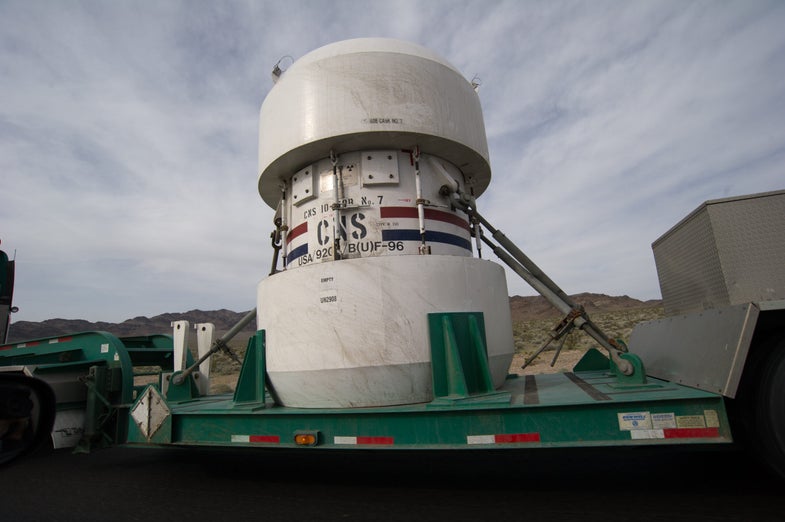
Nuclear Waste Container A nuclear waste disposal canister emerges from the Nevada Test Site in 2010. Wikimedia Commons

The government doesn’t just want a community to accept the nation’s nuclear waste. The government wants a community to want that waste.

A city or town volunteering to serve as the nation’s nuke dump is a better alternative than having the government pick a place, according to a federal commission. A “consent-based” approach would reduce costs and inevitable delays stemming from a not-in-my-backyard fight, Bloomberg reports.

Nuclear power plants generate several types of radioactive waste, which all has to go somewhere. In some cases, spent fuel rods and waste byproducts are stored at nuclear power plants; in other cases, they’re sent elsewhere for safe storage. Lawmakers have been wrangling over the location of a nuclear waste site for years, with the main proposed site located at Yucca Mountain, Nev., about 100 miles north of Las Vegas. Nevada lawmakers — notably Sen. Harry Reid, the Senate majority leader — have vehemently opposed the plan.

In 2010, President Obama cancelled plans to build a waste storage site at Yucca Mountain. South Carolina, the S.C. county Aiken County, and Washington state are among those storing nuclear waste on an interim basis, and those governments sued the Nuclear Regulatory Commission to force a decision on Yucca Mountain.

All of this is to say the fight is far from over, which is a problem if the U.S. does intend to reinvigorate the nuclear industry. The disaster at Japan’s Fukushima Daiichi nuclear facility is only further evidence that planning is a necessity.

With the right incentives, some community in the continental U.S. might be willing to step up, however. Apparently a facility in Carlsbad, N.M., has accepted and disposed of defense-related nuclear waste for 10 years, and the community could perhaps be persuaded to support an energy-related disposal site, too, according to Sen. Pete Domenici, R-N.M.

It would probably be easier for everyone if such a community just volunteered to store the waste, according to the Blue Ribbon Commission on America’s Nuclear Future. Any takers?

[Bloomberg News]

35 Comments

The people who approved having a nuclear plant should be delighted to have this stored in their own back yards.

I'd be competing to have the nuclear waste in my city because after this (http://www.popsci.com/technology/article/2010-02/video-bill-gates-agrees-obama-we-need-nukes) becomes a reality, that city would become an energy hub.

It shouldn't be that difficult finding a place to store this. The important part is to avoid confusing storage with dumping. These things are obviously toxic to any natural environment they're put in which is why there's a lot of very good technology and work put into proper storage and safekeeping.

We live in a post-Chernobyl, post-3mile-Island world and no one wants to see nuclear disasters happen. And referencing Japan's Fukushima Daiichi wasn't exactly necessary. There was a natural disaster there. I hate to be utilitarianist about this, but if you compare the good that power plant compared to the risk of bad it caused during the time after the tidal wave, I think most people would agree nuclear power is worth the risk and the waste products.

Geologically speaking Yucca Mountain Nevada is the best place in North America to store the really nasty stuff, but stupid people *cough* Harry Reid *cough* got in the way. Ignorance, and political fear mongering will prevent any sensible plan for being implemented. The only real option is to create technology that can break down radioactive nuclei into nonradioactive nuclei-there is some very promising research being done on this.

Indeed. You could harvest the energy from the reactor to further cause the products to continue nuclear fission.

Sign me up!

You have to admit, there is a business model here. Odds are an extremely poor community will choose to store the waste though so the "rent" should be high enough to compensate them well. Then again I have storage in my basement...I'm sure I could put this thing in there for a few years. Once those super hot lasers are in production - we can burn it.

"Daddy, what's that under the tarp?" Snow tires honey. Now go outside and play.

@beantown179, the nuclear capsule is in the basement, just under your bedroom. As you and the misses do some kissy kissy, nine months later the nuclear baby is born. Its only later in life society finds out what weird and unusual super powers this nuclear baby has, bahaha...

When you use up a nuclear fuel rod you only consume ~1% of the available energy. We swap them out because after we break uranium down to access its energy the stuff it breaks down too is even more radioactive and dangerously so. It takes like a zillion years for the rods to loose there radioactivity but that is a useless factoid. The truth is the dangerous elements degrade much faster in ~ 50 years the fuel rods are virtually new again and can be safely and easily reprocessed and reused. It would be a crime against the future to place these things some place that is too hard to get back when we will want to reuse them.

@ BubbaGump - I agree. If they want a nuclear plant, let them put the nuclear waste under the plant. That way, it will be there when they want to reuse it, and that should put the cost of building a nuclear plant up to over $100 billion. But hay! That $100 billion can pay for its self in a couple of years by jacking your utility rates up...and you know your utility rates are going to go through the roof to pay for that radioactive nuclear power plant.

@JamesDavis, I did not really suggest putting the nuclear waste under the planet. In fact this could pose as a real problem. Imagine the unthinkable happens and the plant has a meltdown. When the plant goes critical, its fuel will melt through the floor. If there is waste under the plant this will just make the problem even more disastrous. I am not a nuclear engineer or a nuclear waste management specialist, but it just not seems to be a good idea to put the waste under the plant.

If you know anything about nuclear waste, you would know that "some" of the waste is too radioactive to ever leave the plant! That's right - there is some waste that is permanently stored on site of the reactor because they DON'T EVEN KNOW HOW TO TRANSPORT IT SAFELY!!! That should give you a clear indication that we should not be messing with nuclear power yet. I say shut them all down. We have more than enough fossil fuels to last until we have fusion.

All the worlds nuclear waste now perfectly contained would fill 1% the volume of the Great Pyramid at Giza which has lasted 5000 years - less than a football field buried 40 feet deep. Not waste. It is fuel enough to power the world for hundreds of years while being destroyed in gen IV reactors like India's new 500 MW first of 5 units. Ironically that is the only way to get rid of it. The tiny amount left is such a low level it can be returned to the mine shaft.

The cost of today's first of kind nuke plants is less that $4B/Gigawatt and is cheaper than any other source of power. Mass produced they cost under $1B/Gw 2 cents a kwh.

Nuclear meltdowns occurred in 50's designed reactors and each case it was systemic corporate and regulatory corruption the caused the breakdown. Note that the seventies design units just down the beach at Fukushimi survived the same corrupt regulation and the same tidal wave without a problem.

A modern nuke would have survived without a hitch.

Most modern day average people would run and hide from anything containing the word "nuclear". It is safe to say that 95% of the world population knows absolutely nothing about nuclear power. Funny thing is, these ignorant souls are the first ones to shout out loud about how bad nuclear power is, when nuclear power itself is the safest and most environmentally conservative choice for energy generation. I dare anyone to take a tour on a nuclear power plant. A nuclear facility is one of the most advanced manmade structures ever built, taking on average 20 million man-hours to PLAN, plus a good half-decade to build. Unforeseen occurrences has led to only 3 major nuclear plant meltdowns which has left a microscopic mark on the environment compared to what coal power plants have done. We will all proper once society matures and realizes the full potential of nuclear energy.

Nuclear enegry is always touted as being highly effecient in producing electricity, but I often wonder if that thought process is fair or accurate. Because until we actually do have an effective way of dealing with the waste and the cost associated in its storage, it seem not fair nuclear energy is efficient taking in the cost of storage, years and still all the "unknowns." It seems like a shell game of sorts and missleading in TRUE efficency.

@Moon Born - Thats not actually accurate. The radioactivity is not what prevents us from continuing to use the spent fuel. You are half right, in that we use little of the usable fissile material available in a fuel load. Also, you correct in saying that the pieces (fission products) of the split atoms hinder further use, but its not the radioactivity that causes this. Infact, its entirely the opposite.

Some of the 'pieces' left over from the broken atoms tend to absorb neutrons. These are called reactor poisons. The more reactor poisons that build up in the fuel, the fewer neutrons that are available to cause fission. Most reactor poisons are radioactive and decay away (such as xenon-135). Other though, are stable elements that do not decay away (samarium-149). These build up to the point where so many neutrons are absorbed by the poison that the fission reaction cannot become self sustaining, and the reactor essentially wont start up.

You can reprocess the fuel to remove these poisons, but you dont need to wait for them to become less radioactive, really. We simply just dont have the infrastructure in the US to reprocess fuel on an industrial scale.

@cruzinmy64 - I'm not really aware of ANY waste that cannot be transported. I worked as a senior operator for a research reactor for a number of years (agreed, we dont see all of the waste issues power reactors do, but we had to be familiar with those operations as well), and the only time I encountered a radioactive waste that was never removed wasnt because it was too radioactive, it was just simply uneconomical to move it. They were large steel cooling pipes that had been replaced, but it was much cheaper to have them stored in a storage pool than to have a specialized cask made to fit them and put on a shipping truck.

True, some waste is too radioactive to work with IMMEDIATELY after removal from a reactor, but even our core would be safe to work with for short periods after only a few months without use(being conservative).

Quote;
"The cost of today's first of kind nuke plants is less that $4B/Gigawatt and is cheaper than any other source of power. Mass produced they cost under $1B/Gw 2 cents a kwh."

Yes you are correct! Only the cost of transport, storage, and facility infrastructure to deal with the spent fuel is always magically left out of those calculations. What about the R&D costs of an entire Government Branch dedicated to the safety and harm reduction of the nuclear industry, shouldn't that be factored in as a cost of doing business?
What about the staggering government grants, subsidies and task forces, propping the efficiency you've touted in your comments? Shouldn't those dollars spent be included in the cost of utility?
What about the land purchases made by the federal and state governments surrounding both the plants themselves and the waste fuel storage facilities? Those dollars are not factored in either.
Hey I can claim I produce electricity really efficiently too, and with some creative accounting I'll factor out the cost of food to feed me, and the cost of the stationary bike I used to produce it. Just hire me for our energy needs! I produce electricity at $0/kwh!

There is a few things I would like to point out. One, "Storage of nuclear waste" does not fully describe what it is they want stored. Many people think right off of spent fuel, or high level radioactive waste. I doubt the article had any lower level stuff in mind, so i will leave well enough alone.
Second, many people feel that reprocessing the fuel would be a simple solution to fix the problem, as there is in deed unspent uranium and other elements capable of powering a fission reactor. The issue here is that we are not allowed to do any reprocessing. my understanding is that this is due to some nuclear arms act to prevent the refining of plutonium. if we started now (especially after the stink we raised in the middle east for doing the same thing), it could become painful. If there was a way to overcome the act, then we could also reduce a seldom seen impact of nuclear power, the mining sites. We would also need to develop the refining facilities, so that would put us a few years out anyway. We would also reduce the amount of UF6 we needlessly store (look it up). The tech does exist for the next gen reactor to burn our "waste", but we can't get there at the moment.
Nuclear power is in fact a very safe, very clean source of our energy, cheaply produced once all the costs are compared, and at the plant i work at, has such tight environmental controls that we can't even spill distilled water without reporting it (honest truth).
If it seems I'm giving mixed reviews here, that's also another principle of what the workers of the industry are like. We look for the bad any place we can, and try and fix it, stop it, or contain the damage... by our own free will. People might say that the NRC demands we do things, and they are right. but the NRC gets many of their inputs from INPO, an organization of operators policing ourselves. I'll get off my soap box now.

@Mifdeath - Those are all generally factored into the $/kwh analysis of a nuclear plant. Above and beyond what ou may expect, the final decommisioning and cleanup of the site is also estimated and factored in. They take into account mining costs for fuel (very small fraction of total cost), transportation, contruction, waste disposal/storage (there is a per killowatt fee levied to cover that cost when you pay for the electricity as a consumer, if you draw from nuclear plants in your area), land purchase, legal fees, etc.

The original estimates to build nuclear plans was in the hundred millions, not multi-billions. You can see the reflection of these (possibly initially unseen) costs driving up realworld prices per kilowatt. They dont need to estimate these costs. We've been at this for 50+ years. They can tell you exactly what it costs, and they do.

As for grants and subsidies, I dont know personally if those are reflected in the costs. But to be quite honest, I seriously doubt that all the susidies and grants that are being awarded for renewable energy sources is ever factored into thier costs either.

@ schlepnir : I believe the restriction on commercial reprocessing has been lifter for some years now; however, we are left with no infrastructure to do so (because why would we build facilities to do illegal things ;)). I remember reading in an American Nuclear Society magazine issue about a theoretical (so far) reactor design that would allow the re-use of spent fuel to power itself, without reprocessing. I think the idea was called a 'traveling wave reactor', which would send a slow moving 'breeder wave' down the fuel elements length, followed closely by a mopre traditional fission wave. They estimated the waves would take on the order of years to propogate, so no pulsing issues. Not too familiar with any progress since (read this a year ago), but found it promising.

Quote;
"Those are all generally factored into the $/kwh analysis of a nuclear plant."
Those? What those? I did not comment on mining costs, nor site cleanup upon decommission. Neither was there a mention of the original estimates to build. Why did you bring that up? It had nothing to do with anything.
The Nuclear Regulatory Commissions Costs are absolutely not factored in. Neither are land purchases completed by state authorities at the behest of the facility itself or the citizenry concerned about proximity. Those become disaster prevention dollars handled under a completely different branch of government.
Then you go on to state that yes, there is no accounting of subsidies and grants propping up the industry. Since we were not talking comparisons to other sources of energy I find it very telling of your defensive stance in regards to nuclear when you point out that alternate energy sources get subsidies as well.
In elementary school my teachers learned how to handle comments like that;
"Yes Johnny he may do that, but we aren't discussing Billy are we? We're discussing you."
Essentially you responded to one portion of my comment and conveniently ignored all else that was said.

Quote;
"We've been at this for 50+ years. They can tell you exactly what it costs, and they do."
Freudian slip much? We've been at this for 50 years. You folks sure have, and obfuscating the hell out of the issues for every day of those.

Quote;
"The original estimates to build nuclear plans was in the hundred millions, not multi-billions. You can see the reflection of these (possibly initially unseen) costs driving up realworld prices per kilowatt."
So the $/kwh estimates are, and always have been wrong on their face simply because the original costs of manufacture were not done properly? Wouldn't that imply that any $/kwh estimate are completely wrong since we are still adjusting for our accounting errors and trickery in the 50's?

@mifdeath - I admit misreading the land purchase portion of your statement, and I'm not aware of any account of those purchases. however, as far as asking what 'those' are, I list them shortly thereafter. The infrastructure, facilities and funding for storage facilities are, infact, factored into the kWh cost, as well as others that you did not originally mention. I was merely trying to show the scope of the considerations made.

As for citizenry self-incurring costs due to personal fears, that is thier own issue, and should not be factored into the cost. If you're speaking of depreciation of property, that is more a gray area.

I cant speak for all programs run by the NRC, but many programs run by the NRC are paid for by levies in the final cost, such as fuel storage monitoring programs, many research initiatives, etc. I agree that not ALL of thier funding is accounted for, however, its is misleadign to say none of it is. There are numerous overhead charges applied by the NRC to review procedural changes, contract changes, safety reviews, and licensing or relicensing. Much of this overhead is used to run the agency (again, cant say all, but certainly not 'none').

If the point of questioning the cost of a technology isnt to crossreference and compare it to competing techlogoies, then why does cost matter at all? The reason we quantify any of these costs is to help us weigh the value of the technology as compared to an alternative solution. If you leave the same cost consideration out of both solutions (such as my reference to alternative energies), then the error is likely a zero-sum. So yes, we are talking about billy, otherwise talking about jonny in this context is pointless.

And lastly, I see no value added to your suggestion that the industry has been purposely altering figures. If you look into the history of the industry, initial cost estimates did not anticipate such heavy protest to thier construction. when I say the 'real world cost' has risen, I meant the capital costs associated with working through extended building periods and legal fees to do injuctions brought about petition. Operating costs have not considerably increased, nor have the fuel production costs. Disposal has, but again, that is paid for with a levy accounted for in the final $/kWh cost (about .1 cent/kWh covers the 20-30 billion dollar program that operated the waste depositories yearly).

How much does it cost to store extreme large quantities impossibly dangerous nuclear waste that never goes away, just curious? What happens in the future, when this facility is broken and all the waste leaks into the water supply?

Here's the deal.. When I first heard about this, I did something called 'research', which dissolved quite a bit of the fear, uncertainty and doubt.

Fact: The water tables below were studied for many years by many geologists to find that there wasn't a significant amount of water in the table. This is one of the reasons they chose the area.

Fact: The regulations, laws and other precautions taken to keep from having a 'leak' are so numerous and tight that it's impractical for a significant amount of it to contaminate a dwindling water table in the middle of the mojave. In the event of a cataclysmic event, secondary and tertiary levels support irrigation and cleansing to keep it from getting to the water below.

Fact: The riskiest part of the operation is actually transporting the waste to the site.

Fact: This is to be storage, not disposal. Though the technology isn't up to date enough to do anything with it, it's not being dumped into a pond to drain or clean.

Fact: Most people in Nevada/Las Vegas have never even heard of Yucca. The past 2 weeks I've spent there, I mentioned it and people looked as me as if I had clowns coming out of my ears.

Fact: It has to go somewhere. There are water tables everywhere. This is very close to Death Valley, and for those who have been near there, you'd imagine what type of arid land this is a decent place for. Little chance of contamination.

Fact: All around these areas, nuclear testing occurred. There are nuclear sites EVERYWHERE that you haven't known about which are being cleaned and made into reservations.

Speculation: What a politician has to say about a key phrase such as 'nuclear waste' to gain votes.

Fact: Thousands of jobs were lost because of this. Good people, in fact. A massive amount were IT workers. Jobs may not be a good cause to overlook 'nuclear waste', but given the circumstances, your fearless politician is blaming the economy on jobs lost in Vegas. A large percentage of those lost were his fault, and this project.

I know this because I work for the company in charge of cleaning up "nuclear" sites after they've been closed. There are hundreds everywhere that we're cleaning and monitoring. This site isn't evil. IN fact, it's a technological advancement, compared to other solutions we've had in the past. To pose it as evil because of your own uncertainty, undermines the thousands of scientists and researchers that did their best to make it work efficiently and safely.

You can take my word for it, or take a politician's word for it. Your call.

Nuclear is not the answer, it is a good interim crutch until we sort out our energy needs. The uncertainty of the populace, our elected leaders, and the opposing research both financial and environmental, should be a huge indicator of my above statement.
Within all of the comments here there is a surprising amount of doubt and uncertainty, even from those choosing to be proponents of the industry. Facts not completely understood, statements of further research needed, claims of incorrect cost projections and estimates only now being accounted for, and statements to the effect of future cost increases because of past errors.
The hulking industry Nuclear has become has stagnated itself. I have one simple question, if nuclear is so great and wonderful why is the industry not self-sustaining?

@mockylock, I think my factual question was how much does this cost? Lets isolated down, how much money has been spent so far in the cleanup and containment of nuclear wast, just curious?

We have heard nuclear energy is highly efficient, but I like to see a cost analysis to the expensive of it, numbers please?

The USA American people pay for this, they do have a right to know.

@mifdeath - How is the nuclear industry not self sustaining? The industry operates like any other. Companies get grants or loans to build new infrastructure, they complete construction and then pay the loans back. They sell goods or services to pay for their costs, and many industries are overseen by regulatory agencies, especially those that would be potentially hazardous if left only to the devices of profit (this isnt a politically charged remark, just pointing out that it promotes reducing cost, sometimes to the point where that conflicts with safety).

I'm not going to apologize for the industry, but if we measure a technology by how much uncertainty exists in the layman and our politicians, we will be in a very sore spot. I would go so far as to say that the very reason the nuclear industry hasn't been able to outright solve every perceived issue in the industry is the nearly total and vehement opposition to any new infrastructure being built by exactly the same 'uncertain' people, many with very little understand of the field at all. May I ask what exposure or background research you have had/done with the nuclear industry? Far be it from me to suggest only nuclear professionals could be educated on the issue, but at least some basic research and understanding are needed to pass judgment on anything.

In the end, I cant help but feel you are deducing that 'Facts not completely understood, statements of further research needed' are being drawn from mine and others statements here. Make no mistake, I am no supreme expert in the nuclear field (and further, am no longer working in that field). I have a solid understanding of reactor operations and nuclear physics, but I am no business man or executive. I have basic understanding of how the industry operates as a whole, and can give you broad strokes, but to suggest that my lack of a neat answer to every facet of the costs incurred by the nuclear industry should hardly be taken as the state of the industry as a whole.

Your last few sentences also completely ignore the reality of what I have said, and how the industry operates.

The industry is not just now adjusting projected costs. You failed to pick up that correction in my last post. I said initial (as in the first few plants ever built) estimates were underestimated. all subsequent estimates are not.

The industry is not experiencing increased future costs because of past errors, but rather from legal opposition and inability to invest in modernized infrastructure because they are bound to certain legal and regulative proceedings (rightly so, however restrictive they are), which are easy to delay.

And again, the industry has stagnated largely from PERCEIVED threat by individuals and organizations who have not bothered to do sufficient research into the true challenges the industry faces. If you're interested I would be happy to discuss some of the nuclear incidents that have plagued the industries public opinion (TMI for instance) and the misnomers many have regarding them, but I feel that is outside this conversation...

Why not just launch the nuclear waste at the sun? Take all the world's waste and launch at our star. Do it. Will there be explosions? Possible. The sheer size of the product (nuclear waste) shouldn't have that much effect on a G2V burning ball of PP chain.

Think about that U.S.

"Be sure that you go to the author to get at his meaning, not to find yours." S.R.

Fusion in theory and paper is wonderous and great. It reality we just can't seem to make it practical and work. We just spend billions in wasted effort. Nuclear engergy does give cheap energy, but we put on blinders to the managment of the waste and leave this out of the economics. We do know we can make electricity with fuel cells, solar power, wind power and hydro electric safely and create jobs locally. Our country is going through a economic down turn and unemployment is getting bigger. As our USA dollars go over seas, they are getting richer. We should invest in USA and we should invest in things we know that works and creates jobs and a cleaner enviroment. We also know the more we use hydrocarbon fuels the enviroment is being polluted. I buy gas at my local gas station same as you. I have no control of where it comes from. But we as a people of voters can force the direction of our government leaders and their goals and making of laws.

What everyone fails to realise is it's either nuclear waste or coal/oil/natural gas power.Many people say green power is the way to go but the tech is very expensive.solar panels generate less power foot per foot compared to every other industrial revolution method of power generation.They do not work well in cloudy weather.need to be kept clean to work best an still need a factory to produce which produces waste products.Plus you would need banks of batteries to store power for night or cloudy day use.banks of batteries that need to be produced in a factory that makes....you guessed it....waste.some of it hazardous.which would need to be stored or disposed of or processed.If you built a solar cell power generation facility to power an average size town it would cover a huge area.much more that say a coal or nuclear plant.Clean but the bigger the area needed the more problems with environmental damage from construction, construction waste, habitat loss(due to acreage covered.).
One possibility is if the government started a program to put solar panels on top of as many structures as possible coast to coast all hooked up to the grid.if the government could do this and maintain this network then one area would power the adjoining area in event of outage like say rain.Plants built to produce hydrogen during hours when power is produced in excess could be used as a storage medium for night use which would be less than day use.Hydrogen would be used in fuel cell generators to produce power at night.If more hydrogen is produced than is used then hydrogen fuel transport becomes a possibility.
Winds biggest issue is maintenance.the generators, gearboxes, oil(which is also a waste product), material fatigue and replacement etc.Land loss is minimal for this method but aesthetics are an issue as well as some concern to avian wildlife flight dangers.as well as the limited placements for these generators due to wind availability and commercial flight paths etc.We could feasibly generate most if not all our power needs this way but that would be a huge maintenance issue.
In my humble opinion...the best new source of energy for the future is liquid fluoride thorium reactors.Or"lifter".
Minimal risk, exceptional energy density, compact size, lessened waste products that need be stored for less time.this pro list goes on and on.look it up.

I suggest that rather than just store nuclear waste, it could be re purposed. The spent fuel rods may not be energetic enough to maintain a hot enough fusion reaction for nuclear power plants. But, they can still get pretty hot for a very long time. We should be looking at how to use that energy to make electricity. There has been ongoing research for years to find ways to convert as much thermal energy as possible into electricity. There are geothermal resources that aren't all that hot, so someone developed a more efficient turbine generator. A generator that uses a liquid with a lower boiling point such as freon can make power from far lower temperatures. So, technologies could be combined to keep using the waste instead of just burying it.

Another possibility is a nuclear battery. Researchers are developing thermocouple modules that more efficient. So the heat from the material could be converted directly into electricity. I have also read about nuclear batteries that work like solar cells except they convert nuclear radiation directly into electricity.

An option that should be considered is nuclear lighting. The lamps are made by mixing radioactive material with phosphors The radiation makes the phosphors glow without using any electricity and the material can be imbedded in leaded glass so even if it breaks, no radioactive material is released. We could light our streets and highways without using any electricity. Such lighting has actually been used in certain industrial applications for many years. The lights can last thirty years or more.

Why dispose of all of that energy? Why spend all of that money digging holes in the ground if we can make use of the material?

Here are two things to keep in mind about nuclear power and nuclear waste:

1.) Simple and inexpensive processes for destroying the radioactivity in nuclear waste have been known for decades:

"Radioactive isotope decay rate or half-life can be increased or decreased as needed to deactivate radioactivity or to increase shelf life of radioactive isotopes. Currently many investigators/experimenters have reported half-life anomalies and have demonstrated repeatability of the various processes. The deactivation/neutralization of radioactivity in isotopes by the several demonstrated processes clearly suggest the possibility of full scale processing of radioactive nuclear materials to deactivate radioactive nuclear materials. "

"In 1964 we thought and believed that radioactivity in nuclear waste would soon be history on planet earth. As history has proven us wrong, we now know and understand that there is a fortune, billions yearly, to be made by saving every scrap of radioactive nuclear waste and trying to bury it in Yucca Mountain and in cleaning up spills, leaks, and escaping radioactive particles from decaying containment schemes. We were just looking at the wrong goal post. No one receiving the funds has any interest in eliminating radioactivity in nuclear waste. Nuclear Half-Life Modification Technology could reduce the cost to a fraction of the cost that is experienced today." ( "Radioactivity Deactivation at High Temperature in an Applied DC Voltage Field Demonstrated in 1964". Larry Geer & Cecil Baumgartner, www.gdr.org/nuclear_half.htm )

Destroying radioactive waste on site obviates concerns about reprocessing, packaging, transportation, storage, and worries about terrorism and off-site accidents.

There are more details, and other processes, described in my article "Adventures in Energy Destruction" at scripturalphysics.org/qm/adven.html

2.) I am told that about 96% of high level nuclear waste can be reprocessed and reused as fuel. So why would we want to destroy it permanently? There is certainly one good reason (among others): the nuclear power industry is headed for the junk yard. It will be going the way of the Linotype machine, the mechanical typewriter, the landline telephone, and the incandescent light bulb. Already consumers are becoming able to sell power back to the utility companies from their homes. Eventually, even the Grid will disappear. There are political developments too: Germany is trying to shut down its nuclear power industry. And Japan, Italy and Switzerland are having second thoughts.

But the thing that will destroy the nuclear power industry is economics and lack of investors. Rapid advances in other energy fields will make nuclear power obsolete. Here is one example from solar power:

RSi's ChemArc Process has greatly reduced the cost of photovoltaic silicon.
www.engineeringtv.com/video/The-Chemistry-of-RSis-ChemArc-P (See also www.engineeringtv.com/video/Revolutionary-Power-Converters )

And relevant advances are being made in storage of electrical power:
"Utilization of poly(ethylene terephthalate) plastic and composition-modified barium titanate powders in a matrix that allows polarization and the use of integrated-circuit technologies for the production of lightweight ultrahigh electrical energy storage units (EESU)" www.freepatentsonline.com/7466536.html , en.wikipedia.org/wiki/EEStor

"This paper reports the successful creation of a new ultracapacitor structure that offers a capacitance density on the order of 100 to 200 Farads per cubic centimeter; versus the current state of the art capacitance density of 1 F/cm3. " ("New mega-farad ultracapacitors", Bakhoum, E., 2009, ieeexplore.ieee.org/xpl/freeabs_all.jsp?arnumber=4775259

"We report the observation of extremely high dielectric permittivity exceeding 10^9 and magnetocapacitance of the order of 10^4% in La0.875Sr0.125MnO3 single crystal." ("Giant dielectric permittivity and magnetocapacitance in La0.875Sr0.125MnO3 single crystals", R. F. Mamin, T. Egami, Z. Marton, and S. A. Migachev, 29 March 2007; DOI: 10.1103/PhysRevB.75.115129 ; PACS numbers: 77.22.d, repository.upenn.edu/cgi/viewcontent.cgi?article=1158&context=physics_papers

In the last citation, a dielectric permitivity of over a BILLION (one thousand million) is simply astounding, and would also be useful in antigravity research. (scripturalphysics.org/4v4a/ADVPROP.html#Biefeld-BrownEffect )

Old battery charging technology is being pulled out of the closet too. One implementation uses an AC electropolishing technique to increase the charge/discharge cycling life times of ordinary batterys by a factor of 20 to 30 times the usual.
pages.ripco.net/~marnow/uk/NASA_Vargo_Start.html
www.freepatentsonline.com/2752550.pdf

This is just ONE example in ONE industry. There are many others, and some are astonishing--real "poop-a-brick" developments!

The nuclear power industry has only a short, limited future. This is NOT a good time to build new nuclear plants. But it is a good time to DESTROY radioactive waste ( or "spent fuel") permanently by simple, safe, inexpensive processes that have been known for decades. Some additional research will be needed to convert this knowhow into an industrial process, but that will still be MUCH cheaper than digging more 100 billion dollar holes in the ground. The nuclear power industry would have quickly solved these problems if it had been required to dispose of its own nuclear waste on-site at the power plant WITHOUT help (subsidies) from the federal government!

If the waste of nuclear enegry is so great, simply why don' they use it and just simply store it. The WHOLE techology has been around a long time. The answer is, they can not and in many ways we are being lied to. If they could make money off of re-using it, they would. If they could store it, they world. It is crossly a matter of fact in the face; it's the reality, they have no place to put this stuff. IT SCREAMS THEY HAVE NO PLACE TO PUT THIS STUFF, REALITY IS OUR FACES. They make make wonderful arguments, but the crap and wasted nuclear enegry is just pilling up and up and up and up without it being SAFELY PUT AWAY> REALITY IS NOW! IF THEY COULD DO IT< THEY BE DOINT IT ALREADY. BUT THEY CAN"T.

That's ridiculous. I want to see them try B ing their way into making the public accept such a deal.

blog.shawcapitalmanagement.com


June 2013: American Energy Independence

Five amazing, clean technologies that will set us free, in this month's energy-focused issue. Also: how to build a better bomb detector, the robotic toys that are raising your children, a human catapult, the world's smallest arcade, and much more.


Online Content Director: Suzanne LaBarre | Email
Senior Editor: Paul Adams | Email
Associate Editor: Dan Nosowitz | Email
Assistant Editor: Colin Lecher | Email
Assistant Editor: Rose Pastore | Email

Contributing Writers:
Rebecca Boyle | Email
Kelsey D. Atherton | Email
Francie Diep | Email
Shaunacy Ferro | Email

circ-top-header.gif
circ-cover.gif
bmxmag-ps