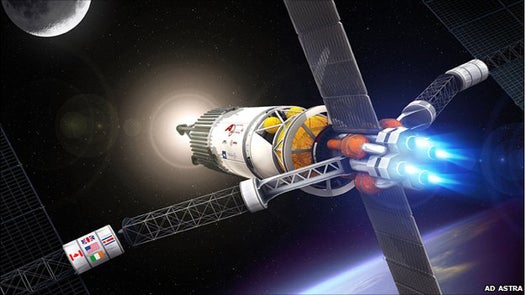
NASA’s Innovative Advanced Concepts (NIAC) program has selected 30 proposals for future space technologies for funding, including schemes for orbital spaceflight refueling stations, electrostatic force fields to shield future astronauts from radiation, and various schemes for propulsion, long-term space habitation, and even 3-D printable spacecraft.
Each winning proposal will receive roughly $100,000 with which to bring their ideas closer--albeit only slightly closer--to reality. Many of the ideas, if developed fully, would cost well into the billions of dollars to develop (entanglement-assisted quantum communications systems for deep space missions don’t come cheap, even in this economy).
Hopefully by the time any of these projects matures (and NASA itself says the horizon for any of these proposals is ten years out) the agency will have a little more money to spend. Because--and this is the whole point of this exercise--NASA hopes these ideas will incubate and grow into technologies that will underpin the future of long-duration spaceflight as well as pay technological dividends elsewhere.And who knows? We might just get that ambient plasma wave propulsion engine we’ve been waiting for. See the whole list of winning proposals here.
[NASA]
Five amazing, clean technologies that will set us free, in this month's energy-focused issue. Also: how to build a better bomb detector, the robotic toys that are raising your children, a human catapult, the world's smallest arcade, and much more.


Online Content Director: Suzanne LaBarre | Email
Senior Editor: Paul Adams | Email
Associate Editor: Dan Nosowitz | Email
Assistant Editor: Colin Lecher | Email
Assistant Editor: Rose Pastore | Email
Contributing Writers:
Rebecca Boyle | Email
Kelsey D. Atherton | Email
Francie Diep | Email
Shaunacy Ferro | Email
Keeping hope alive? Preparing our plates for the feast father forgot to hunt? These grandiose ideas should of been considered and formulated when our economy was at its prime to show the world we can keep pushing boundaries. Instead we got lazy and egotistical and stuck with being practical, comfortable, and safe. There is no more honey in the hive. Three million dollars isn't much support for even one idea to fruit profitability to help America out of the red in "hopes" which we "hopefully" get. If I were a participant who won I would seek out other nation states who are funding space heavily and develop with them (ie. ESA,China). America is like the dirt fair in comparison to six flags when it comes to space. Its a sad state of affairs.
The only reason NASA should be not shut down completely is to be completely reorganized into a space R & D division of the government.
Frankly NASA has screwed up so much, and blown so many billions that I'm a little glad inside that we cut the space shuttle program.
the program itself was 40 years old. Old tech, old management, old everything. NASA itself needs to be completely shaken up, we need NEW focus on NEW tech, NEW innovation, and NEW BLOOD.
This is a good step in the right direction. Now they need to start working with the Private Sector; and I don't mean major investment banks, I mean Pepsico, Coca-Cola inc., Pizza Hut, Rockstar, Lucasarts, and every other company that actually has the real money in this country.
Honestly, if we have a ship in five years that gets us to Mars in 15 days, is anyone gonna care that it has a Google logo on the side?
@Fummfur
What NASA is trying to do is spawn private interest in space for the masses to take a larger part in than before. You could take a brilliant idea to a country which spends more of its government spent GDP on spaceframe technology, but you have to realize every other government entity (save the E.U.) has less GDP and GNP than the U.S. A good idea would get just as much help there as it would here (if not less); and if you take your ideas to China, they will become state property. Got rock in the free world to take credit and capitalize.
@seatellite
The problem is not NASA. The problem is public interest in NASA. This generation cares more about the trivial superficial aspects of American life that's pumped up by every media outlet spewing out of Hollywood to even give a care about space exploration (way more than ever before). This sentiment is reflected by elected officials by what funds they choose to allocate to NASA. Less than 1% of GDP funds everything NASA does which is small compared to the funding that got us into space and to the moon long ago (around 4% GDP not compensated for inflation). NASA does need new blood, but it also needs public support because it is a public (non-profit) organization. Without public support it will dwindle in it's abilities and could possibly wither and die. The future lies in the private industry, but NASA roll in manned and unmanned space exploration will still be un-matched in this nation because of it's foundation and it's track record. Even if it is to stepback its yearly operations in the future, it will still lead the forefront of all ground breaking scientific exploration in the cosmos coming out of this country. It's still doing amazing things even for half of every American's penny. Imagine what they could do with just a nickel.
What a pitiful amount of money. NASA probably spend more annually keeping track on its toilet paper inventory (than 3 millions)!
With even the smallest satellite adding up in hundreds of millions, I would find 300-1000 millions - perhaps in grants over several years - the correct amount for 20-30 potentially important future technology projects.
What is NASA annual budget?
@caygill
"What is NASA annual budget?" 18 billion is the answer. When you think about it that's not alot.
I like space ships, ZOOOOOMING AWAY!!!
Correct me if im wrong, but is that a NORTH KOREAN flag?
@Phoenix1012...if private companies are now being asked to take on the role of NASA, which I'm not a dummy and I do understand thank you, and as you say...your words...NASA receives less than 1% of the US GDP (Which I also knew), then how is anyone supposed to believe that companies that won't see profitability in privately funded space in the matter of one or two CEO's lifetimes actually expect that less than 1% of the US GDP divided and given to them is really enough incentive to invest in long term space business that will take more than a few hundred years to actually develop a means of commercialization that gives a net profit? The answer is in global cooperation for this process, not single countries to commercialize space. Tribes didn't worry about sailing the seas until they were unified under one government.
My hopes are that we can get past our differences to get to space. We're not there yet. Though, to get back to the article, I really support quantum communication as a starting point since this is the closest necessity for deep space exploration that is in our technological grasp.
"entanglement-assisted quantum communications systems"....Being able to control tele-presence robots on another planet in real time would be epic.
I never understood why "experts" said quantum entanglement wouldn't be useful for communications. Its quite simple, detect a change in the spin or state of the entangled particle and record that as an 0 or 1... right? If by not applicable they meant "not possible for two-way communication" well the same problem exists for radio telecommunications. Which is why cell phones have a separate receiving and sending antennae.
If you are going to tell me that the Heisenberg Uncertainty Principle prevents such levels of "decoding" entangled particles, how do researches even know that entanglement is happening? They are observing the particles in some way, and we can do perfectly fine detecting a change in the state so long as we don't attempt to detect velocity (or some other measurement) at the same time.
That said if you have two separate pairs of entangled particles, one for "receiving" the other for "sending" then you could effectively have two way instantaneous communication with another craft no matter how far away it is. Add more receiving and sending particles to make it a "digital" quantum communication device and we could have Gigabit speed communications. Able to communicate with distant planetary rovers and control them in real time, download photos, stream video, they sky is the limit.
@drax, I Google “North Korean Flag " and yes the flag right of the USA flag is very similar to the North Korean Flag, but the illustration here seems to have a lot more white area. Now the question arises why make such a similarity? What was the illustrator or writer of this article hidden point? “In the future of space we are all just one happy family”, maybe?
@phoenix1012
Good points. The main focus I think is money. You're right about the public interest, but I think if more movies and pop bottle cap contests were focused around space travel, it may raise public awareness. Which of course you KNOW pepsi and coke would be all over. Hell, rockstar is doing a 100k givaway right now!
If NASA jumped in bed with some major corporate sponsors, and had a deal negotiation team worth their salt, we would be colonizing Mars in 10 years. Not to mention cities on the moon.
The Plasma-Ion engine will propel us to the outer edges of the solar system, but if NASA is left in charge, and there are no attempts to bring generation Y into the space age we will languish on this planet for 100 more years...
lawsonrw,
Agreed. Two sets of particles (or clusters of particles) could in theory create two way communication. The potential deal breaker is keeping the particles entangled. My VERY LIMITED understand of this topic is that the entanglements we can produce right now only last for seconds or maybe a few minutes. For interplanetary communication we need particles that will stay entangled for years.
AD ASTRA's founder is Costa Rican. The flag in question is the Costa Rican flag (though it does look nearly identical to the north korean flag.... and kind of rhymes now that I think of it...)
@ cholin3947
I've never heard of a time limit to how long a pair stays entangled. Could you share a link? I know one of the more typical ways quantum entangled particles are produced results in a short-life span particle, but thats an issue of decay and not the relationship of entanglement. Other methods, like quantum swapping, should allow presumably indefinite periods of entanglement.
I am cool with Costa Rica having a flag and being in space, GO COSTA RICA, baby!
@seatellite
I agree with all you had to say. I am curious about this statement though.
"but if NASA is left in charge, and there are no attempts to bring generation Y into the space age we will languish on this planet for 100 more years..."
You feel that if GenY doesn't make it, later generations wont either for 100 years? Why the gap?
Just curious as to what you meant...
__________________________________________________________
My FYI Question :)
http://www.popsci.com/science/article/2010-10/fyi-what-would-happen-if-every-element-periodic-table-came-contact-simultaneously
you nasa haters are a bunch of morons, politicians are to blame for most of nasa's woes, now that the iss is finished and the hugely wasteful shuttle program is shut down, nasa can do what it does best and leave the trucking bussiness to low earth orbit to private enterprise, rediculous to blame nasa for not having a crystal ball about the economy, which was again a political problem, china is not the future of space, they are only in it for themselves, this small amount of cash is for developing what is feesible, you idiots would be screaming if they threw billions at unproven tech and then cry for not giving it huge amoounts of cash, wake up before you post stupid statements
@drchuck1 are you venting to the world at large or anyone particular that has commented here, curious?
can you read?...NASA HATERS
@drchuck1, decaffeinated coffee is good, try some. Yes I can read, thank you for asking.
WTF, really you can read? f off
America needs to refocus its attention on space exploration projects. Even though our economy is supposedly in the red, Space exploration could revitalize our economy & give Americans more jobs.
America can truly restore its greatness by building a successor to the space shuttle & building a habitable research station on the Moon.
Once this Moon research station is successfully established, America could earn money to put in a space exploration fund by establishing a Moon tourism program. Tourists would pay to visit the Moon & the money earned from this tourism would be put in this space exploration fund.
While the ISS is an amazing achievement, Building on the Moon would give us more room for expansion. I’ve never understood why America hasn’t tried this idea. In addition, This Moon research station would help to pave the way for a manned Mars exploration mission.
As an American, Instead of truly progressing, I feel America is sitting on its ass slowly degrading. But, This Moon research station project would revitalize Americas greatness.
While America mustn’t trample over other nations, America is so concerned with world opinion & perception of itself that America is losing its identity & greatness. America MUST restore AND forever maintain its greatness in a way FREE of egoistical arrogance.
NASA needs to lead or get out of the way.
The selected 20 technologies quite frankly are
a reguritation from same o same o, nothing new here. Yawn !
So NASA get out of the way.
@holoman, as you suggest for NASA to get out of the way. I am curious; does NASA have a 'Gigantic Yellow Bus' in outer space blocking the 'Galatic Space street', so other countries from space flight cannot reach space? Please elaborate exactly how NASA is stopping any other country from space exploration?
@seatelite
As a rule, the majority of a common populous are not generally interested in science or science fiction. Such things tend to make their heads hurt, eyes glaze, and simply makes them sleepy. More stories with space themes can be generated, but they will only fall into the favor of a certain crowd.
We will only see space themed films become more mainstream when it's a common place in reality.
@Fummfur
Understand that these private aerospace firms were not created to take NASA's place. They are commercial endeavors creating opportunities (and a new market) to any organization or individual looking to go into space. By creating a new market they create new job opportuntities in an industrial complex for which a sufficient demand already exist.
Over time, these companies will be able to produce more profit than the amount of money NASA gets funded on a yearly basis. Every private company in America makes way more money than the tax funds allocated for government spending (which is usually about 18 trillion annually). These tax funds account for only 26% GDP. Where else do you think all that money is?
You must also understand that we will never get past our differences in the matter that you (and many others) are thinking of. Of course if you take a look at the world around you, you might realize that we are living in the world that everyone is waiting on. The U.N. and several other global organiztional functions govern international commerce, collaborative R&D projects, humanitarian efforts, etc.
We live in a world increasingly more united than any other time in history, and people are still displeased because they come across something on the evening news that displeases them. Even if we achieve our self defined ideal utopia, we wouldn't recognize it because we'd still find something to be displeased with it. We are just not capable of being perpetually content. No one is ever going to completely get along. Humanity will never be completely satisfied. If we can except that and move forward we will continue to achieve progress as opposed to stagnation.
Waiting for the world to change is a cop out!!
if we find paradise, that paradise would be all about change. human curiosity keeps us alive, including problem solving.
I approached NASA numerous times, soliciting my proposal for an interstellar propulsion technology. But they turned me down each time saying we only deal with US-based firms. I even offered my technology to them for FREE for development, they still were not interested. If only, and only, I could get a tiny fraction of those billions of TAX money which is being spent on "research", I could do a better job at it than the entire NASA's+ Lockheed Martin's+ ATK's+ P&W's.... engineers and scientists combined. Seriously, people only need to think outside the box and beyond. That's all it took me, well for 4 years.
Check out my invention to see it for yourself:
www.hosseinnabipour.ca
www.ultimate-propulsion.com
-Hossein Nabipour, inventor of the first practical interstellar propulsion engine