First Steps of a Cyborg
Austin Whitney didn’t want to graduate from college in a wheelchair. So he and the student engineers at U.C. Berkeley’s “Kaz Lab” built a machine that allowed him to stand up and walk across the commencement stage
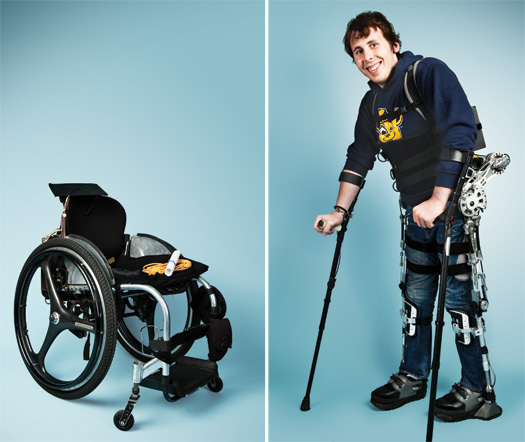
Seven steps. A short, straight walk across a stage backed by blue and gold balloons, lit by camera flashes, and ringing with the cheers of 15,000 people in the track stadium at the University of California at Berkeley. For most of the class of 2011, traipsing across the carpeted commencement platform is a triumphal but essentially symbolic exercise. You don’t even get your diploma, just a rolled-up note saying that one will be mailed. But for Austin Whitney, who comes last this year, the walk itself will be a major achievement.
Whitney is a paraplegic. For the past four years, he has been bound to a wheelchair, unable to walk. Then he got a call from Homayoon Kazerooni, the director of Berkeley’s Robotics and Human Engineering Laboratory. Kazerooni creates robotic exoskeletons, motorpowered devices worn by users to add mechanical might to the movements of muscle and bone. The U.S. military funds most exoskeleton research, with the goal of one day creating a super-soldier, a bionic man who can punch through brick walls or carry 200-pound loads all day long. Kazerooni has built exoskeletons that are now being tested by the Army, but when he contacted Whitney in August 2010, he had other users in mind. He was looking for a research subject to help his students develop an exoskeleton that didn’t give its wearer a superpower but rather a much more basic one: the ability to walk.
On the stage, Whitney’s mortarboard tassel drops in front of his eyes and he flips it aside with a shake of his head. Lurking a few feet behind him in dark glasses and black sport coats are Michael McKinley, Jason Reid and Wayne Tung, graduate students in Kazerooni’s lab. Waiting offstage is another graduate student, Minerva Pillai, and the lab manager, Arun Joshua Cherian. Whitney is about to demonstrate their invention in public for the first time, and the exoskeleton has been bedeviled with technical glitches that persisted until moments before he wheeled himself onstage.
“This in many ways is like a moon launch. When the countdown reaches zero, we hit the stage.”Until now, the exoskeletons developed in Kazerooni’s lab have been elaborately engineered test pieces. “All we’ve been doing is making really expensive machines,” Kazerooni says. “We’re making Porsches.” For the current project, Kazerooni challenged the students to invent the Honda of exoskeletons, a bare-bones device that would cost $15,000 or less, not $100,000 or more. Only at that price, he says, will disabled people (and their insurance companies) be able to afford them. Since the project began in January 2009, it has become a steadily consuming obsession for Kazerooni’s students, who powered themselves through 17-hour days with caffeine, candy bars and pirated MP3s. In the month before graduation, most of the students took up unofficial residence in the lab. “This in many ways is like a moon launch,” McKinley says. “When the countdown reaches zero, we hit that stage.”
Whitney grips the handles of a walker placed in front of him. Arms quivering, he pushes himself up from the chair. Cheers swell around him as his right leg, powered by the clacking machinery of the exoskeleton, flexes at the knee and begins to swing forward.on Tuesday at Midnight, four days before graduation, it seems uncertain that the first step will even happen, though the students refuse to voice any doubt. Kazerooni is in China for a conference, the students are running the shop, and the exoskeleton is having problems. The “Kaz Lab,” a windowless, basement-level room in Berkeley’s engineering building, is strewn with wires, circuit boards, Thai food containers and Twix wrappers. McKinley hunches over a computer-controlled machining tool, which cuts into a copper plate with a nails-against-the-chalkboard scream. Pillai works at a sewing machine to modify the exoskeleton’s shoulder harness. Exoskeleton prototypes with gears for hips and thin metal rods for legs hang from ceiling straps around the room’s perimeter.
Crammed against one wall, a treadmill sits covered by a bed sheet. Two sneakered feet jut out from underneath it. They belong to Whitney, who, somehow, amid the pandemonium, is able to nap. Though he isn’t an engineer (double major in history and political science), Whitney’s input is critical to the Kaz Lab team. He has participated in hundreds of tests and provided design suggestions, user feedback and motivation. The students might say they’re working to advance the cause of the disabled, but what they’re really thinking about is helping their friend to walk. The schedule has been so hectic lately that Whitney returns home for only a few hours a night and has taken to napping between exoskeleton tests. A paper-plate sign taped to his treadmill shanty reads “Will pilot exos for food.”
Reid stands up from a computer where he had been tweaking some of the software that controls the exoskeleton. He comes over and taps Whitney on the shoulder. “We’re about ready for you, Austin,” he says. Whitney sits up and rubs his eyes. He hoists himself into a wheelchair that already holds the exoskeleton in a seated position. He cracks open a 16-ounce Monster Energy drink as the team members tighten the bindings that hold him in the machine. The test is about to begin when Whitney calls out, “Oh wait, music. Come on guys, step up!” A student taps at a keyboard, and a beat starts pumping out of desktop speakers. “Some labs run on water, others on honey,” Whitney says. “We run on techno.”
Whitney pushes himself laboriously to his feet, and the exoskeleton experiment is under way. With a safety cord running to a ceiling track, he takes a lurching, clanking step forward, like the Tin Man breaking free from his prison of rust.
Long Walk
General Electric unveiled the world’s first powered exoskeleton—Hardiman, a 1,500-pound, marginally functional beast—in 1965, but it was too bulky and difficult to control to be practical. Exoskeletons now often weigh less than 100 pounds, but they work fundamentally the same way. The user is strapped into a metal framework with articulated limbs and joints that he directs with body movements or electrical stimulation. Motors supply the superhuman power.
Whitney’s exo is named “Austin” in his honor, and its robotic heritage extends back to BLEEX, an exoskeleton that Kazerooni began developing in 2000 with grant money from the Pentagon’s Defense Advanced Research Projects Agency (Darpa). In 2005, Kazerooni co-founded the company Berkeley Bionics to commercialize the devices pioneered in his university lab.
With the goal of developing an exoskeleton that costs close to what a powered wheelchair does, the students were forced to adopt a minimalist approach. Instead of updating earlier models by adding features, they had to strip them out. “Kaz told us, ‘Find a way to use fewer motors and still make this thing walk,'” Pillai says. She and the team employed two motors rather than the four or six motors of previous models. Instead of custom-designing every part, the team members bought some components from Sports Authority, including snowboard bindings and soccer shin guards to secure Whitney’s feet and legs, and shoulder straps from a backpack to hold the exo’s motors and batteries to his back. Reid, who was in charge of the Austin’s computer control systems, had to work with a system that had very few actuators powering joint movements or sensors reporting leg positions to the computer brain, which itself is a $60 microprocessor rather than a $500 one. “It’s been a huge adjustment to get performance out of the machine,” he says.
Seven minutes into the test, Whitney has walked only about 20 feet. The team had completely rebuilt the knees just a few days prior, a major design change equivalent to replacing the wings of the space shuttle a week before takeoff. The good news is that they’re holding firm. But now the machine’s torso framework is out of alignment. “It just doesn’t feel right,” Whitney says. “It’s pushing really hard on my lower back, and that’s causing me pain.” He takes another step, then stops, panting, head hung down over his shoulders and a bead of sweat dripping from his nose. “I can’t make it any further,” he says. “Get the chair.”
McKinley and Tung fix the back-angle problem by 2 a.m. But new problems keep cropping up. On Thursday, after working flawlessly for thousands of previous steps, a bolt in the hip joint wriggles loose and locks the legs into a completely straight position. Austin has to be lifted, like a corpse frozen in rigor mortis, back to his chair. At Friday evening’s dress rehearsal, less than 24 hours before the commencement ceremony, Whitney’s black graduation gown gets pinned beneath the pads that hold him in the exo. When he tries to stand up, the tautly stretched fabric breaks one of the plates in the back. This time the Kaz Lab members are up until 3 a.m. machining a replacement.
“It’s like a game show,” McKinley says. “Like someone has written these riddles for us and we have x-amount of time to solve them.” When Whitney stands at graduation, though, the time to solve problems will have expired. If you comb YouTube for exoskeleton videos, what you’ll see are tightly edited demonstrations in clinical settings where every variable, such as the walking surface, can be controlled. Whitney, in contrast, is going to perform live and outdoors. “This will be a very transparent demonstration,” Reid says, “for better or worse.”
Final Push
On his fourth step across the stage, Whitney stops for just a moment. Until then, he’s been concentrating deeply and ignoring the 15,000 people watching him. Ignoring his mom, dad and the university chancellor on the other side of the stage.
“Someone has written these riddles for us and we have x-amount of time to solve them.”Focus is essential. An exoskeleton is true cyborg technology, a partnership between metal and flesh. When Whitney presses a button mounted on the walker, it signals the exoskeleton to drive his legs forward at a predetermined pace. The framework supports his otherwise limp legs. But with its minimalist design, the Austin model doesn’t have sensors to detect Whitney’s upper-body position, or motors to automatically correct his position if he leans too far in any direction. With no feeling whatsoever below his waist, he is a torso slowly flying through the air. “My biggest job in the exo suit is balancing,” he says. His biggest fear is of falling flat on his face.
As traumatic as a face-plant would be, the experience would hardly be the worst of his life. That distinction goes to the car accident that broke his spine in 2007. “I had just graduated from high school and was driving back from a party where I’d been drinking,” he says. “I went too fast around a turn and wrapped my car around a tree.” Now, Whitney says, “whenever I meet someone for the first time, they wonder, Why is he in a wheelchair? And I have to tell them. It’s so hard to be defined forever by the worst moment in your life.”
But here on the stage in Berkeley—this could be another defining moment. The affordable exoskeleton developed by Whitney and the other students allows paraplegics to realistically dream about walking. “Finding redemption,” Whitney says, “is what has pushed me to everything I’ve done since the accident.”
Whitney knows he needs to concentrate on staying upright. But for just an instant, he shifts his focus. He can hear everyone cheering, and he wants to see them. He lifts his head and looks right, realizes that he is getting a standing ovation, and smiles.
The seventh and final step brings Whitney to chancellor Robert Birgeneau, who shakes his hand. Whitney then turns to Kazerooni, who has returned from China, and the two hug, face to face. For a paraplegic, used to people having to bend over to engage him, embracing someone at a standing level is a pleasure that he hasn’t been able to enjoy since the accident. Whitney smiles at the graduating class once more, and then his friends lower him gently back into his wheelchair.
Backstage, the Kaz Lab members hoot, high-five, and debrief. At the beginning of the walk, “I was afraid I was going to fall down,” Whitney tells them. At the end, Kazerooni was an inch away from accidentally flipping the exo’s “off” switch when he hugged Whitney. But even before the adrenaline rush has faded, exhaustion advances. “Now we sleep,” says Pillai. “Kaz Lab out,” McKinley says.
By Monday, though, the students will all be back in the lab. They are working on a new exoskeleton, one that is even more streamlined and affordable than the Austin model. A long vacation would seem well deserved, so what is the urgency to return to work? “What’s the urgency to breathe?” Reid says. “This is what we do. I don’t think we can stop.”
Austin Whitney has since landed his first post-collegiate job–as a bionic leg tester.
Don’t forget to check out our companion piece to Austin’s story: The State of the Bionic Body, or, the Best Replacements for My Flimsy Human Parts.