Airport Pods ULTra PRT

Driverless cars are just catching on in this country, but they’re already zooming around London’s main airport, ferrying passengers from their people-driven cars to the terminal.

Twenty-two of these automated pods are operating at Heathrow’s Terminal 5, the shiny new terminal occupied by British Airways. They were built to replace a duo of diesel buses that formerly drove in a loop from the car parks to the terminal, pausing at various stations no matter how many people were present.

The electric-power pods, which can accommodate up to four travelers and their bags, travel up to 25 mph along 2.4 miles of paved guideways, which can be customized to fit any path. They don’t require a special railway or magnetic field — just lines that can be used for optical navigation. The pods can even maneuver through light snow, according to their manufacturer, ULTra PRT. The New York Times says the autonomous pods have not been in any accidents.

The first trials started in April, and service became fully operational this summer when the buses were removed from rotation, the Times says.

Passengers have to press "start" when they get in, to ensure efficiency and to prevent people from making the pods move while they’re empty. About 800 people per day use the pods, the Times says.

Heathrow Pods:  ULTra PRT

According to the ULTra, American travelers might see them soon, too. The systems are under review by airports in California and New York; transit systems in California, Oregon and Tyson’s Corner, Va., a Washington, D.C., suburb; downtown Calgary; and even in Mountain View, Calif., where Google and NASA workers battle congestion.

The pods are cheaper than high-speed rail, which might make them attractive to cash-strapped cities. Passengers like them because they’re more convenient than checking transit timetables, ULTra says — the pods come to you, rather than you waiting for them. But the best part may be their simplicity: With a customizable guideway system, they could even be used on regular roads, meaning pods like this could be an easy way to integrate driverless vehicles into commuters’ lives.

Watch one in action below.

[New York Times]

4 Comments

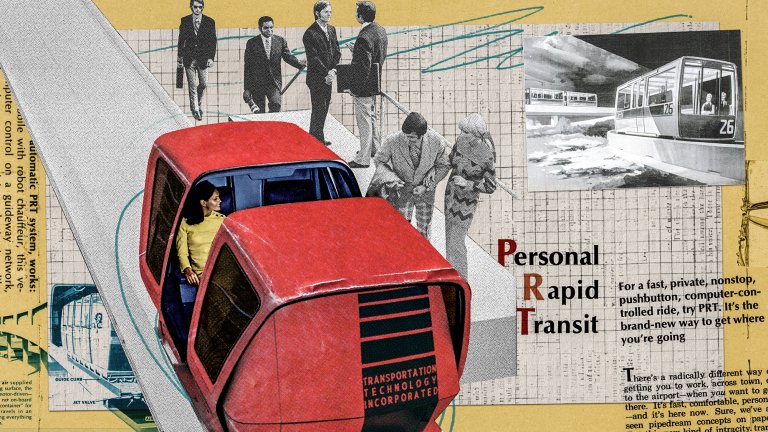
This looks like a supped up version of West Virginia Universities PRT that has been around since the 70's. PRT stands for "Personal Rapid Transport". However us students like to call it the "Partially Reliable Train"

www.michaeltaylor3d.com

I would enjoy riding one of these, or something similar around town. My town doesn't even have passenger trains. If I could take a commuter train to a beach town or a big city and then ride one of these to a pseudo-station around town, I would never drive again. It seems to me that a credit card scanner could even be installed in the vehicle so that they aren't just used for free. Not to mention, when my wife asks me to drive her somewhere, and I am just to worn out to go anywhere, we could just ride one of these and I wouldnt have to argue with her about driving

Looks like a very bumpy ride, how about installing shock absorbers on the suspension since they didn't make the ride track smooth? It looks like a Disney park ride. These cars can't leave the pathway So these cash strapped cities will have a budget for major roadway renovations to put up curbed pathways all over town for these cars to roam around on?

"The pods are cheaper than high-speed rail, which might make them attractive to cash-strapped cities."

Bicycles are also cheaper than high speed rail. What point are you trying to make? High speed rail services were conceived as an alternative to short-haul flights, and they have competed very successfully in France and elsewhere. A four-person pod that goes 25 mph is hardly a replacement for a passenger jet. This is a local transit system, and a remarkably capital-intensive one to build at that. Heathrow could have likely operated the buses for decades with the money it took to build the Ultra system. Hopefully the better service and lower operating costs are worth it.


June 2013: American Energy Independence

Five amazing, clean technologies that will set us free, in this month's energy-focused issue. Also: how to build a better bomb detector, the robotic toys that are raising your children, a human catapult, the world's smallest arcade, and much more.


Online Content Director: Suzanne LaBarre | Email
Senior Editor: Paul Adams | Email
Associate Editor: Dan Nosowitz | Email
Assistant Editor: Colin Lecher | Email
Assistant Editor: Rose Pastore | Email

Contributing Writers:
Rebecca Boyle | Email
Kelsey D. Atherton | Email
Francie Diep | Email
Shaunacy Ferro | Email

circ-top-header.gif
circ-cover.gif
bmxmag-ps