The century-old Panama Canal has a major shortcoming: New ships are too long, too deep and too wide to fit through it. by 2015, 40 percent of the world’s fleet will have outgrown the roughly 50-milelong passageway that is a key artery for goods headed from Asia to Europe and the U.S. Gulf and East coasts. Since 2008, the Panama Canal Authority has been leveling hillsides, excavating miles of new access channels to make room for the so-called post-Panamax ships. by the time the seven-year, $5.25-billion project is complete, it will have dredged a total of 5.3 billion cubic feet of dirt, sand and mud.
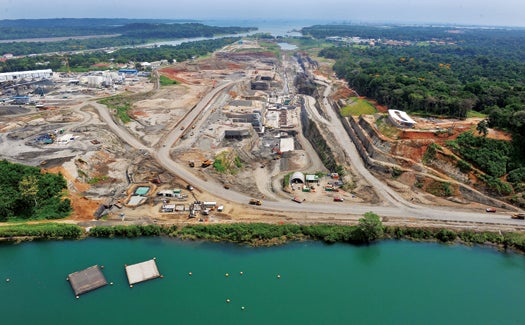
But the biggest bottlenecks are at each end of the canal, where locks lift and lower ships into and out of the channels. Instead of enlarging the current locks, the port authority will build two more sets—one at each end—large enough to fit ships that are 1,200 feet long and 160 feet wide and that can carry 12,000 containers (2.5 times more than the current capacity). With construction set to begin later this year, the new locks will increase the canal’s annual cargo capacity from 340 million to 600 million tons when they open in 2014.
The new locks will consist of three quarter-milelong, 60-foot deep chambers. A gate closes behind the ship, operators open a chute, and water rushes in. The water level raises 27 feet per chamber, and with it the ship. Gates then open to the next chamber. The old locks drew some 55 million gallons of water from an adjacent lake to raise the ship and then emptied it into the sea. In the new design, 60 percent of the water is recycled through three storage basins. The result is that even though the new locks are 30 percent bigger, they use 7 percent less freshwater per transit.
Read more about the future of shipping here
Five amazing, clean technologies that will set us free, in this month's energy-focused issue. Also: how to build a better bomb detector, the robotic toys that are raising your children, a human catapult, the world's smallest arcade, and much more.


Online Content Director: Suzanne LaBarre | Email
Senior Editor: Paul Adams | Email
Associate Editor: Dan Nosowitz | Email
Assistant Editor: Colin Lecher | Email
Assistant Editor: Rose Pastore | Email
Contributing Writers:
Rebecca Boyle | Email
Kelsey D. Atherton | Email
Francie Diep | Email
Shaunacy Ferro | Email
This is more a question than a comment. Will the new canal locks be doing anything to ensure exotic (non-native)biologicals don't migrate between the Atlantic and Pacific oceans?
If Americans were smart they would spend $100 billion or more to dig out the Rio Grande to make the largest man made canal in the world (by a factor of 10) and thereby create also the biggest 'Castle America' moat which would assist in keeping out illegals.
I don't think that the new locks will do any more or less than the existing locks to prevent biologicals to migrate.
I as a USA citizen am helpless in the decision process of what the Panamanians are doing. It is Panamas own country. We gave it up the rights to the canal. Yes I did not do this and I know for fact my father and grandfather said giving up our rights to the Panama Canal was a bad idea, so we have only to blame ourselves. But if the Panamanians decide to expand their canal, well stupid us, yes it’s their right and to HELL with the environment. We USA people have no say, our leaders once again did it to us. We are suffering for President Jonson’s decision to spend of the excess social security fund and today our social security and weak leaders put ourselves and social security in risk and we have no opinion now with the Panamanians are doing with the canal. Thank GOD for democracy, for some leaders will leave and there is hope of this for the future. Democracy is the best in the world.
The Panama Canal was once one of the largest engineering projects undtertaken by man, it can be seen from space easily, and does greatly redice the cost of goods transported from between the Atlantic and Pacific oceans. Do we have it right?...Should we enlarge it further? Perhaps if we spent more time on such projects within the U.S borders there would be fewer people out of work.