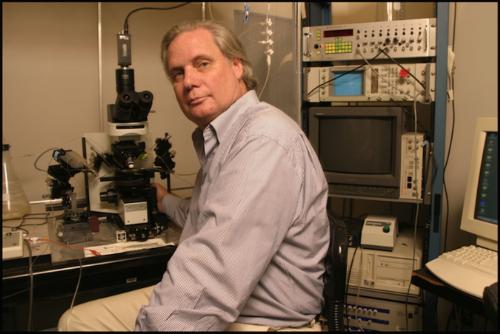
Dr. Theodore Berger PR NEWSWIRE

A new brain implant tested on rats restored lost memories at the flick of a switch, heralding a possible treatment method for patients with Alzheimer’s disease, stroke or amnesia. Such a “neural prosthesis” could someday be used to facilitate the memory-forming process and help patients remember.

The device can mimic the brain’s own neural signals, thereby serving as a surrogate for a piece of the brain associated with forming memories. If there is sufficient neural activity to trace, the device can restore memories after they have been lost. If it’s used with a normal, functioning hippocampus, the device can even enhance memory.

In the study, scientists at Wake Forest University and the University of Southern California trained rats to learn a task, pressing one lever after another to receive water. In a series of tests, the rats pressed one lever and were then distracted. They had to remember which one they’d already pressed and therefore which lever to press next, left or right, in order to receive their reward.

The team attached electrodes to the rats’ brains, connected to two areas in the hippocampus, called CA1 and CA3. Prior research has shown that the hippocampus converts short-term memory into long-term memory. The team recorded the signals between these regions as the rats performed their tasks, and then they drugged the rats so that the hippocampus regions could not communicate. The rats forgot which lever to press next, said Theodore Berger, a biomedical engineering professor at USC and lead author of the study, which is published in the Journal of Neural Engineering.

“The rats still showed that they knew ‘when you press left first, then press right next time, and vice-versa,’” Berger said. “And they still knew in general to press levers for water, but they could only remember whether they had pressed left or right for 5-10 seconds.”

Then, the team made an artificial hippocampus, which could duplicate the normal neural signals between the CA1 and CA3 regions. They turned it on, and replayed the previously recorded signal from CA1 — like a recorded message from the brain. The rats remembered.

“Flip the switch on, and the rats remember. Flip it off, and the rats forget,” Berger said.

Although this is a long way from being tested in humans, the research shows that if there’s enough information about the neural coding of memories, the signal patterns can be recorded and duplicated, and restored later through a neural implant. This could be difficult to do in patients with severely limited memory, as the New York Times points out — there needs to be a memory trace that can be recorded and amplified. But for patients with dementia, enhancing the memory-formation process can be useful — remembering where you put the keys, for instance, or where the bathroom is located. Simple memories like those could keep people independent for longer periods.

The researchers want to test the device in monkeys next, according to USC.

17 Comments

a few things come to mind.
in the tv sereies stargate sg1, season 10, they had a device that could do this.
IT JUST SEEMS SO AWSOME!!!!!!!!!!!!!!
well of course the pple were farther advanced than us. and it did more than just erase and recall memories. it could implant false memories.

and the other thing.
THE CIA NOW HAVE A MEMORY ERASER FOR UFO SIGHTINGS!!!!!!!!!!
better hide now.

Fake.

This technology is simultaneously superb and terrifying. It could be useful in the criminal justice system, however...
;-)
-Spouting a fountain of nonsense since 1995-

It would be cool to have this feature (if perfected and completely reversible) ... I'd like to be able to watch some movies or try bacon or read a book for the first time again.

(click)
Oh man, i just got my memory back, and as i recall i don't really care for you!
(click)
Wait a minute who are you?
(click)
Hey i know you!
(click)
What's your beef stranger?
(click)
Well if it isnt my old nemesis...

I know Kung Fu - Neo

I would like a neuronet of these implants to know, instead of learn. Nothing more logical then to just skip to the understanding of everything and go straight into being a professional.

Copy paste intelligence! I want to share a dream, record memory? I could share evidence of a crime, if I witnessed it and had my prosthetic memory proteins recording. Cell phone with memory bank and triggers? Just buy and download memories online. Mass artificial intellectualism.

A.I. Robotics with human memory implant.

This technology has a big future.

~ You fall somewhere in the Balanced Frequency of Nature. Someone Along the Infinite Spectrum of Life.

FaceBook: www.darkfx.cjb.net
DeviantArt: www.exodusprime.cjb.net
www.youtube.com/d4rkfx
www.myspace.com/exodusprime

I can definitely see this taking off sometime in the next century. Building on DarkFx's point, while we wouldn't want to KEEP these memories in our own personal external hard drives, they could go a tremendous way to enhance learning of their content.

Just plug in one that has all concepts that are working together - except one, and because the memory module is itself full, the missing concept would be learned and stored in our own brain. Plug in the next module which has another concept missing, and we learn that one. I'm certain that things could go quicker this way, since at no point do we lose the motivation to know how to do these things.

Basically, at school, with the equipment, we're learning quantum mechanics. At home, we're learning arithmetic, the normal way. Learning from both ends of the spectrum sounds good to me.

Who knows, perhaps our brains will somehow be able to copy the memory from the modules just by emulating their contents - suppose we do a few problems using the expanded memory, and then the rest of our brain has itself stored the information that was used to solve the problem. Most likely not, but the human brain has surprised us before. We'll have to try it to find out!

Figures I thought of something else right after commenting. This could be great for a workforce as well - someone get sick? Bring in a substitute and plug in the memory module that he'll use to do his job, no training required. This would also allow individuals to try out many, many jobs at once, and see what they like doing the most.

A somewhat substantial cure for Alzheimer's disease. I was shocked when the article wrote how this artificial memory chip can enhance one's memory, but to what point?

But, the team would definitively need more evidence to support their finding.

Amazing discovery, and I wonder how the rats are feeling at the moment.

Thank you, HyperNova

@Onihikage

But then would we have enough "RAM" to handle the information on the said "external harddrives"?

Since brains are a bit like computers, we can assume that too much knowledge would eventually slow the system because of the length of the path that it takes to reach a given thought/memory.

What good is knowing everything when it takes you half an hour to remember that one specific thing?

But meh, still looks like a nice piece of tech!

They say you can't fix stupid... now we could just copy and paste.

"Oh, Aaaalgernoooooonnn!" -Bugs Bunny

sound like that one movie "Repo Men" where the guy is shot in the head and half dead. they "make" him think that he is living the life he ultimately wanted by creating an artificial reality in his mind. and it also sounds like that other movie Source Code. but that kind of different.

@DarkFx -> First, awesome avatar, 2nd great thoughts, the crime recordings, etc. Now we are entering total recall, "dream" vacations, etc. Ever wanted to be with that gorgeous, gorgeous person? Well, now you can have your memories of that experience... Woo hoo! I could be a baller!

This technology has a terrifying dark side. Criminals could use it against you. Make you forget the crime they just committed against you never took place. This technology once miniturized could easily be incorporated into existing locator chips (much like used by pet owners) so that spouses could cheat on each other and one of them makes the other forget.

The list of dark sides goes on and on. If a human can think of it they can make it happen.

This new date from 2003.

Of course if we get to dependent one good EMP could bring humankind back to toddler level intelligence. Much like late night info-mercials, soap operas, tabloids, and speeches by President Obama does.


July 2013: The Future Of Flight

The incredible innovations, like drone swarms and perpetual flight, bringing aviation into the world of tomorrow. Plus: today's greatest sci-fi writers predict the future, the science behind the summer's biggest blockbusters, a Doctor Who-themed DIY 'bot, the organs you can do without, and much more.


Online Content Director: Suzanne LaBarre | Email
Senior Editor: Paul Adams | Email
Associate Editor: Dan Nosowitz | Email
Assistant Editor: Colin Lecher | Email
Assistant Editor: Rose Pastore | Email

Contributing Writers:

Kelsey D. Atherton | Email
Francie Diep | Email
Shaunacy Ferro | Email

circ-top-header.gif
circ-cover.gif
bmxmag-ps