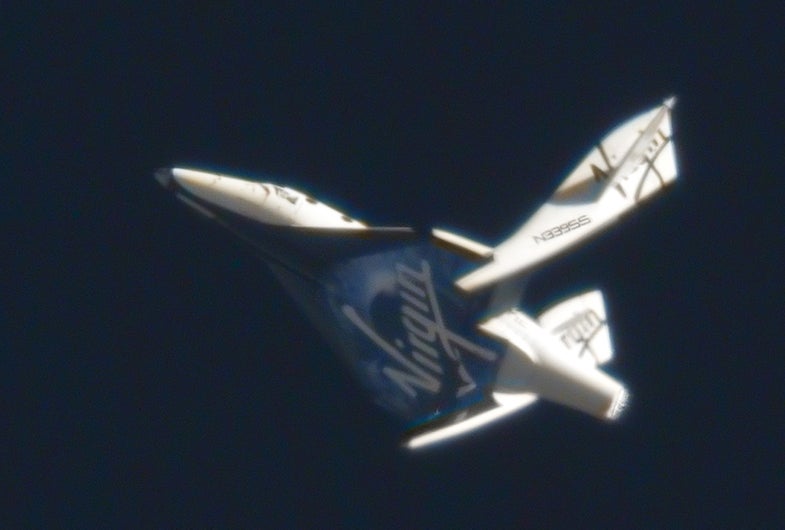
VSS Enterprise, Feathering Clay Center Observatory/Virgin Galactic

Virgin Galactic just keeps on ticking off the milestones on its way to becoming the first commercial company to take tourists on high-altitude flights to suborbital space and return them safely through the atmosphere to Earth. In the video below, we actually get to see Virgin’s SpaceShipTwo (aka VSS Enterprise) making its first “feathered” flight.

“Feathering,” as it is known, is probably the biggest innovation integrated into SpaceShipTwo’s design. In the feathered position, the entire tail section of the plane rotates upward about 65 degrees, creating a different aerodynamic shape that is highly stable yet creates tremendous drag to slow the aircraft down during re-entry. Though that drag is pretty significant, the light weight of the aircraft keeps the skin temperature from rising too high, circumventing the need for heat shields and other thermal protection.

Moreover, when feathered correctly the aircraft is so stable that the pilot can more or less take his hands off the sticks and let the aircraft work its way through the atmosphere naturally, based purely on its aerodynamic shape. That’s a huge safety feature, as the pilot doesn’t have to maintain a specific degree of entry or rely on a sophisticated fly-by-wire computer.

The test shown below took place May 4 and did not actually include a trip to space. But this first feathering test, which began when SpaceShipTwo was dropped from the carrier aircraft WhiteKnightTwo at 51,500 feet, proves that Burt Rutan’s feathering design actually works as well in the air as it did on paper. Where you see the aircraft feather, keep in mind that it is basically falling straight down at 15,500 feet per minute, a rate that is slowed significantly by the aerodynamic drag generated by the feathering configuration.

[Virgin Galactic]

35 Comments

The private industry is progressing at extraordinary speed. I hope all goes well on the actual first flight! I'd like to ride it someday if I had the money.

~ 176 miles per hour, but I guess 15,500 feet per minute sounds more impressive.

That wing design is inspired.

Wow, I hope that our private industry picks up the manned space flight mantle because our Administration has gotten totally out. I hope there are LeRoy Grumman, William Boeing, and Donald Douglas's out there to go toe to toe with China and the European Space Agency. Can you believe that we blew a 40 year head start in space technology that we could have handed future Grumman's, Boeing's and McDonnell Douglas's?

It's a good thing that the realization of our short-sightedness has finally prompted us to action. Not. But Godspeed Richard Branson, Burt Rutan et al. May you create the means to finally get us to the moon and then to Mars, even embarassingly later than 2001 as a Space Odyssey.

@Whys333 Hey! don't tell the journalist how to do their job!
But personally I would have expressed the descent rate in units everyone can understand, such as
89.3 [Barony ell]/[microfortnight] or,
6.63x10⁻¹¹ [AU]/[GalacticYear]
/end sarcasm

I know what your saying, historically IMHO writers and numbers and units don't mix well. BTW, I think it's a pretty clever wing design too.

Whys333,

Feet per minute is commonly used to describe an aircraft's climb and decent rate because its is more useful / meaningful to pilots then mph-not because it more impressive sounding.

that's quite amazing, it doesn't need a heat shield because it doesn't weigh enough to punch through the atmosphere, just like a feather! mind=blown!

it actually makes a lot of sense though, the space shuttles were designed in an age where they built big, THEN met the requirements to get there and back. these people are doing it with less resources, possibly less fuel, and will possibly be an economically viable company while doing it. hooray!

Just imagine the forces on that plane. Wonder how often they have to replace the tail?

Sorry I am new here and have a question. How is this different from SpaceShip One? Did not that have a tilting wing as well?

Sorry, not impressed. 51,000 feet, please.

Just like "Big Oil" will probably never compete with the OPEC cartel, Virgin will probably never compete with NASA funding and engineering. It's nobody's fault, really. Perhaps some good can come out of it; some good comes out of everything; but this seems more like a circus and a bunch of hype.

Especially with a name like virgin all over the place; what a terrible eponym for a corporation. I would never work for them.

@Charles R. Kiss -

While SS2 will be suborbital to ~430,000 ft. apogee Virgin Galactic is slso involved in an orbital spaceplane project under NASA's Commercial Crew Development-2 (CCDev-2) program. Specifically, this is the Sierra Nevada Dream Chaser.

Dream Chaser is a 7 passenger (or cargo) spacecraft that would, like SS2, land on a conventional runway after launch on an Atlas V or other EELV class launcher. Others involved with VG are Northrop Grumman (Scaled Composites parent), Boeing Phantom Works and others.

The goal is obvious: Virgin Galactic will sell rides on SS2 for suborbital and Dream Chaser for orbital. Problem solved.

DocM

Sell Rides like an amusement park at a circus. Exactly.

The US Government would never be involved in such trivial matters; Randroids and Tea-Partiers, take note.

@docmorbid

Please, don't even mention 430,000 feet, "Virgin" still has twice as far to go, then twice as far than that, then twice again as farther than that! You've made it sound like it's just around the corner, "virgin" is not even close to one eighth the altitude 430,000 feet you mention. And then re-entry????

Good luck finding a test pilot, or even customers(!) for re-entry.

"Private" space flight hype, that's what this is. Don't forget NASA put a man in orbit, landed him on the moon, and brought him back safely to Earth almost fifty years ago.

Members at "Virgin", and private industry in general, should stop trash talking nationalized space programming until they've proven to do better.

To ALL READERS

This never happened:

"a different aerodynamic shape that is highly stable yet creates tremendous drag to slow the aircraft down during re-entry. Though that drag is pretty significant, the light weight of the aircraft keeps the skin temperature from rising too high, circumventing the need for heat shields and other thermal protection."

It's a disingenuous statement that implies "creates", when it should read, "intended to create"

For all we know, pressure around the axis of the tail's rotation will just burn it off.

Also, this statement:

"suborbital space and return them safely through the atmosphere to Earth."

implies that it somehow left the atmosphere when it never did... "suborbital space and return"??

How about "upper atmosphere, to one eighth orbital altitude, then back down to the runway."

Jeez, Charles, relax man. It's a test flight. Of the first ever privately owned, sub orbital craft. You're behaving as if Branson walked up to your door and punched you in the face. So they didn't go into space. They wanted to make sure it could at least handle those pressures before amping it all the way up. No one's saying the national program didn't achieve great things. But it only did that with the support of the government which it no longer has to any manageable extent, as far as manned missions in the near future go. This is the spark that may ignite the fire of privatized space flight. It has to begin somewhere. Why does that seem to offend you personally? I want to go to the moon, too, man. I feel your pain. You sound crotchety, so you're probably much older than me. I get it. You see the clock on the wall ticking away the remaining seconds of your meagre existence. You just want to feel the crunch of moon dust beneath your astro-boots. I get that. But it's gotta start somewhere. You gotta walk before you can run. And crawl before that. And possibly scoot on your bum before that. And maybe even pull yourself along on your belly with your arms. Only on the tile, though. There's too much friction on the carpet for your little arms to overcome. But you don't know that. You're just a baby. A baby who might go to the moon one day. But probably not, we already established that. Try to keep up, Charles. This is the scoot. We’ve witnessed the scoot of privatized space flight and you’re shouting at them. You’re shouting at a small baby. For shame.

I hope this new airplane does not fly to low to the ground and scare the squirels. I worry about those squirels. Bark! SQUIREL! SQUIREL! BARK! BARK!!

@DickySimms

LOL!

Why do people keep calling this "sub-orbital"? It hasn't even gone higher than a basic weather balloon.

There's so much bad reporting and hype, something private industry has with conflicts of interest that reminds me of watching "Meet the Press" with David Gregory: if he would ask tough questions, NBC would't find anymore guests. It's that simple.

The other problems I have are with the Randroids who think the only "unintended consequences" are those created by government. Wait until all the agencies are gone, buying a "ticket into space" and frying on your way down will be the least of your problems.

Let's face it, for thousands of years, "governments" and "taxes" have funded everything from the pyramids at Giza to the internet gateways at CERN.

DickySimms you are my hero

@DickySimms- +1 Well said sir!

@Charles R. Kiss

Perhaps you've heard of a space shuttle by the name of Enterprise? It too had test flights, three of them, and were dropped from a height of between 19,000 and 26,000 feet(see www.grin.hq.nasa.gov/ABSTRACTS/GPN-2000-000218.html for details), well below where this "test flight" took place and look what the shuttle has accomplished.

It's called a "test flight" for a reason.

I love how people come on here and saying "that will never work!!!!" and make that judgement on a video or a reporters statements, have either: no idea what the actual specs are on the said subject, and/or not having any technical knowledge in the area. Said people come here thinking they know everything just hilarious. Good luck Virgian. i hope these guys do what a multi trillion dollar gov. could do....sustain a viable space program.

@ghost,this doesn't need a heat shield because it does not come close to reaching the speeds of the shuttles...@TomMariner, we didn't quite blow 40 years, nasa has learned tons of stuff about living in space, constructing in space, way to many accomplishments to list here, nasa is collaborating with private enterprise to take over low earth orbit, to the moon and even possibly mars (spacex to name one), get informed before you just go about bashing nasa...@Charles R. Kiss, get a life and stop posting ignorance

@Charles

You have a valid point that NASA has been doing a hell of a job since its inception; and shutting it down will create a power vacuum in space exploration that will leave the US behind. NASA had two goals in the '60s never lose a man in space and put a man on the moon. Virgin has one goal turn a profit transporting people into space. NASA's model of space flight is safe and effective, Virgin wants a model that is safe, effective, and cost effective something NASA's program would never be. Virgin's feathering system was yes tested at a meager 51,000feet, but if it proves viable (larger ships and of course a decent from orbit) it could revolutionize space flight as we know it. This test was a proof of concept and Virgin is on the cusp of a major breakthrough or a major let down. Think of the possibilities of lighter ships that don't need heat shields and maybe in time could be launched without rockets or at the least without the huge fuel costs of current shuttles.

As far as the name "Virgin" get a grip man does Apple make any better sense for a hardware company then Virgin for a name for a telecommunications/space enterprise/what ever else they do company? People take pride in what they do and what their company sells, not what it's called (ok with the exception of geek squad that one crosses a line). Do you think Space X is better then Virgin Galactic? Neither is exactly original (Virgin is the parent company of Virgin Galactic hence the name)or especially catchy.

The name Virgin goes back a long ways (as applied to this subject.) Super business tycoon Richard Branson started a record store way back when and called it Virgin. . . (Records, or just Virgin Music, not sure which) because he was "a virgin in business." Branson started small, but he became big. Really big. The name Virgin became his brand and he retains rights to it. Virgin Galactic is a company of Branson's Virgin group, a group of nearly 400 companies world wide all carrying his brand. So what it comes down to is brand recognition. Richard Branson's Virgin Group is dumping the big bucks in a company for commercialized space flight. So it is Virgin Galactic to keep with Branson's brand stamping formula. The name may not be the most Star Trekky name to work with, but brand recognition is simply that. . . will you associate the name Virgin with space flight after a few years? Yeah, we will. That is-- if they continue the milestones and become as important to commercialized space as we hope they will and they hope to be. Some brand name's can be lame, but Virgin is a word that does grab your eye. People made fun of Apple for decades. . . some still do. . . but there are not many souls on planet earth who do not know what Apple is. Names take time, Branson has groomed his since 1979. It's not going anywhere.

@ Chas. R Kiss; Your statements infer that just because a motorcycle now can hit 170 mph; there was no need for both Harley AND Davidson, nor all the advancements that came out of Europe, nor all of those from Japan, because a Ducati can hit 170, so that is the ONLY state of the art motorcycle. Ducati didn't get there by themselves, dude. Nor will NASA, nor will America, nor will humanity. NASA has exceeded the largest portion of it's original mandate, but now, even with hundreds of billions of dollars at it's disposal, THEY CAN'T MAKE WHAT THEY'VE CREATED FLY. You say no one can do it except NASA? So then, no one else on Earth IS doing it? Grow up.

@ Chas R. Kiss; Even better, try to understand it from this. Ford, Chrysler, and GM were not hammered in the 70's gas crunch. They were hammered by the sales of a more cost efficient automobile in the Datsun B210. A little tiny underpowered car that can't stand up to a 427 side-oiler or a 426 hemi if it tried. Except in efficiency; and as it turns out, that one area IS king. Over power, and over speed.

@quasi44
"even with hundreds of billions of dollars at it's disposal" If only NASA had had that much money. They have a budget of 18 billion a year. That's not even one % of the US budget.

@JamesL85, lanredneck, drchuck1, littlebang523, Macdaddydave
quasi44, kokofan50

A bit defensive for one reason or another? Virgin Employees, because you're virgins, never had a job before? Who knows, you don't publish your real names; maybe you're all the same virgin?

No one needs to explain to me the origin of the name, the definition of "test flight"; I searched this page for "that will never work" (it only appeared once, now twice), inferences, "hundreds of billions of dollars," etc. and I still don't understand what any of your comments have to do with any of mine, notwithstanding personal attacks.

If you would like me to summarize, perhaps you can focus your critique on the single statement below:

Firstly, Charles R. Kiss, slightly taken aback by the eponym, perceives significantly biased use of tense in the reporting
of Virgin altitude (hype), in a context of "private business is better than government" hype (Randroids).

As an argument supporting my position, I state: "for thousands of years, "governments" and "taxes" have funded everything from the pyramids at Giza to the internet gateways at CERN." This is an argument for the pooling of massive resources.

I have no interests in the failures of either governments or Virgin, you'll have to take me at my word here since I've never stated otherwise.

But as an aside, I'll claim additionally, that redundancy -something government does very well- serves a purpose, and American individuals and private companies benefited a lot from the impassioned humility it recalls, over and over again.

@Charles R. Kiss
whos the defensive one? And man you realy got us, we really are the same people beacuse we don't post our names, addresses, social security numbers and mothers maden names on a public forum....and we are in your closet BOO!!! All histerics aside, this will be great for american space technology, the capatilist style of ecoconomy thrives on power vaccums. It alows for smaller more competitive companies to step in and try to best each other. This will only work though if there is a financial incentive. call it darwinistic economics, only the most fit survive, NASA has become a bloated blundering giant that can no longer survive, its time for quick, agile companies to step in and pick it up again.

Oh BTW i was critizing your statement "For all we know, pressure around the axis of the tail's rotation will just burn it off." aka "this will never work!!!!" aka you have no idea what your talking about. Not that at i do but i doubt very much that you do.

cool design but i wanna see it space.

@lanredneck

The operative words are "For all we know", I wasn't making a prediction it was a was a critique of using the word "creating" where it should read, "designed to create", since the vehicle hasn't re-entered, yet.

However, the design surely looks complicated relative to vehicles which have re-entered, I was merely pointing this out. One has to be travelling very fast to stay in a low orbit (~20,000 mph), and it appears needed to take several orbits to slow down; which will take a long time = time risk; I'm not convinced and not buying into hype as little as I may know.

Again, I don't like the "anti-government" inferences -in many cases implying "government just gets in the way". Today, this sort of rhetoric seems most popular among men younger than 40 years of age (Randroids), and this machismo simply associates poorly with the eponym.

All the hypotheticals on how private business will do space-dev better are huge extensions in logic and are easy when "suborbital" flights occurred half-a-century ago. Waiting for private business to build and send up the next "Hubble," the next "space station," or "cosmic ray detector," or landing on the moon, etc, would be a giant step backwards for all humanity.

@lanredneck
"NASA has become a bloated blundering giant" We spend more moey on the war in Afghanistan (at minimom cost from what I found) in three months than NASA gets for a year. Here's another fact Bill gates could fund NASA for to years. Think about that the fact one man could fund NASA and you called it bloated. All in all I'd say NASA is under funed for evey thing they do. Here's a video to help show you how much they do.

http://www.youtube.com/watch?v=IOKRR9sYlzc

I don't think I can personly say it better than that video. I think NASA doesn't need to die but grow.I'm not just for NASA, I like privet companies trying to get people in space.I don't however want people to think that now that we have companies taking people in to space NASA has no reason to still be around.

@KatieSaucey

15 000 feet = 3.0561932325e-8 astronomical units

-and-

120,888,000,000,000 minutes = 1 galactic year

-or-

0.0000000000000827 galactic years = 1 minute

therefore,

3.06*10^-8 au / 8.27 * 10^-14 galactic year =

370,012 astronomical units/galactic year.

It seems you're mistaken by a factor of:
5,580,876,197,600,000

But someone please check my math!

nasa is not going anywhere, congress just increased their budget to continue orion, a combination of nasa and private enterprise is happening now and is the forseeable future, nasa bloated? that is ignorance talking

The universe is so large that it is more than enough room for everyone, because there are all so small.
It would be much easier if we would knew any instance from nature, how animals fly and arrive from outer space, but apparently no one is doing it, at least large ones doesn't. So far only things landing from outher space are meteors generally, but they lack any real flying skills in doing so. Actualy they are not so bad at that, always achieving landing, except usually they fall apart in the air, divided into smaller pieces and ignited. Maybe we could emulate this, the vessel would spread apart, widened it's surface and lit several small engines, that could land slow and in controlled manner. Much can still be learned from nature, but levels of observation gets increasingly difficult with heights ;)

YAY!!!

still waiting on the zombie apokolypse


June 2013: American Energy Independence

Five amazing, clean technologies that will set us free, in this month's energy-focused issue. Also: how to build a better bomb detector, the robotic toys that are raising your children, a human catapult, the world's smallest arcade, and much more.


Online Content Director: Suzanne LaBarre | Email
Senior Editor: Paul Adams | Email
Associate Editor: Dan Nosowitz | Email
Assistant Editor: Colin Lecher | Email
Assistant Editor: Rose Pastore | Email

Contributing Writers:

Kelsey D. Atherton | Email
Francie Diep | Email
Shaunacy Ferro | Email

circ-top-header.gif
circ-cover.gif
bmxmag-ps