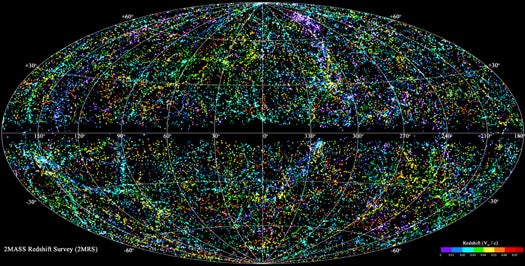
The Most Complete 3-D Map of Local Universe T.H. Jarrett (IPAC/SSC) via Harvard-Smithsonian Center for Atrophysics

Mapping the universe and its billions of galaxies is a tedious business, but a project spanning more than a decade and mashing up near-infrared sky surveys with painstaking redshift analysis has produced the wold’s most detailed 3-D map of the local universe. Reaching out to a distance some 380 million light-years from our own solar system, the 2MASS Redshift Survey (2MRS) was presented today at the 218th meeting of the American Astronomical Society.

The project mapped more than 43,000 galaxies picked from the Two-Micron All-SkySurvey (2MASS), which scanned the entire sky in three near-infrared wavelengths. But 2MASS alone offered an incomplete picture. To achieve the third dimension, astronomers needed to know not only how galaxies relate spatially on a flat map, but how far away they are from Earth and each other. So the 2MASS Redshift Survey began measuring the galaxies’ redshifts, one by one, using two telescopes in Arizona and Chile.

Redshifting is the way in which a galaxy’s light is stretched into longer wavelengths by the expansion of the universe. The farther a galaxy is from Earth, the greater its redshift. By analyzing those measurements, the 2MRS was able to achieve that important third dimension, and to produce the map you see above.

But 2MRS isn’t just notable for mapping faraway galaxies. It also made great strides closer to home. Regions nearer the Milky Way tend to be difficult to observe, as they are obscured by the dust and gas in our own galaxy. The near-infrared wavelengths employed by 2MASS are better at penetrating this dust, giving us a better look at our own galactic neighborhood.

A higher res version of the pic is available here.

[Harvard-Smithsonian Center for Astrophysics]

11 Comments

Why no 'You Are Here ★' place?

You know, talking about light-years always puts me in awe, but 380 million light-years just takes the cake. It's far back into the age of the dinosaurs when the things we're observing actually happened. For all we know, intelligent life could have evolved out there and been broadcasting for years and we won't know for another 380 million years.

Crazy thoughts, aren't they?

-IMP ;) :)

We are in the center. Imagine walking into the center of that image, grabbing the two edges and wrapping them in a circle around your head so the image forms a sphere around you.

I like this image better than the All-Sky full image of all the visible galaxies, which just has too many points to make any sense. You can almost see the structure here by looking at the colours as they shift from violet to dark red.

So incredible. And remember guys, it all came from nothing! :-7

Rod, is not God more complex than the entirety of the Universe? And you God-people believe he 'has always been', effectively believing him to have 'come from nothing'.

So get off it already, you sound retarded.

Rod... In order to touch on this sarcastic remark, we have to probe a little deeper. Lets start at the beginning.

In Genesis 1:1, the earth and "heaven" are created together "in the beginning," whereas according to current estimates, the earth and universe are about 4.6 and 13.7 billion years old, respectively.

In Genesis, the earth is created (1:1) before light (1:3), sun and stars (1:16); birds and whales (1:21) before reptiles and insects (1:24); and flowering plants (1:11) before any animals (1:20). The order of events known from science is in each case just the opposite.

"Let there be light” God creates light and separates light from darkness, and day from night, on the first day. Yet he didn't make the light producing objects (the sun and the stars) until the fourth day (1:14-19). And how could there be "the evening and the morning" on the first day if there was no sun to mark them?

The Firmament (Heaven) God spends one-sixth of his entire creative effort (the second day) working on a solid firmament. This strange structure, which God calls heaven, is intended to separate the “higher waters” from the “lower waters”. Right…

“Let the earth bring forth grass" Plants are made on the third day before there was a sun to drive their photosynthetic processes (1:14-19). Notice, though, that God lets "the earth bring forth" the plants, rather than creating them directly. Maybe Genesis is not so anti-evolution after all.

“God made the two great lights." "The greater light [the sun] to rule the day, and the lesser light [the moon] to rule the night." But the moon is not a light; it only reflects light from the sun. And why, if God made the moon to "rule the night", does it spend half of its time moving through the daytime sky?

Ah… and now to the point!!!!!

"He made the stars also." (1:16) God spends a day making light (before making the sun and stars) and separating light from darkness; then, at the end of a hard day's work, and almost as an afterthought, he makes the trillions of stars.

"And God set them in the firmament of the heaven to give light upon the earth."
Then why is only a tiny fraction of stars visible from earth? Under the best conditions, no more than a few thousand stars are visible with the unaided eye, yet there are hundreds of billions of stars in our galaxy and a hundred billion or so galaxies.

So, you say “remember guys, it all came from nothing! “But in all actuality -- they all created "to give light upon the earth.” Period. So that’s why the rest of the universe is here. Lighting. Ambiance. LOL

There are various seemingly reasonable explanations for all those points you outlined... such as the way the narrative was written, from an earth perspective... as you go through the days, you can imagine the sky becoming clearer, for whatever reason, overcast day you would just see 'dark and light', as the sky cleared you would see stars, the sun and the moon, and so forth... as for the earth bringing forth grass, we know that plant life originated in the ocean, but a goat herder wouldn't know what was going on in the deep... would he? Just what he'd see on the surface, or drag up in nets...

Now don't get me wrong, I'm not defending scripture, I just know some of the 'reasonings' of Christians trying rectify scripture with known scientific fact.

Seriously folks, if you can't trust your eyes, and learn to trust the eyes of others who are reporting the same thing you are...and trust that reality is self-evident, and can be studied and agreed upon...

There'll be no agreement over scripture, ever... because it can't be scientifically examined.. and what it does have contradicts observed facts, it's really just pathetic scripture has as many devotees as it does, and science has so relatively few.

My Christmas tree looks very simuliar. Go figure!

lol here we go again with the science vs religion debate. honestly guys both of you are neither right or wrong seeing how its impossible to know the absolute truth about the mystery of life and existence. maybe one day. just maybe....
wow isnt this picture amazing. thats maybe only like .oo1 percent of the whole universe or even less. we still got a long way to go humanity. think of it like an ant only being able to see the water near the shore of a beach and not knowing whats beyond it.

Vishnu brought forth and commanded Brahma, to create the world. According to Śrīmad Bhāgavatam, one of Brahma's days is of 4.3 billion years duration.

The Universe has no beginning, rather, it perpetually cycles itself. Brahma creates, Vishnu lives, Shiva destroys, and the cycle repeats.

@ThisNameTaken finally someone who has the same idea


June 2013: American Energy Independence

Five amazing, clean technologies that will set us free, in this month's energy-focused issue. Also: how to build a better bomb detector, the robotic toys that are raising your children, a human catapult, the world's smallest arcade, and much more.


Online Content Director: Suzanne LaBarre | Email
Senior Editor: Paul Adams | Email
Associate Editor: Dan Nosowitz | Email
Assistant Editor: Colin Lecher | Email
Assistant Editor: Rose Pastore | Email

Contributing Writers:
Rebecca Boyle | Email
Kelsey D. Atherton | Email
Francie Diep | Email
Shaunacy Ferro | Email

circ-top-header.gif
circ-cover.gif